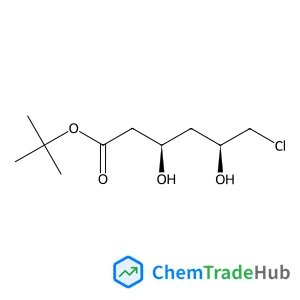
2-Methyl-2-propanyl (3R,5S)-6-chloro-3,5-dihydroxyhexanoate
CAS Number:
154026-93-4
Molecular Formula:
C10H19ClO4
Akinari Sumita, Yuko Otani, Tomohiko Ohwada
Here, we report new methodology for synthesizing 2,3-benzodiazepines and their analogues by means of phosphate-assisted acylation reaction of 1-arylpropan-2-ones with a carboxylic acid followed by hydrazine cyclization in a one-pot two-step manner. An unprotected amino group is tolerated in this reaction. This method provides a direct access to 2,3-benzodiazepines containing aromatic 7,8-dimethoxy and 1-p-aminophenyl groups, which are generally considered important for bioactivity. The presence of 3,4-dimethoxy or 3-methoxy substitution on the benzene ring of the 1-arylpropan-2-one is important for high regioselectivity in the acylation reaction.
Bang Li, Qi Mao, Jia Zhou, Feng Liu, Na Ye
DOI: 10.1039/C8OB03073A
Mengmeng Zhang, Liming Yang, Chao Tian, Meng Zhou, Guangming Li
DOI: 10.1039/C9OB00136K
Jiali Chen, Haiqing Xiong, Yun Zhang, Wenqiang Chen, Jiarong Sheng
DOI: 10.1039/C8OB02998A
Sudha Devi, Indu Bala, Santosh Prasad Gupta, Pravesh Kumar, Santanu Kumar Pal, Sugumar Venkataramani
DOI: 10.1039/C8OB01579A
Xuelan Wen, Chang-Qiang Ke, Tian Zhang, Ligen Lin, Sheng Yao, Jason D. Goodpaster, Chunping Tang
DOI: 10.1039/D0QO00093K
Samer Gnaim, Doron Shabat
DOI: 10.1039/C8OB03042A
Steven C. Schlitzer, Dhanarajan Arunprasath, Katelyn G. Stevens, Indrajeet Sharma
DOI: 10.1039/C9QO01336A
Zhili Chen, Hui Mao, Fangli Hu, Dongmei Li, Yu Tan, Fengqing Yang, Wenling Qin
DOI: 10.1039/C8OB02967A
(1R,3S)-1,3-Cyclopentanediol finds applications in various industries. In the ph...
When handling N'-[4-(Dimethylamino)phenyl]-N,N-dimethyl-1,4-benzenediamine, it i...
There are several alternatives to 5-(2,4-Difluorophenyl)-2-methoxypyrimidine in ...
1-(3-Methoxyphenoxy)propan-2-ol (CAS: 382141-68-6) must comply with the Globally...
Tetrodotoxin Citrate is extremely dangerous and should be handled with extreme c...
2-Methyl-2-propanyl [(1R,3S)-3-hydroxycyclopentyl]carbamate (CAS: 225641-84-9) i...
Waste containing 4-(2-Hydroxyhexafluoroisopropyl)Benzoic Acid (CAS: 16261-80-6) ...
2-Methyl-2-proanyl {(2S)-1-[(benzyloxy)amino]-3-hydroxy-3-methyl-1-oxo-2-butanyl...
Benzeneethanamine, α-ethyl-, hydrochloride (1:1) is an organic compound with the...
In the synthesis of compounds similar to 3-{(E)-[4-(Dimethylamino)phenyl]diazeny...

Organic & Biomolecular Chemistry (OBC) publishes original and high impact research and reviews in organic chemistry. We welcome research that shows new or significantly improved protocols or methodologies in total synthesis, synthetic methodology or physical and theoretical organic chemistry as well as research that shows a significant advance in the organic chemistry or molecular design aspects of chemical biology, catalysis, supramolecular and macromolecular chemistry, theoretical chemistry, mechanism-oriented physical organic chemistry, medicinal chemistry or natural products. Articles published in the journal should report new work which makes a highly-significant impact in the field. Routine and incremental work is generally not suitable for publication in the journal. More details about key areas of our scope are below. In all cases authors should include in their article clear rationale for why their research has been carried out.
![N-[(5,6-Dichloro-1H-benzimidazol-2-yl)methyl]-9-(1-methyl-1H-pyrazol-4-yl)-2-(4-morpholinyl)-9H-purin-6-amine structure](https://static.chemtradehub.com/structs/238/2387704-62-1-25f4.webp "N-[(5,6-Dichloro-1H-benzimidazol-2-yl)methyl]-9-(1-methyl-1H-pyrazol-4-yl)-2-(4-morpholinyl)-9H-purin-6-amine structure")
![Ethyl 3-((6-(4,5-dihydro-1H-benzo[d]azepin-3(2H)-yl)-2-(pyridin-2-yl)pyrimidin-4-yl)amino)propanoate structure](https://static.chemtradehub.com/structs/137/1373423-53-0-496a.webp "Ethyl 3-((6-(4,5-dihydro-1H-benzo[d]azepin-3(2H)-yl)-2-(pyridin-2-yl)pyrimidin-4-yl)amino)propanoate structure")