


An energy efficient and facile synthesis of high molecular weight polyesters using ketenes
Literature Information
Publication Date
2011-08-30
DOI
10.1039/C1CC14055H
Impact Factor
6.222
Authors
Martin Wolffs
View Original
Abstract
A facile, ketene-based strategy for the synthesis of polyesters from stable Meldrum's acid monomers has been developed which overcomes many issues associated with traditional step-growth procedures. A significant increase in polymerization efficiency is observed with only 10 min reaction time at 220 °C being needed to obtain high molecular weight polymers.
Recommended Journals

Acta Materialia

Current Opinion in Solid State & Materials Science

Chemical Communications

Russian Chemical Bulletin

Journal of Natural Medicines

Saudi Pharmaceutical Journal

Journal of Peptide Science

Russian Journal of General Chemistry

Journal of Saudi Chemical Society

Russian Journal of Applied Chemistry
Related Literature
Direction control in DNA binding of chiral d-lysine-based peptide nucleic acid (PNA) probed by electrospray mass spectrometry
Stefano Sforza, Tullia Tedeschi, Roberto Corradini, Arnaldo Dossena, Rosangela Marchelli
2003-04-02
Communication
DOI: 10.1039/B212718K
Poly(9,9′-spirobifluorene-manganese porphyrin): a new catalytic material for oxidation of alkenes by iodobenzene diacetate and iodosylbenzene
Cyril Poriel, Yann Ferrand, Paul le Maux, Joëlle Raul-Berthelot, Gerard Simonneaux
2003-04-02
Communication
DOI: 10.1039/B301717F
A novel catalyst with high activity for polyhydric alcohol oxidation: nanosilver/zeolite film
Jiang Shen, Wei Shan, Yahong Zhang, Junming Du, Hualong Xu, Kangnian Fan, Wei Shen, Yi Tang
2004-11-15
Communication
DOI: 10.1039/B412986E
Influence of substrate on self-assembled photonic crystal
Sachiko I. Matsushita
2004-02-09
Communication
DOI: 10.1039/B313410E
Attachment of glycosaminoglycan oligosaccharides to thiol-derivatised gold surfaces
Susannah J. Patey, Jeremy E. Turnbull
2004-10-11
Communication
DOI: 10.1039/B411726C
Chiral Co(iii)(salen)-catalysed hydrolytic kinetic resolution of racemic epoxides in ionic liquids
Dong Joon Choo, Woo Ho Shim, Dong Hoon Lee, Eun Joo Roh, Sang-gi Lee, Choong Eui Song
2003-04-02
Communication
DOI: 10.1039/B301490H
Concerning the relative importance of enantiomorphic site vs. chain end control in the stereoselective polymerization of lactides: reactions of (R,R-salen)- and (S,S-salen)–aluminium alkoxides LAlOCH2R complexes (R = CH3 and S-CHMeCl)
Malcolm H. Chisholm, Nathan J. Patmore, Zhiping Zhou
2004-11-25
Communication
DOI: 10.1039/B413266A
Stereochemistry of contiguous cyclopropane formation from cascade cyclization of a skipped dienyl homoallyl triflate
Christopher M. Lincoln, James D. White, Alexandre F. T. Yokochi
2004-10-28
Communication
DOI: 10.1039/B412811G
Silica coated fullerenols: seeded growth of silica spheres under acidic conditions
Elizabeth A. Whitsitt, Andrew R. Barron
2003-04-04
Communication
DOI: 10.1039/B212808J
Photon-driven nanomechanical cyclic motion
Hai-Feng Ji, Yu Feng, Xiaohe Xu, Vemana Purushotham, Thomas Thundat, Gilbert M. Brown
2004-09-28
Communication
DOI: 10.1039/B408997A
You might also like
Compound Q&A
What industries use (1R,3S)-1,3-Cyclopentanediol (CAS: 16326-97-9)?
(1R,3S)-1,3-Cyclopentanediol finds applications in various industries. In the ph...
16326-97-9(1R,3S)-1,3-Cyclopen...
Compound Q&A
What precautions should be taken when handling N'-[4-(Dimethylamino)phenyl]-N,N-dimethyl-1,4-benzenediamine (CAS: 637-31-0)?
When handling N'-[4-(Dimethylamino)phenyl]-N,N-dimethyl-1,4-benzenediamine, it i...
637-31-0N'-[4-(Dimethylamino...
Compound Q&A
Are there alternatives to 5-(2,4-Difluorophenyl)-2-methoxypyrimidine (CAS: 1352318-16-1) in synthesis?
There are several alternatives to 5-(2,4-Difluorophenyl)-2-methoxypyrimidine in ...
1352318-16-15-(2,4-Difluoropheny...
Compound Q&A
What regulatory guidelines apply to 1-(3-Methoxyphenoxy)propan-2-ol (CAS: 382141-68-6)?
1-(3-Methoxyphenoxy)propan-2-ol (CAS: 382141-68-6) must comply with the Globally...
382141-68-61-(3-Methoxyphenoxy)...
Compound Q&A
Is Tetrodotoxin Citrate (CAS: 18660-81-6) safe?
Tetrodotoxin Citrate is extremely dangerous and should be handled with extreme c...
18660-81-6Tetrodotoxin Citrate
Compound Q&A
What are the main uses of 2-Methyl-2-propanyl [(1R,3S)-3-hydroxycyclopentyl]carbamate (CAS: 225641-84-9)?
2-Methyl-2-propanyl [(1R,3S)-3-hydroxycyclopentyl]carbamate (CAS: 225641-84-9) i...
225641-84-92-Methyl-2-propanyl ...
Compound Q&A
How should waste containing 4-(2-Hydroxyhexafluoroisopropyl)Benzoic Acid (CAS: 16261-80-6) be handled?
Waste containing 4-(2-Hydroxyhexafluoroisopropyl)Benzoic Acid (CAS: 16261-80-6) ...
16261-80-64-(2-Hydroxyhexafluo...
Compound Q&A
How is 2-Methyl-2-proanyl {(2S)-1-[(benzyloxy)amino]-3-hydroxy-3-methyl-1-oxo-2-butanyl}carbamate (CAS: 102507-19-7) typically synthesized?
2-Methyl-2-proanyl {(2S)-1-[(benzyloxy)amino]-3-hydroxy-3-methyl-1-oxo-2-butanyl...
102507-19-72-Methyl-2-propanyl ...
Compound Q&A
What is Benzeneethanamine, α-ethyl-, hydrochloride (1:1) (CAS: 20735-15-3)?
Benzeneethanamine, α-ethyl-, hydrochloride (1:1) is an organic compound with the...
20735-15-3Benzeneethanamine, α...
Compound Q&A
Are there alternatives to 3-{(E)-[4-(Dimethylamino)phenyl]diazenyl}benzoic acid (CAS: 20691-84-3) in synthesis?
In the synthesis of compounds similar to 3-{(E)-[4-(Dimethylamino)phenyl]diazeny...
20691-84-33-{(E)-[4-(Dimethyla...
Source Journal
Chemical Communications
CiteScore:
8.6
Self-citation Rate:
4.7%
Articles per Year:
2458
ChemComm publishes urgent research which is of outstanding significance and interest to experts in the field, while also appealing to the journal’s broad chemistry readership. Our communication format is ideally suited to short, urgent studies that are of such importance that they require accelerated publication. Our scope covers all topics in chemistry, and research at the interface of chemistry and other disciplines (such as materials science, nanoscience, physics, engineering and biology) where there is a significant novelty in the chemistry aspects. Major topic areas covered include: Analytical Chemistry Catalysis Chemical Biology and medicinal chemistry Computational Chemistry and Machine Learning Energy and sustainable chemistry Environmental Chemistry Green Chemistry Inorganic Chemistry Materials Chemistry Nanoscience Organic Chemistry Physical Chemistry Polymer Chemistry Supramolecular Chemistry
Recommended Compounds
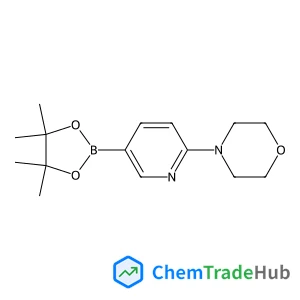
4-(5-(4,4,5,5-tetramethyl-1,3,2-dioxaborolan-2-yl)pyridin-2-yl)morpholine
CAS Number:
485799-04-0
Molecular Formula:
C15H23BN2O3
Recommended Suppliers





Disclaimer
This page provides academic journal information for reference and research purposes only. We are not affiliated with any journal publishers and do not handle publication submissions. For publication-related inquiries, please contact the respective journal publishers directly.
If you notice any inaccuracies in the information displayed, please contact us at support@chemtradehub.com. We will promptly review and address your concerns.