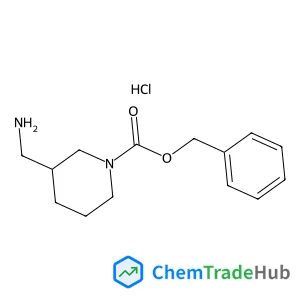
Benzyl 3-(aminomethyl)piperidine-1-carboxylate hydrochloride
CAS Number:
1186663-23-9
Molecular Formula:
C14H21ClN2O2
Polymerization of M1, a chiral N-propargylamide monomer, was carried out with (nbd)Rh+B−(C6H5)4 as the catalyst in five solvents to explore the effect of solvents on polymerization. All the polymerizations occurred smoothly and provided polymers in high yield, however the number-average molecular weights of the polymers differ largely, which is attributed to the different solubility of the polymers in solvents. The helical structure and the optical activity of the polymer prepared in THF was examined by CD and UV-Vis spectroscopy measurements in the five solvents and in solvent mixtures consisting of CH2Cl2 (a relatively good solvent) and THF (a relatively not-so-good solvent) in varied ratios. The polymer could adopt helical conformations in all the solvents, but different CD intensities and UV-Vis absorptions were observed. In CH2Cl2, the polymer exhibited lower intensity in both CD effect and UV-Vis absorption, while they were higher when the polymer was examined in THF, demonstrating that solvophobic effects made large contribution for the polymer chains to adopt helical conformations.
James A. Jarvis, Maria Concistre, Richard W. Bounds, Ilya Kuprov, Marina Carravetta, Philip T. F. Williamson
DOI: 10.1039/C8CP06276E
Andres Rojano Crisson, Enrique Wagemann, Harvey A. Zambrano
DOI: 10.1039/C8CP03186J
Ling Huang, Jian Zhou, Anmin Zheng
DOI: 10.1039/C8CP04872J
Noelia Faginas-Lago, Thierry Leininger, Stefano Evangelisti
DOI: 10.1039/C8CP07159D
Darren M. Driscoll, Diego Troya, Pavel M. Usov, Andrew J. Maynes, Amanda J. Morris, John R. Morris
DOI: 10.1039/C8CP07778A
Yi Li, Jian Liu, Ji-Chao Li, Yu-Fei Chen, Xin-Miao Zhang, Xue-Jin Wang, Fu-Ning Wang, Wen-Bin Su, Lan-Ling Zhao, Chun-Lei Wang
DOI: 10.1039/C8CP02783H
Alonso W. P. Sanches, Marco A. T. da Silva, Neusmar J. A. Cordeiro, Alexandre Urbano, Sidney A. Lourenço
DOI: 10.1039/C8CP06916F
Jianghao Li, Yihang Fan, Xiaotian Xue, Lingwei Ma, Sumeng Zou, Zhu Fei, Zheng Xie
DOI: 10.1039/C8CP05533E
Bertrand Morel, Maria Paz Carrasco, Samuel Jurado, Carmen Marco, Francisco Conejero-Lara
DOI: 10.1039/C8CP02685H
6-(3-Fluorophenyl)picolinic acid is generally considered safe for laboratory use...
(3R)-3-Pyrrolidinol is used in the pharmaceutical industry as a precursor for dr...
When handling (4R,5R)-4,5-Diethoxycarbonyl-2,2-dimethyldioxolane (CAS: 59779-75-...
1-(6-Chloroimidazo[1,2-b]pyridazin-3-yl)ethanone is often synthesized via a mult...
The market for N-Ethyl-3,4-dimethylbenzylamine (CAS: 39180-83-1) remains steady,...
Tert-butyl 3-(pyrrolidin-1-yl)azetidine-1-carboxylate is a chemical compound wit...
1-Bromo-3-chloro-2,4-dimethoxybenzene (CAS: 1228956-93-1) falls under the classi...
The safety of 8-Bromo-2-methyl-3,4-dihydroisoquinolin-1(2H)-one (CAS: 1368622-07...
Benzyl [(3S)-2,6-dioxo-3-piperidinyl]carbamate is generally safe when handled wi...
1-{[4-(4,4,5,5-Tetramethyl-1,3,2-dioxaborolan-2-yl)phenyl]sulfonyl}pyrrolidine s...

Polymer Chemistry welcomes submissions in all areas of polymer science that have a strong focus on macromolecular chemistry. Manuscripts may cover a broad range of fields, yet no direct application focus is required.
![2-[({[(2-Methyl-2-propanyl)oxy]carbonyl}amino)methyl]isonicotinic acid structure](https://static.chemtradehub.com/structs/473/473924-63-9-973b.webp "2-[({[(2-Methyl-2-propanyl)oxy]carbonyl}amino)methyl]isonicotinic acid structure")