












Synthesis of 1,2-annulated and 1,2-unsubstituted pyrrolo[2,1,5-de]quinolizin-5-ones (cycl[3.3.2]azin-5-ones) via [3+2] cycloadditions of 1-oxoquinolizinium ylides with cyclic alkenes
Literature Information
Publication Date
2010-08-26
DOI
10.1039/C0OB00299B
Impact Factor
3.876
Authors
Hua-You Hu, Hong-Wen Hu, Jian-Hua Xu
View Original
Abstract
1,2-Annulated pyrrolo[2,1,5-de]quinolizin-5-ones (cycl[3.3.2]azin-5-ones) 6a–6k, 8a–8b and 9 have been synthesized by one pot tandem reactions of 2-acetyl-N-phenacylpyridinium bromides (1a–1d) with electron-deficient cyclic alkenes (N-alkyl(aryl)maleimides, benzoquinones and naphthoquinone) in the presence of sodium carbonate as a base and tetrakispyridinecobalt(II) dichromate (TPCD) as an oxidant. These products are formed by 1.3-dipolar cycloaddition of the 1-oxoquinolizinium ylides generated in situ from 1a–1d with the alkene followed by dehydrogenation of the primary cycloadduct under the action of TPCD. Similar reactions of the ylides generated in situ from 1a–1f with maleic anhydride gave the 1,2-unsubstituted pyrrolo[2,1,5-de]quinolizin-5-ones 7a–7f via oxidative bisdecarboxylation and dehydrogenation of the primary cycloadducts under the action of TPCD.
Related Literature
Metal-free 2D/2D heterostructured photocatalyst of black phosphorus/covalent triazine-based frameworks for water splitting and pollutant degradation
Yilin Chen, Lvting Wang, Mingyue Tan, Yingying Xiao, Bifen Gao, Bizhou Lin
2020-05-18
Paper
DOI: 10.1039/D0SE00394H
The estimation of pentosans and its application to the analysis of foods
Paper
DOI: 10.1039/AN8992400178
Three-dimensional flower-like nickel phyllosilicates for CO2 methanation: enhanced catalytic activity and high stability
Tengfei Zhang, Zhiwei Tian, Qing Liu
2020-04-16
Paper
DOI: 10.1039/D0SE00360C
Topical delivery of chemotherapeutic drugs using nano-hybrid hydrogels to inhibit post-surgical tumour recurrence
Chendan Liu, Yudi Ma, Song Guo, Bingfang He, Tianyue Jiang
2021-03-29
Paper
DOI: 10.1039/D0BM01766C
In situ monitoring of polymerredox states by resonance μRaman spectroscopy and its applications in polymer modified microfluidic channels
Hella Logtenberg, Laurens-Jan C. Jellema, Maria J. Lopez-Martinez, Jetsuda Areephong, Elisabeth Verpoorte, Ben L. Feringa, Wesley R. Browne
2011-10-20
Paper
DOI: 10.1039/C1AY05475A
You might also like
Compound Q&A
What industries use (1R,3S)-1,3-Cyclopentanediol (CAS: 16326-97-9)?
(1R,3S)-1,3-Cyclopentanediol finds applications in various industries. In the ph...
16326-97-9(1R,3S)-1,3-Cyclopen...
Compound Q&A
What precautions should be taken when handling N'-[4-(Dimethylamino)phenyl]-N,N-dimethyl-1,4-benzenediamine (CAS: 637-31-0)?
When handling N'-[4-(Dimethylamino)phenyl]-N,N-dimethyl-1,4-benzenediamine, it i...
637-31-0N'-[4-(Dimethylamino...
Compound Q&A
Are there alternatives to 5-(2,4-Difluorophenyl)-2-methoxypyrimidine (CAS: 1352318-16-1) in synthesis?
There are several alternatives to 5-(2,4-Difluorophenyl)-2-methoxypyrimidine in ...
1352318-16-15-(2,4-Difluoropheny...
Compound Q&A
What regulatory guidelines apply to 1-(3-Methoxyphenoxy)propan-2-ol (CAS: 382141-68-6)?
1-(3-Methoxyphenoxy)propan-2-ol (CAS: 382141-68-6) must comply with the Globally...
382141-68-61-(3-Methoxyphenoxy)...
Compound Q&A
Is Tetrodotoxin Citrate (CAS: 18660-81-6) safe?
Tetrodotoxin Citrate is extremely dangerous and should be handled with extreme c...
18660-81-6Tetrodotoxin Citrate
Compound Q&A
What are the main uses of 2-Methyl-2-propanyl [(1R,3S)-3-hydroxycyclopentyl]carbamate (CAS: 225641-84-9)?
2-Methyl-2-propanyl [(1R,3S)-3-hydroxycyclopentyl]carbamate (CAS: 225641-84-9) i...
225641-84-92-Methyl-2-propanyl ...
Compound Q&A
How should waste containing 4-(2-Hydroxyhexafluoroisopropyl)Benzoic Acid (CAS: 16261-80-6) be handled?
Waste containing 4-(2-Hydroxyhexafluoroisopropyl)Benzoic Acid (CAS: 16261-80-6) ...
16261-80-64-(2-Hydroxyhexafluo...
Compound Q&A
How is 2-Methyl-2-proanyl {(2S)-1-[(benzyloxy)amino]-3-hydroxy-3-methyl-1-oxo-2-butanyl}carbamate (CAS: 102507-19-7) typically synthesized?
2-Methyl-2-proanyl {(2S)-1-[(benzyloxy)amino]-3-hydroxy-3-methyl-1-oxo-2-butanyl...
102507-19-72-Methyl-2-propanyl ...
Compound Q&A
What is Benzeneethanamine, α-ethyl-, hydrochloride (1:1) (CAS: 20735-15-3)?
Benzeneethanamine, α-ethyl-, hydrochloride (1:1) is an organic compound with the...
20735-15-3Benzeneethanamine, α...
Compound Q&A
Are there alternatives to 3-{(E)-[4-(Dimethylamino)phenyl]diazenyl}benzoic acid (CAS: 20691-84-3) in synthesis?
In the synthesis of compounds similar to 3-{(E)-[4-(Dimethylamino)phenyl]diazeny...
20691-84-33-{(E)-[4-(Dimethyla...
Source Journal
Organic & Biomolecular Chemistry

CiteScore:
3.4
Self-citation Rate:
10.3%
Articles per Year:
1041
Organic & Biomolecular Chemistry (OBC) publishes original and high impact research and reviews in organic chemistry. We welcome research that shows new or significantly improved protocols or methodologies in total synthesis, synthetic methodology or physical and theoretical organic chemistry as well as research that shows a significant advance in the organic chemistry or molecular design aspects of chemical biology, catalysis, supramolecular and macromolecular chemistry, theoretical chemistry, mechanism-oriented physical organic chemistry, medicinal chemistry or natural products. Articles published in the journal should report new work which makes a highly-significant impact in the field. Routine and incremental work is generally not suitable for publication in the journal. More details about key areas of our scope are below. In all cases authors should include in their article clear rationale for why their research has been carried out.
Recommended Compounds
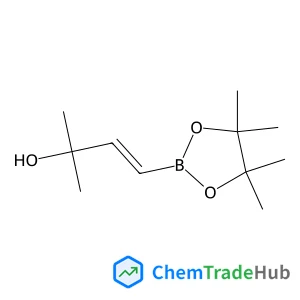
(E)-2-methyl-4-(4,4,5,5-tetramethyl-1,3,2-dioxaborolan-2-yl)but-3-en-2-ol
CAS Number:
581802-26-8
Molecular Formula:
C11H21BO3
Recommended Suppliers





Disclaimer
This page provides academic journal information for reference and research purposes only. We are not affiliated with any journal publishers and do not handle publication submissions. For publication-related inquiries, please contact the respective journal publishers directly.
If you notice any inaccuracies in the information displayed, please contact us at support@chemtradehub.com. We will promptly review and address your concerns.