












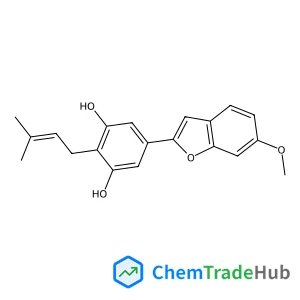
5-(6-Methoxy-1-benzofuran-2-yl)-2-(3-methyl-2-buten-1-yl)-1,3-benzenediol
CAS Number:
1017277-40-5
Molecular Formula:
C20H20O4
A graphical abstract is available for this content
José Francisco Rizo, Jesús F. Arteaga, Ludovic Favereau, Abel Ros, Uwe Pischel
DOI: 10.1039/D3QO01762A
Irene Sánchez-Sordo, Sergio Barbeira-Arán, Martín Fañanás-Mastral
DOI: 10.1039/D3QO01631E
Shiwen Fan, Runxia Ma, Aohua Yang, Hongbo Jia, Yufei Dong, Cheng Guo, Jingyun Ren
DOI: 10.1039/D3QO01716H
Haolin Qiu, Yang Xiao, Ling Shen, Tao Han, Qiang He, Aiying Li, Peng Zhang
DOI: 10.1039/D3OB01642K
Ganesh Sambasivam, Govindarajulu Gavara, Ramraj S, Gaikwad Rajendra, Karthikeyan Sivashanmugam
DOI: 10.1039/D3OB90143B
Jinyuan Wang, Yunzhi Liu, Nan Han, Yuan Gao, Jun Luo
DOI: 10.1039/D3QO01790G
Qing Sun, Jia-Jie Chen, Jia-Yi Liu, Wen-Qing Zhang, Xin Lu, Ren-Jie Song
DOI: 10.1039/D3QO01792C
Junjie Ying, Jingrong Huang, Chenguang Liu, Fa-Jie Chen
DOI: 10.1039/D3QO01534C
Alexander P. Atkins, Atul K. Chaturvedi, Joseph A. Tate, Alastair J. J. Lennox
DOI: 10.1039/D3QO01865B
Shuyuan Liang, Liangjian Tang, Ying Chen, Xueqiu Huang, Xueqin Wei
DOI: 10.1039/D3QO01525D
When handling 2-Methyl-2-propanyl 5-amino-2-thiophenecarboxylate (CAS: 1498311-5...
5-Bromo-1,2-dichloro-3-fluorobenzene (CAS: 1000572-93-9) is a crystalline solid ...
(2R)-2-Amino-2-(4-bromophenyl)ethanol (CAS: 354153-64-3) should be stored in a c...
Methyl 4-(aminomethyl)tetrahydro-2H-pyran-4-carboxylate hydrochloride (CAS: 3627...
1,4-Dimethyl-1H-pyrazole-5-sulfonyl chloride is primarily used as an intermediat...
Dinaphtho[1,2-b:2',1'-d]furan is generally safe when handled with appropriate pe...
The market for 7-Methyl-7,9-dihydro-1H-purine-2,6,8(3H)-trione (CAS: 612-37-3) i...
2-(4-Chlorophenyl)malonaldehyde (CAS: 205676-17-1) is a colorless or light yello...
2-Methylchrysene (CAS: 3351-32-4) is typically synthesized via the reaction of c...
N-(6-aminopyrimidin-4-yl)acetamide (CAS: 89533-23-3) is generally considered saf...

Physical Chemistry Chemical Physics (PCCP) is an international journal co-owned by 19 physical chemistry and physics societies from around the world. This journal publishes original, cutting-edge research in physical chemistry, chemical physics and biophysical chemistry. To be suitable for publication in PCCP, articles must include significant innovation and/or insight into physical chemistry; this is the most important criterion that reviewers and Editors will judge against when evaluating submissions. The journal has a broad scope and welcomes contributions spanning experiment, theory, computation and data science. Topical coverage includes spectroscopy, dynamics, kinetics, statistical mechanics, thermodynamics, electrochemistry, catalysis, surface science, quantum mechanics, quantum computing and machine learning. Interdisciplinary research areas such as polymers and soft matter, materials, nanoscience, energy, surfaces/interfaces, and biophysical chemistry are welcomed if they demonstrate significant innovation and/or insight into physical chemistry. Joined experimental/theoretical studies are particularly appreciated when complementary and based on up-to-date approaches.
![3-[7-Amino-3-(3-pyridinyl)pyrazolo[1,5-a]pyrimidin-6-yl]phenol structure](https://static.chemtradehub.com/structs/861/861249-77-6-025b.webp "3-[7-Amino-3-(3-pyridinyl)pyrazolo[1,5-a]pyrimidin-6-yl]phenol structure")
![4-Chloro-N-{[4-(dimethylamino)phenyl]carbamoyl}benzenesulfonamide structure](https://static.chemtradehub.com/structs/558/5581-42-0-7dcb.webp "4-Chloro-N-{[4-(dimethylamino)phenyl]carbamoyl}benzenesulfonamide structure")




