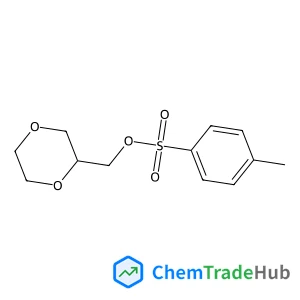
(S)-(1,4-Dioxan-2-yl)methyl 4-methylbenzenesulfonate
CAS Number:
917882-64-5
Molecular Formula:
C12H16O5S
Juan Pablo Catalán
The solvatochromism of the n ↔ π* electronic transitions of acetone, which is determined in this work by means of absorption and emission spectroscopy, has been studied using the pure solvent scales for polarizability, dipolarity and acidity of the medium. From these analyses, the necessary reduction of the dipole moment and the increase of the polarizability for acetone on electronic excitation are evaluated using Abe's approach (Bull. Chem. Soc. Jpn. 1966, 39, 936). The influence that the increase of the aromatic structure (cf.acetophenone) and the lengthening of the size of the alkyl substituents R– (cf. R–CO–R) cause on the solvatochromism of acetone is discussed. Also, we have shown that the photophysical model proposed by Pimentel (J. Am. Chem. Soc. 1957, 79, 3323), which is widely accepted for explaining the n → π* blue shift phenomenon for hydrogen-bonded complexes, is mistaken due to ignoring the acid–base changes undergone on electronic excitation; accordingly, a new photophysical model has been proposed.
DOI: 10.1039/C6CP07834F
Vladimir A. Osipov
DOI: 10.1039/C6CP07496K
Iffat H. Nayyar, Sara E. Chamberlin, Tiffany C. Kaspar, Niranjan Govind, Scott A. Chambers, Peter V. Sushko
DOI: 10.1039/C6CP06087K
Martin Dračínský, Jan Storch, Vladimír Církva, Ivana Císařová, Jan Sýkora
DOI: 10.1039/C6CP07552E
Qiang Shao, Zhijian Xu, Jinan Wang, Jiye Shi, Weiliang Zhu
DOI: 10.1039/C6CP06624K
Yang Zhang, Zhi-Feng Wu, Peng-Fei Gao, Dang-Qi Fang, Er-Hu Zhang, Sheng-Li Zhang
DOI: 10.1039/C6CP07575D
Thomas Buchecker, Sebastian Krickl, Robert Winkler, Isabelle Grillo, Pierre Bauduin, Didier Touraud, Arno Pfitzner, Werner Kunz
DOI: 10.1039/C6CP06696H
Yinlong Du, Ningning Dong, Menghan Zhang, Kai Zhu, Ruiqi Na, Shuling Zhang, Ningwei Sun, Guibin Wang, Jun Wang
DOI: 10.1039/C6CP05920A
M. Pérez-Rodríguez, A. Vidal-Vidal, J. M. Míguez, F. J. Blas, J.-P. Torré, M. M. Piñeiro
DOI: 10.1039/C6CP07097C
Michael Dommett, Rachel Crespo-Otero
DOI: 10.1039/C6CP07541J
2-(2-Chloroacetamido)-3-phenylpropanoic acid (CAS: 7765-11-9) is generally consi...
2-(Benzyloxy)-5-bromobenzoic acid can be handled safely if appropriate precautio...
(4-Methyl-1,2,5-oxadiazol-3-yl)methanamine hydrochloride is a chemical compound ...
2-(5-Hexylthiophen-2-yl)-4,4,5,5-tetramethyl-1,3,2-dioxaborolane (CAS: 917985-54...
While 4-(8-Methyl-9H-1,3-dioxolo[4,5-h][2,3]benzodiazepin-5-yl)benzenamine (CAS:...
The market for tert-butyl 3-hydroxy-4,5,7,8-tetrahydro-2H-pyrazolo[3,4-d]azepine...
Waste containing 3,5-Diamino-1H-pyrazole-4-carbonitrile (CAS: 6844-58-2) should ...
(6-Fluoro-3-pyridinyl)boronic acid can be synthesized through the reaction of 6-...
Dibenzyl carbonimidoylbiscarbamate (CAS: 10065-79-9) finds applications in vario...
The market for (beta,beta,2,3,4,5,6-~2~H_7_)Phenylalanine (CAS: 74228-83-4) is g...

Physical Chemistry Chemical Physics (PCCP) is an international journal co-owned by 19 physical chemistry and physics societies from around the world. This journal publishes original, cutting-edge research in physical chemistry, chemical physics and biophysical chemistry. To be suitable for publication in PCCP, articles must include significant innovation and/or insight into physical chemistry; this is the most important criterion that reviewers and Editors will judge against when evaluating submissions. The journal has a broad scope and welcomes contributions spanning experiment, theory, computation and data science. Topical coverage includes spectroscopy, dynamics, kinetics, statistical mechanics, thermodynamics, electrochemistry, catalysis, surface science, quantum mechanics, quantum computing and machine learning. Interdisciplinary research areas such as polymers and soft matter, materials, nanoscience, energy, surfaces/interfaces, and biophysical chemistry are welcomed if they demonstrate significant innovation and/or insight into physical chemistry. Joined experimental/theoretical studies are particularly appreciated when complementary and based on up-to-date approaches.