












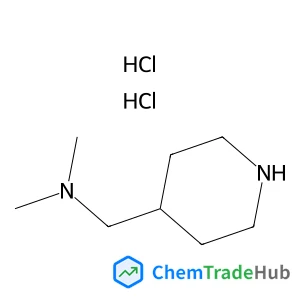
N,N-dimethyl(piperidin-4-yl)methanamine hydrochloride
CAS Number:
172281-72-0
Molecular Formula:
C8H20Cl2N2
Tobias N. Krauss, Esther Barrena
We combine X-ray reflectivity and scanning electron microscopy measurements to investigate the mechanisms involved in the growth of vertical arrays of phthalocyanine nanowires directed by templates of Au nanoparticles. The study has been carried out for H16CuPc at different substrate temperatures. It is shown that three organic morphologies evolve during the growth: 1D nanostructures on top of the Au nanoparticles, a multilayer film on the substrate and a layer wetting the gold nanoparticles. For substrate temperatures below 100 °C there is a coexisting and competing growth of the three structures, whereas beyond this temperature the 1D growth on the nanoparticles is predominantly favored. The observance of two regimes with the temperature is characterized by two different activation energies. Both the length of the 1D structures and the thickness of the multilayer film can be precisely controlled by the substrate temperature which is of importance for application of vertical organic nanowires as donor/acceptor architecture in organic solar cells.
Milad Radiom, Phally Kong, Plinio Maroni, Mark Schäfer, Andreas F. M. Kilbinger, Michal Borkovec
DOI: 10.1039/C6CP05696B
Petr Jeřábek, Jan Florián
DOI: 10.1039/C6CP03692A
Lo-Yun Lee, Marusu Katada, Asuka Fujii, Jer-Lai Kuo
DOI: 10.1039/C6CP05537K
Nan Gao, Tao Liang, Yuan Yuan, Xiuchan Xiao, Yihuan Zhao, Yanzhi Guo, Menglong Li, Xuemei Pu
DOI: 10.1039/C6CP03710K
Sara Hany, Samer Aouad, Cédric Gennequin, Madona Labaki, Edmond Abi-Aad, Antoine Aboukaïs
DOI: 10.1039/C6CP05574E
Aurélien Bornet, Arthur Pinon, Lyndon Emsley
DOI: 10.1039/C6CP05587G
H. B. Ramalingam, R. Hari Krishna, B. M. Nagabhushana, R. Chandramohan, C. Shivakumara, J. Thirumalai, Tiju Thomas
DOI: 10.1039/C6CP04633A
Prince Saurabh Bassi, Li Xianglin, Yanan Fang, Joachim Say Chye Loo, Lydia Helena Wong
DOI: 10.1039/C6CP05379C
S. F. Bychkov, M. P. Popov
DOI: 10.1039/C6CP05435H
Telugu Bhim Raju, Jayraj V. Vaghasiya, Mohammad Adil Afroz, Saurabh S. Soni
DOI: 10.1039/C6CP05641E
Ethyl 4-chlorothieno[2,3-b]pyridine-5-carboxylate (CAS: 59713-58-5) can be synth...
5-Methyl-1H-indole-3-carbaldehyde (CAS: 52562-50-2) is subject to various regula...
(1,3-Dimethyl-2,4-dioxo-1,2,3,4-tetrahydro-5-pyrimidinyl)boronic acid is a white...
Waste containing Sulfocostunolide A (CAS: 1016983-51-9) should be handled with c...
When handling Murraxocin (CAS: 88478-44-8), ensure proper personal protective eq...
Formvar (CAS: 63148-64-1) is an alkyd resin characterized by a high molecular we...
(S)-4-benzyl-2-((benzyloxy)methyl)morpholine is generally safe when handled with...
Methyl 1-(5-bromo-2-pyrimidinyl)cyclopropanecarboxylate (CAS: 1447607-69-3) is p...
2-Methyl-1-phenyl-1-propanamine hydrochloride (CAS: 24290-47-9) is generally con...
3-(4-Bromophenyl)-2-methylpropanoic acid is synthesized through a multi-step pro...

Physical Chemistry Chemical Physics (PCCP) is an international journal co-owned by 19 physical chemistry and physics societies from around the world. This journal publishes original, cutting-edge research in physical chemistry, chemical physics and biophysical chemistry. To be suitable for publication in PCCP, articles must include significant innovation and/or insight into physical chemistry; this is the most important criterion that reviewers and Editors will judge against when evaluating submissions. The journal has a broad scope and welcomes contributions spanning experiment, theory, computation and data science. Topical coverage includes spectroscopy, dynamics, kinetics, statistical mechanics, thermodynamics, electrochemistry, catalysis, surface science, quantum mechanics, quantum computing and machine learning. Interdisciplinary research areas such as polymers and soft matter, materials, nanoscience, energy, surfaces/interfaces, and biophysical chemistry are welcomed if they demonstrate significant innovation and/or insight into physical chemistry. Joined experimental/theoretical studies are particularly appreciated when complementary and based on up-to-date approaches.

![2-(Methylsulfonyl)-2,4,5,6-tetrahydropyrrolo[3,4-c]pyrazole structure](https://static.chemtradehub.com/structs/122/1226781-80-1-09d5.webp "2-(Methylsulfonyl)-2,4,5,6-tetrahydropyrrolo[3,4-c]pyrazole structure")






