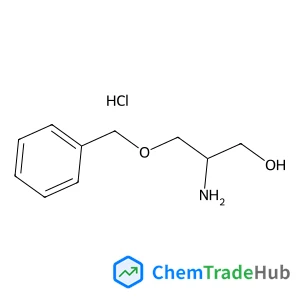
(R)-2-amino-3-(benzyloxy)propan-1-ol hydrochloride
CAS Number:
58577-95-0
Molecular Formula:
C10H16ClNO2
Seiji Tsuzuki, Hajime Matsumoto, Wataru Shinoda, Masuhiro Mikami
Molecular dynamics simulations of ionic liquids [1-alkyl-3-methylimidazolium (alkyl = ethyl, butyl and hexyl), N-butylpyridinium, N-butyl-N,N,N-trimethylammonium and N-butyl-N-methylpyrrolidinium cations combined with the (CF3SO2)2N− (TFSA) anion] show that the conformational flexibility of the alkyl chains in the cations is one of the important factors determining the diffusion of ions. Artificial constraint imposed on the internal rotation of alkyl chains significantly decreases the self-diffusion coefficients of cations and anions. The internal rotation of the C–N bond connecting the alkyl chain and the aromatic ring has large effects on the diffusion of ions in imidazolium and pyridinium based ionic liquids. The calculated self-diffusion coefficients of cations and anions decrease 20–40% by imposing the torsional constraint of the C–N bond. On the other hand the torsional constraint of the C–N bond does not largely change the diffusion of ions in the quaternary alkyl ammonium based ionic liquids. The conformational flexibility of the terminal C–C–C–C bond of the alkyl chains has large effects on the diffusion of ions in the quaternary alkyl ammonium based ionic liquids. The influence of the electrostatic interactions and the high density of ionic liquids on the diffusion of ions were studied. The electrostatic interactions have the paramount importance on the slow diffusion of ions in ionic liquids, while the high density of ionic liquids is also responsible for the slow diffusion. The electrostatic interactions and the high density of ionic liquids enhance the effects of the torsional constraint on the diffusion of ions, which suggests that the charge-ordering structure and small free volume originated in the strong electrostatic interactions are the causes of the significant effects of the conformational flexibility on the diffusion of ions in ionic liquids.
Som Sarang, Hidetaka Ishihara, Yen-Chang Chen, Oliver Lin, Ajay Gopinathan, Vincent C. Tung, Sayantani Ghosh
DOI: 10.1039/C6CP02971J
H. B. Ramalingam, R. Hari Krishna, B. M. Nagabhushana, R. Chandramohan, C. Shivakumara, J. Thirumalai, Tiju Thomas
DOI: 10.1039/C6CP04633A
Junjie Li, Alexander B. Pacheco, Krishnan Raghavachari, Srinivasan S. Iyengar
DOI: 10.1039/C6CP04450F
Ji Won Yang, Jeong Min Choi, Jun Yeob Lee
DOI: 10.1039/C6CP06308J
Qi Wang, Qingfeng Dong, Yanjun Fang, Jinsong Huang
DOI: 10.1039/C6CP06496E
G. Kolhatkar, A. Boucherif, C. Dab, S. Fafard, V. Aimez, R. Arès, A. Ruediger
DOI: 10.1039/C6CP05063H
Yaqiang Ma, Xu Zhao, Tianxing Wang, Wei Li, Shanshan Chang, Yi Li, Mingyu Zhao
DOI: 10.1039/C6CP06046C
Kazuki Furukawa, Norifumi Yamamoto, Kazuyuki Hino, Hiroshi Sekiya
DOI: 10.1039/C6CP04322D
Thi Mai Huong Tran, Adriano Ambrosi, Martin Pumera
DOI: 10.1039/C6CP05569A
Jeevan B. GC
DOI: 10.1039/C6CP03776C
Ethyl 4-chlorothieno[2,3-b]pyridine-5-carboxylate (CAS: 59713-58-5) can be synth...
5-Methyl-1H-indole-3-carbaldehyde (CAS: 52562-50-2) is subject to various regula...
(1,3-Dimethyl-2,4-dioxo-1,2,3,4-tetrahydro-5-pyrimidinyl)boronic acid is a white...
Waste containing Sulfocostunolide A (CAS: 1016983-51-9) should be handled with c...
When handling Murraxocin (CAS: 88478-44-8), ensure proper personal protective eq...
Formvar (CAS: 63148-64-1) is an alkyd resin characterized by a high molecular we...
(S)-4-benzyl-2-((benzyloxy)methyl)morpholine is generally safe when handled with...
Methyl 1-(5-bromo-2-pyrimidinyl)cyclopropanecarboxylate (CAS: 1447607-69-3) is p...
2-Methyl-1-phenyl-1-propanamine hydrochloride (CAS: 24290-47-9) is generally con...
3-(4-Bromophenyl)-2-methylpropanoic acid is synthesized through a multi-step pro...

Physical Chemistry Chemical Physics (PCCP) is an international journal co-owned by 19 physical chemistry and physics societies from around the world. This journal publishes original, cutting-edge research in physical chemistry, chemical physics and biophysical chemistry. To be suitable for publication in PCCP, articles must include significant innovation and/or insight into physical chemistry; this is the most important criterion that reviewers and Editors will judge against when evaluating submissions. The journal has a broad scope and welcomes contributions spanning experiment, theory, computation and data science. Topical coverage includes spectroscopy, dynamics, kinetics, statistical mechanics, thermodynamics, electrochemistry, catalysis, surface science, quantum mechanics, quantum computing and machine learning. Interdisciplinary research areas such as polymers and soft matter, materials, nanoscience, energy, surfaces/interfaces, and biophysical chemistry are welcomed if they demonstrate significant innovation and/or insight into physical chemistry. Joined experimental/theoretical studies are particularly appreciated when complementary and based on up-to-date approaches.
![9,9'-Spirobi[fluoren]-2-amine structure](https://static.chemtradehub.com/structs/118/118951-68-1-0d14.webp "9,9'-Spirobi[fluoren]-2-amine structure")