


Phenols as probes of chemical composition of graphene oxide
Literature Information
Publication Date
2016-10-26
DOI
10.1039/C6CP05569A
Impact Factor
3.676
Authors
Thi Mai Huong Tran, Adriano Ambrosi, Martin Pumera
View Original
Abstract
Graphene oxide (GO) can be conveniently used as a starting material for the preparation of selective and sensitive electrochemical sensing systems. The amount of oxygen groups present on the material can be precisely tuned by reduction methodologies which allow the selection of the optimal C/O ratio for specific analytes. An electrochemical reduction procedure is used in this work to alter the oxygen content of the GO starting material and investigate the effects on the electrochemical detection of phenolic compounds selected with different hydroxyl groups: phenol, catechol, hydroquinone and phloroglucinol. Cyclic voltammetry has been used to measure the alteration of the oxidation signal upon tuning the oxygen content of the graphene based electrode material.
Recommended Journals

Russian Chemical Reviews

Proceedings of the National Academy of Sciences of the United States of America

Fibre Chemistry

Planta Medica

Israel Journal of Chemistry

Helvetica Chimica Acta

Organic Preparations and Procedures International

Journal of Physics and Chemistry of Solids

Pure and Applied Chemistry

Journal of Organometallic Chemistry
Related Literature
The effect of secondary structures on the NLO properties of single chain oligopeptides: a comparison between β-strand and α-helix polyglycines
Andrea Alparone
2013-06-07
Paper
DOI: 10.1039/C3CP51496J
Charge trapping in TiO2 polymorphs as seen by Electron Paramagnetic Resonance spectroscopy
Mario Chiesa, Maria Cristina Paganini, Stefano Livraghi, Elio Giamello
2013-04-24
Perspective
DOI: 10.1039/C3CP50658D
Pressure dependent photolysis quantum yields for CH3C(O)CH3 at 300 and 308 nm and at 298 and 228 K
V. G. Khamaganov, J. N. Crowley
2013-05-16
Paper
DOI: 10.1039/C3CP50291K
Identifying the trend of reactivity for sp2 materials: an electron delocalization model from first principles calculations
Bo Yang, Yulong Wang, Yifang Zhao, X.-M. Cao
2013-05-09
Communication
DOI: 10.1039/C3CP51375K
(Sub-)femtosecond control of molecular reactions via tailoring the electric field of light
Philipp von den Hoff, Irina Znakovskaya, Regina de Vivie-Riedle
2013-04-09
Perspective
DOI: 10.1039/C3CP50591J
Stereochemical effects on the aggregation and biological properties of the fibril-forming peptide [KIGAKI]3 in membranes
Parvesh Wadhwani, Johannes Reichert, Erik Strandberg, Jochen Bürck, Julia Misiewicz, Sergii Afonin, Nico Heidenreich, Susanne Fanghänel, Igor V. Komarov
2013-05-07
Paper
DOI: 10.1039/C3CP50896J
C72: gaudiene, a hollow and aromatic all-carbon molecule
Dage Sundholm
2013-04-18
Communication
DOI: 10.1039/C3CP51042E
Self-assembly of binary molecular nanostructure arrays on graphite
Jia Lin Zhang, Tian Chao Niu, Andrew T. S. Wee
2013-04-15
Perspective
DOI: 10.1039/C3CP00023K
Preparation and characterization of titania-entrapped silica hollow particles: effective dye removal and evidence of selectivity
Kritapas Laohhasurayotin, Duangkamon Viboonratanasri
2013-04-05
Paper
DOI: 10.1039/C3CP50872B
You might also like
Compound Q&A
How is Ethyl 4-chlorothieno[2,3-b]pyridine-5-carboxylate (CAS: 59713-58-5) typically synthesized?
Ethyl 4-chlorothieno[2,3-b]pyridine-5-carboxylate (CAS: 59713-58-5) can be synth...
59713-58-5Ethyl 4-chlorothieno...
Compound Q&A
What regulatory guidelines apply to 5-Methyl-1H-indole-3-carbaldehyde (CAS: 52562-50-2)?
5-Methyl-1H-indole-3-carbaldehyde (CAS: 52562-50-2) is subject to various regula...
52562-50-25-Methyl-1H-indole-3...
Compound Q&A
What are the physical and chemical properties of (1,3-Dimethyl-2,4-dioxo-1,2,3,4-tetrahydro-5-pyrimidinyl)boronic acid (CAS: 223418-73-3)?
(1,3-Dimethyl-2,4-dioxo-1,2,3,4-tetrahydro-5-pyrimidinyl)boronic acid is a white...
223418-73-3(1,3-Dimethyl-2,4-di...
Compound Q&A
How should waste containing Sulfocostunolide A (CAS: 1016983-51-9) be handled?
Waste containing Sulfocostunolide A (CAS: 1016983-51-9) should be handled with c...
1016983-51-9Sulfocostunolide A
Compound Q&A
What precautions should be taken when handling Murraxocin (CAS: 88478-44-8)?
When handling Murraxocin (CAS: 88478-44-8), ensure proper personal protective eq...
88478-44-8Murraxocin
Compound Q&A
What are the physical and chemical properties of Formvar (CAS: 63148-64-1)?
Formvar (CAS: 63148-64-1) is an alkyd resin characterized by a high molecular we...
63148-64-1Formvar(R)
Compound Q&A
Is (S)-4-benzyl-2-((benzyloxy)methyl)morpholine (CAS: 205242-66-6) safe?
(S)-4-benzyl-2-((benzyloxy)methyl)morpholine is generally safe when handled with...
205242-66-6(S)-4-benzyl-2-((ben...
Compound Q&A
What industries use Methyl 1-(5-bromo-2-pyrimidinyl)cyclopropanecarboxylate (CAS: 1447607-69-3)?
Methyl 1-(5-bromo-2-pyrimidinyl)cyclopropanecarboxylate (CAS: 1447607-69-3) is p...
1447607-69-3Methyl 1-(5-bromo-2-...
Compound Q&A
Is 2-Methyl-1-phenyl-1-propanamine hydrochloride (CAS: 24290-47-9) safe?
2-Methyl-1-phenyl-1-propanamine hydrochloride (CAS: 24290-47-9) is generally con...
24290-47-92-Methyl-1-phenyl-1-...
Compound Q&A
How is 3-(4-Bromophenyl)-2-methylpropanoic acid (CAS: 66735-01-1) typically synthesized?
3-(4-Bromophenyl)-2-methylpropanoic acid is synthesized through a multi-step pro...
66735-01-13-(4-Bromophenyl)-2-...
Source Journal
Physical Chemistry Chemical Physics

CiteScore:
5.5
Self-citation Rate:
10.3%
Articles per Year:
3036
Physical Chemistry Chemical Physics (PCCP) is an international journal co-owned by 19 physical chemistry and physics societies from around the world. This journal publishes original, cutting-edge research in physical chemistry, chemical physics and biophysical chemistry. To be suitable for publication in PCCP, articles must include significant innovation and/or insight into physical chemistry; this is the most important criterion that reviewers and Editors will judge against when evaluating submissions. The journal has a broad scope and welcomes contributions spanning experiment, theory, computation and data science. Topical coverage includes spectroscopy, dynamics, kinetics, statistical mechanics, thermodynamics, electrochemistry, catalysis, surface science, quantum mechanics, quantum computing and machine learning. Interdisciplinary research areas such as polymers and soft matter, materials, nanoscience, energy, surfaces/interfaces, and biophysical chemistry are welcomed if they demonstrate significant innovation and/or insight into physical chemistry. Joined experimental/theoretical studies are particularly appreciated when complementary and based on up-to-date approaches.
Recommended Compounds
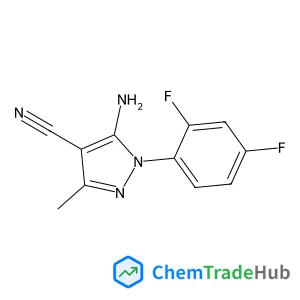
5-Amino-1-(2,4-difluorophenyl)-3-methyl-1H-pyrazole-4-carbonitrile
CAS Number:
1020057-92-4
Molecular Formula:
C11H8F2N4
Recommended Suppliers







Disclaimer
This page provides academic journal information for reference and research purposes only. We are not affiliated with any journal publishers and do not handle publication submissions. For publication-related inquiries, please contact the respective journal publishers directly.
If you notice any inaccuracies in the information displayed, please contact us at support@chemtradehub.com. We will promptly review and address your concerns.