












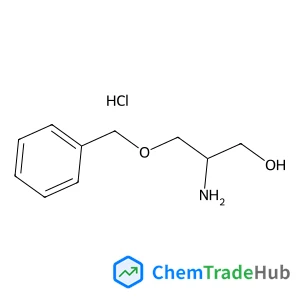
(R)-2-amino-3-(benzyloxy)propan-1-ol hydrochloride
CAS Number:
58577-95-0
Molecular Formula:
C10H16ClNO2
Jeevan B. GC
The Ebola virus is a lipid-enveloped virus that obtains its lipid coat from the plasma membrane of the host cell it infects during the budding process. The Ebola virus protein VP40 localizes to the inner leaflet of the plasma membrane and forms the viral matrix, which provides the major structure for the Ebola virus particles. VP40 is initially a dimer that rearranges to a hexameric structure that mediates budding. VP40 hexamers and larger filaments have been shown to be stabilized by PI(4,5)P2 in the plasma membrane inner leaflet. Reduction in the plasma membrane levels of PI(4,5)P2 significantly reduce formation of VP40 oligomers and virus-like particles. We investigated the lipid–protein interactions in VP40 hexamers at the plasma membrane. We quantified lipid–lipid self-clustering by calculating the fractional interaction matrix and found that the VP40 hexamer significantly enhances the PI(4,5)P2 clustering. The radial pair distribution functions suggest a strong interaction between PI(4,5)P2 and the VP40 hexamer. The cationic Lys side chains are found to mediate the PIP2 clustering around the protein, with cholesterol filling the space between the interacting PIP2 molecules. These computational studies support recent experimental data and provide new insights into the mechanisms by which VP40 assembles at the plasma membrane inner leaflet, alters membrane curvature, and forms new virus-like particles.
Dániel Péter Szekrényes, Szilárd Pothorszky, Dániel Zámbó, András Deák
DOI: 10.1039/C9CP01541H
Pavel Kocán, Barbara Pieczyrak, Leszek Jurczyszyn, Yoshihide Yoshimoto, Kazuma Yagyu, Hiroshi Tochihara, Takayuki Suzuki
DOI: 10.1039/C9CP01335K
Wenyu Li, Qianyun Zhang, Jonas J. Joos, Philippe F. Smet, Jörn Schmedt auf der Günne
DOI: 10.1039/C9CP00953A
Wenfeng Zhao, Chao Duan, Weihua Li
DOI: 10.1039/C9CP00949C
Alan Sam, Vishnu Prasad K., Sarith P. Sathian
DOI: 10.1039/C9CP00429G
Zexing Cao
DOI: 10.1039/C9CP01370A
Shu-Hua Xia, Meng Che, Yan Liu, Yan Zhang, Ganglong Cui
DOI: 10.1039/C9CP00692C
Yuhang Yao, Yu Rao, Yiwei Liu, Liang Jiang, Jin Xiong, Ying-Jie Fan, Zhen Shen, Jun-Long Zhang
DOI: 10.1039/C9CP01177C
Xinxin Pi, Fei Sun, Jihui Gao, Zhibin Qu, Ani Wang, Zhipeng Qie, Lijie Wang, Hui Liu
DOI: 10.1039/C8CP07782G
Bing Ma, Raul D. Rodriguez, Alexey Ruban, Sergey Pavlov, Evgeniya Sheremet
DOI: 10.1039/C9CP00093C
Ethyl 4-chlorothieno[2,3-b]pyridine-5-carboxylate (CAS: 59713-58-5) can be synth...
5-Methyl-1H-indole-3-carbaldehyde (CAS: 52562-50-2) is subject to various regula...
(1,3-Dimethyl-2,4-dioxo-1,2,3,4-tetrahydro-5-pyrimidinyl)boronic acid is a white...
Waste containing Sulfocostunolide A (CAS: 1016983-51-9) should be handled with c...
When handling Murraxocin (CAS: 88478-44-8), ensure proper personal protective eq...
Formvar (CAS: 63148-64-1) is an alkyd resin characterized by a high molecular we...
(S)-4-benzyl-2-((benzyloxy)methyl)morpholine is generally safe when handled with...
Methyl 1-(5-bromo-2-pyrimidinyl)cyclopropanecarboxylate (CAS: 1447607-69-3) is p...
2-Methyl-1-phenyl-1-propanamine hydrochloride (CAS: 24290-47-9) is generally con...
3-(4-Bromophenyl)-2-methylpropanoic acid is synthesized through a multi-step pro...

Physical Chemistry Chemical Physics (PCCP) is an international journal co-owned by 19 physical chemistry and physics societies from around the world. This journal publishes original, cutting-edge research in physical chemistry, chemical physics and biophysical chemistry. To be suitable for publication in PCCP, articles must include significant innovation and/or insight into physical chemistry; this is the most important criterion that reviewers and Editors will judge against when evaluating submissions. The journal has a broad scope and welcomes contributions spanning experiment, theory, computation and data science. Topical coverage includes spectroscopy, dynamics, kinetics, statistical mechanics, thermodynamics, electrochemistry, catalysis, surface science, quantum mechanics, quantum computing and machine learning. Interdisciplinary research areas such as polymers and soft matter, materials, nanoscience, energy, surfaces/interfaces, and biophysical chemistry are welcomed if they demonstrate significant innovation and/or insight into physical chemistry. Joined experimental/theoretical studies are particularly appreciated when complementary and based on up-to-date approaches.
![Imidazo[1,5-a]pyrazine structure](https://static.chemtradehub.com/structs/274/274-49-7-d749.webp "Imidazo[1,5-a]pyrazine structure")
![4-[(1-Methyl-1H-pyrrol-2-yl)methylene]-1,3(2H,4H)-isoquinolinedione structure](https://static.chemtradehub.com/structs/110/1104546-89-5-a600.webp "4-[(1-Methyl-1H-pyrrol-2-yl)methylene]-1,3(2H,4H)-isoquinolinedione structure")






