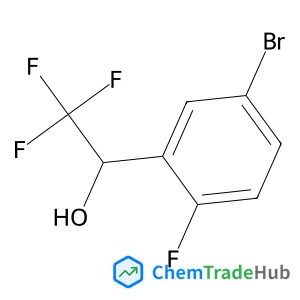
1-(5-Bromo-2-fluorophenyl)-2,2,2-trifluoroethanol
CAS Number:
1039827-16-1
Molecular Formula:
C8H5BrF4O
Chiranjib Ghatak, Vishal Govind Rao, Rajib Pramanik, Souravi Sarkar, Nilmoni Sarkar
The fluorescence resonance energy transfer (FRET) in a lipid bilayer system containing two different donors and one common acceptor at below and above transition temperature has been studied and all the FRET parameters are analyzed using steady state and time-resolved fluorescence spectroscopy. Using dynamic light scattering measurement, we have followed the process of preparation of small unilamellar vesicles, and by following the FRET parameters of C-153–Rh6G and C-151–Rh6G pairs inside SUVs at 16 °C and 33 °C (Tm = 23.9 °C) we have noticed that there is greater effect of temperature on the FRET parameters in case of the C-153–Rh6G pair than that of the C-151–Rh6G pair. Finally we have concluded that this difference is due to their different location inside the lipid bilayer in which fluidity of the long alkyl chain markedly affects the FRET parameters for C-153–Rh6G pair embedded inside a small unilamellar vesicle of size 20–50 nm.
Daniel A. Jacobs, Yiliang Wu, Heping Shen, Chog Barugkin, Fiona J. Beck, Thomas P. White, Klaus Weber, Kylie R. Catchpole
DOI: 10.1039/C6CP06989D
A. V. Gorbunov, X. Meng, I. Urbanaviciute, T. Putzeys, M. Wübbenhorst, R. P. Sijbesma
DOI: 10.1039/C6CP08015D
Ji-Chuang Hu, Lin-Lin Xu, Hai-Fang Li, David Yubero Valdivielso, André Fielicke, Sheng-Gui He, Jia-Bi Ma
DOI: 10.1039/C6CP06896K
K. Ragavendran, H. Xia, P. Mandal, A. K. Arof
DOI: 10.1039/C6CP07289E
Xin Ding, Yuhua Wang
DOI: 10.1039/C6CP08300E
DOI: 10.1039/C6CP07519C
Kyoungmin Min, Seung-Woo Seo, You Young Song, Hyo Sug Lee, Eunseog Cho
DOI: 10.1039/C6CP06270A
Qiang Shao, Zhijian Xu, Jinan Wang, Jiye Shi, Weiliang Zhu
DOI: 10.1039/C6CP06624K
Christina Roth
DOI: 10.1039/C6CP08360A
Bolong Huang, Dengfeng Peng, Caofeng Pan
DOI: 10.1039/C6CP07472C
2-(2-Chloroacetamido)-3-phenylpropanoic acid (CAS: 7765-11-9) is generally consi...
2-(Benzyloxy)-5-bromobenzoic acid can be handled safely if appropriate precautio...
(4-Methyl-1,2,5-oxadiazol-3-yl)methanamine hydrochloride is a chemical compound ...
2-(5-Hexylthiophen-2-yl)-4,4,5,5-tetramethyl-1,3,2-dioxaborolane (CAS: 917985-54...
While 4-(8-Methyl-9H-1,3-dioxolo[4,5-h][2,3]benzodiazepin-5-yl)benzenamine (CAS:...
The market for tert-butyl 3-hydroxy-4,5,7,8-tetrahydro-2H-pyrazolo[3,4-d]azepine...
Waste containing 3,5-Diamino-1H-pyrazole-4-carbonitrile (CAS: 6844-58-2) should ...
(6-Fluoro-3-pyridinyl)boronic acid can be synthesized through the reaction of 6-...
Dibenzyl carbonimidoylbiscarbamate (CAS: 10065-79-9) finds applications in vario...
The market for (beta,beta,2,3,4,5,6-~2~H_7_)Phenylalanine (CAS: 74228-83-4) is g...

Physical Chemistry Chemical Physics (PCCP) is an international journal co-owned by 19 physical chemistry and physics societies from around the world. This journal publishes original, cutting-edge research in physical chemistry, chemical physics and biophysical chemistry. To be suitable for publication in PCCP, articles must include significant innovation and/or insight into physical chemistry; this is the most important criterion that reviewers and Editors will judge against when evaluating submissions. The journal has a broad scope and welcomes contributions spanning experiment, theory, computation and data science. Topical coverage includes spectroscopy, dynamics, kinetics, statistical mechanics, thermodynamics, electrochemistry, catalysis, surface science, quantum mechanics, quantum computing and machine learning. Interdisciplinary research areas such as polymers and soft matter, materials, nanoscience, energy, surfaces/interfaces, and biophysical chemistry are welcomed if they demonstrate significant innovation and/or insight into physical chemistry. Joined experimental/theoretical studies are particularly appreciated when complementary and based on up-to-date approaches.
![Ethyl ({[(2-methyl-2-propanyl)oxy]carbonyl}amino)(2-pyridinyl)acetate structure](https://static.chemtradehub.com/structs/313/313490-90-3-dd15.webp "Ethyl ({[(2-methyl-2-propanyl)oxy]carbonyl}amino)(2-pyridinyl)acetate structure")
![Ethyl thieno[3,2-f]quinoline-2-carboxylate structure](https://static.chemtradehub.com/structs/299/29948-26-3-f62b.webp "Ethyl thieno[3,2-f]quinoline-2-carboxylate structure")