












Temperature-cycle single-molecule FRET microscopy on polyprolines
Literature Information
Publication Date
2010-12-10
DOI
10.1039/C0CP01772H
Impact Factor
3.676
Authors
Haifeng Yuan, Ted Xia, Benjamin Schuler, Michel Orrit
View Original
Abstract
Accessing the microsecond dynamics of a single fluorescent molecule in real time is difficult because molecular fluorescence rates usually limit the time resolution to milliseconds. We propose to apply single-molecule temperature-cycle microscopy to probe molecular dynamics at microsecond timescales. Here, we follow donor and acceptor signals of single FRET-labeled polyprolines in glycerol to investigate their conformational dynamics. We observe a steady-state FRET efficiency distribution which differs from theoretical distributions for isotropically orientated fluorescent labels. This may indicate that the orientation of fluorescent labels in glycerol is not isotropic and may reflect the influence of the dye linkers. With proper temperature-cycle parameters, we observed large FRET changes in long series of cycles of the same molecule. We attribute the main conformational changes to reorientations of the fluorescent labels with respect to the oligopeptide chain, which take place in less than a few microseconds at the highest temperature of the cycle (250 K). We were able to follow the FRET efficiency of a particular construct for more than 2000 cycles. This trajectory displays switching between two conformations, which give rise to maxima in the FRET efficiency histogram. Our experiments open the possibility to study biomolecular dynamics at a time scale of a few microseconds at the single-molecule level.
Related Literature
Palladium-polymer nanoreactors for the aqueous asymmetric synthesis of therapeutic flavonoids
E. Lestini, L. D. Blackman, C. M. Zammit, R. J. Williams, M. Inam, B. Couturaud, R. K. O'Reilly
2018-01-30
Communication
DOI: 10.1039/C7PY02050C
Correction: Copper(ii) gluconate (a non-toxic food supplement/dietary aid) as a precursor catalyst for effective photo-induced living radical polymerisation of acrylates
Vasiliki Nikolaou, Fehaid Alsubaie, Alexandre Simula, David J. Fox, David M. Haddleton
2017-11-28
Correction
DOI: 10.1039/C7PY90190A
Conjugate substitution and addition of α-substituted acrylate: a highly efficient, facile, convenient, and versatile approach to fabricate degradable polymers by dynamic covalent chemistry
Yasuhiro Kohsaka, Takumi Miyazaki, Keito Hagiwara
2017-12-28
Paper
DOI: 10.1039/C7PY02114C
Precise synthesis of thermoresponsive polyvinylphosphonate-biomolecule conjugates via thiol–ene click chemistry
Christina Schwarzenböck, Andreas Schaffer, Philipp Pahl, Peter J. Nelson, Ralf Huss, Bernhard Rieger
2017-11-08
Paper
DOI: 10.1039/C7PY01796K
Donor–acceptor conjugated ladder polymer via aromatization-driven thermodynamic annulation
Jongbok Lee, Alexander J. Kalin, Chenxu Wang, Julia T. Early, Mohammed Al-Hashimi
2018-01-24
Paper
DOI: 10.1039/C7PY02059G
One-pot formation of monodisperse polymer@SiO2 core–shell nanoparticles via surfactant-free emulsion polymerization using an adaptive silica precursor polymer
Haitao Wang, Martin Möller
2017-09-18
Paper
DOI: 10.1039/C7PY01264K
Correction: Synthesis of well-defined α,ω-telechelic multiblock copolymers in aqueous medium: in situ generation of α,ω-diols
Alexandre Simula, Vasiliki Nikolaou, Athina Anastasaki, Fehaid Alsubaie, Gabit Nurumbetov
2017-11-28
Correction
DOI: 10.1039/C7PY90189E
Charge-reversible and pH-responsive biodegradable micelles and vesicles from linear-dendritic supramolecular amphiphiles for anticancer drug delivery
Hong Shen, Zuquan Weng
2017-10-27
Paper
DOI: 10.1039/C7PY01556A
Synthesis, properties, and crystallization of the alternating stereocopolymer poly(l-lactic acid-alt-d-lactic acid) [syndiotactic poly(lactic acid)] and its blend with isotactic poly(lactic acid)
Hideto Tsuji, Yuki Arakawa
2018-04-10
Paper
DOI: 10.1039/C8PY00391B
You might also like
Compound Q&A
What precautions should be taken when handling lithium chloride hydrate (1:1:1) (CAS: 16712-20-2)?
When handling lithium chloride hydrate (1:1:1) (CAS: 16712-20-2), it is importan...
16712-20-2Lithium chloride hyd...
Compound Q&A
Is 4-(4H-1,2,4-Triazol-4-yl)piperidine (CAS: 690261-92-8) safe?
4-(4H-1,2,4-Triazol-4-yl)piperidine is generally considered safe for use in phar...
690261-92-84-(4H-1,2,4-Triazol-...
Compound Q&A
How should waste containing 1,3-Thiazole-2-carboxamide (CAS: 16733-85-0) be handled?
Waste containing 1,3-Thiazole-2-carboxamide (CAS: 16733-85-0) should be collecte...
16733-85-01,3-Thiazole-2-carbo...
Compound Q&A
What regulatory guidelines apply to 5-(Difluoromethyl)-2-fluorobenzonitrile (CAS: 934175-58-3)?
5-(Difluoromethyl)-2-fluorobenzonitrile (CAS: 934175-58-3) is subject to regulat...
934175-58-35-(Difluoromethyl)-2...
Compound Q&A
How is Methyl 3-acetamido-2-thiophenecarboxylate (CAS: 22288-79-5) typically synthesized?
Methyl 3-acetamido-2-thiophenecarboxylate can be synthesized by the reaction of ...
22288-79-5Methyl 3-acetamido-2...
Compound Q&A
What is 4-Isoquinolinecarbonitrile (CAS: 34846-65-6)?
4-Isoquinolinecarbonitrile is a chemical compound with the CAS number 34846-65-6...
34846-65-64-Isoquinolinecarbon...
Compound Q&A
How should Methyl 1H-1,2,3-triazole-4-carboxylate (CAS: 877309-59-6) be stored?
Store Methyl 1H-1,2,3-triazole-4-carboxylate (CAS: 877309-59-6) in a cool, dry p...
877309-59-6Methyl 1H-1,2,3-tria...
Compound Q&A
What regulatory guidelines apply to 6-Bromo[1,3]thiazolo[5,4-b]pyridin-2-amine (CAS: 1160791-13-8)?
6-Bromo[1,3]thiazolo[5,4-b]pyridin-2-amine (CAS: 1160791-13-8) is subject to the...
1160791-13-86-Bromo[1,3]thiazolo...
Compound Q&A
Is (2S,3S)-2-Ammonio-3-(3,4-dihydroxyphenyl)-3-hydroxypropanoate (CAS: 23651-95-8) safe?
(2S,3S)-2-Ammonio-3-(3,4-dihydroxyphenyl)-3-hydroxypropanoate (CAS: 23651-95-8) ...
23651-95-8(2S,3S)-2-Ammonio-3-...
Compound Q&A
What are the physical and chemical properties of 7-bromo-3-methyl-3,4-dihydroquinazolin-4-one (CAS: 1293987-84-4)?
7-Bromo-3-methyl-3,4-dihydroquinazolin-4-one is a solid with a crystalline form....
1293987-84-47-bromo-3-methyl-3,4...
Source Journal
Physical Chemistry Chemical Physics

CiteScore:
5.5
Self-citation Rate:
10.3%
Articles per Year:
3036
Physical Chemistry Chemical Physics (PCCP) is an international journal co-owned by 19 physical chemistry and physics societies from around the world. This journal publishes original, cutting-edge research in physical chemistry, chemical physics and biophysical chemistry. To be suitable for publication in PCCP, articles must include significant innovation and/or insight into physical chemistry; this is the most important criterion that reviewers and Editors will judge against when evaluating submissions. The journal has a broad scope and welcomes contributions spanning experiment, theory, computation and data science. Topical coverage includes spectroscopy, dynamics, kinetics, statistical mechanics, thermodynamics, electrochemistry, catalysis, surface science, quantum mechanics, quantum computing and machine learning. Interdisciplinary research areas such as polymers and soft matter, materials, nanoscience, energy, surfaces/interfaces, and biophysical chemistry are welcomed if they demonstrate significant innovation and/or insight into physical chemistry. Joined experimental/theoretical studies are particularly appreciated when complementary and based on up-to-date approaches.
Recommended Compounds
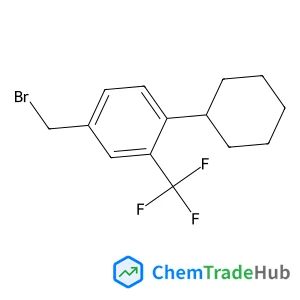
4-(Bromomethyl)-1-cyclohexyl-2-(trifluoromethyl)benzene
CAS Number:
800381-60-6
Molecular Formula:
C14H16BrF3
![8-Bromo-6-fluoro[1,2,4]triazolo[1,5-a]pyridin-2-amine structure](https://static.chemtradehub.com/structs/125/1257705-51-3-9f4a.webp "8-Bromo-6-fluoro[1,2,4]triazolo[1,5-a]pyridin-2-amine structure")
8-Bromo-6-fluoro[1,2,4]triazolo[1,5-a]pyridin-2-amine
CAS Number:
1257705-51-3
Molecular Formula:
C6H4BrFN4
Recommended Suppliers





Disclaimer
This page provides academic journal information for reference and research purposes only. We are not affiliated with any journal publishers and do not handle publication submissions. For publication-related inquiries, please contact the respective journal publishers directly.
If you notice any inaccuracies in the information displayed, please contact us at support@chemtradehub.com. We will promptly review and address your concerns.