












![6,6-Dimethylbicyclo[3.1.1]hept-2-ene-2-carbaldehyde structure](https://static.chemtradehub.com/structs/564/564-94-3-e746.webp "6,6-Dimethylbicyclo[3.1.1]hept-2-ene-2-carbaldehyde structure")
Charge-reversible and pH-responsive biodegradable micelles and vesicles from linear-dendritic supramolecular amphiphiles for anticancer drug delivery
Literature Information
Publication Date
2017-10-27
DOI
10.1039/C7PY01556A
Impact Factor
5.582
Authors
Hong Shen, Zuquan Weng
View Original
Abstract
Recently, nanoparticles self-assembled from amphiphilic supramolecular linear-dendritic block copolymers (LDBCs) have attracted great interest, since the combination of linear and dendritic polymers can incorporate the unique properties of the different segments but avoid some inherent drawbacks of dendrimers, not to mention that the components can be flexibly adjusted to enrich their functionality. In this study, LDBCs formed by host–guest recognition of polyacetal dendrimers with a β-cyclodextrin core and adamantane-terminated zwitterionic poly(sulfobetaine) could self-assemble into micelles and vesicles by varying the hydrophilic/hydrophobic ratio. Owing to the acid-labile characteristic of the dendritic segments, the micelles and vesicles were degradable and could release their payloads in a pH-responsive manner. The incorporation of zwitterionic linear segments gave the micelles and vesicles a charge-reversal ability and excellent resistivity to protein absorption, leading to higher affinity to cell membranes than conventional PEG-coated nanoparticles. In addition, the potential of these nanoparticles as anticancer drug carriers was preliminarily evaluated by using doxorubicin as a model drug and the results indicated that the DOX-loaded micelles and vesicles exhibited remarkable anticancer activity. This study cast a new light on the application of dendrimers and these micelles and vesicles constructed from LDBCs may be promising candidates as anticancer drug delivery platforms for cancer therapy.
Related Literature
Stoichiometric synthesis of a pure ferrite from a tailored layered double hydroxide (hydrotalcite-like) precursor
Junjie Liu, Feng Li, David G. Evans, Xue Duan
2003-01-27
Communication
DOI: 10.1039/B212233B
A facile synthesis of novel cyclodextrin derivatives incorporating one β-(1,4)-glucosidic bond and their unique inclusion ability
Toshiyuki Kida, Akira Kikuzawa, Yohji Nakatsuji, Mitsuru Akashi
2003-11-10
Communication
DOI: 10.1039/B309261E
Hydrogen-ion driven molecular motions in Cu2+-complexes of a ditopic phenanthrolinophane ligand
Angel Mendoza, Juan Aguilar, Manuel G. Basallote, Laura Gil, Juan C. Hernández, M. Angeles Máñez, Enrique García-España, Lena Ruiz-Ramírez, Conxa Soriano, Begoña Verdejo
2003-11-11
Communication
DOI: 10.1039/B309721H
Synthesis and field emission of carbon nanotubular fibers doped with high nitrogen content
Chengchun Tang, Dmitri Golberg, Yoshio Bando, FangFang Xu, Baodan Liu
2003-11-04
Communication
DOI: 10.1039/B311807J
Highly efficient ethylenepolymerisation by scandium alkyls supported by neutral fac-κ3 coordinated N3 donor ligands
2003-10-28
Communication
DOI: 10.1039/B310867H
The key intermediates that interact with the fluorophores in the peroxyoxalate chemiluminescence reaction of 2,4,6-trichlorophenyl N-aryl-N-tosyloxamates
Ryu Koike, Jiro Motoyoshiya, Yutaka Takaguchi, Hiromu Aoyama
2003-02-25
Communication
DOI: 10.1039/B300079F
A 2,3-butanedione protected chiral glycine equivalent—a new building block for the stereoselective synthesis of enantiopure N-protected α-amino acids
Darren J. Dixon, Christopher I. Harding, Steven V. Ley, D. Matthew G. Tilbrook
2003-01-20
Communication
DOI: 10.1039/B210673F
A novel, solventless reductive coupling of carbonyl compounds by alkali metals, catalysed by bromobenzene
Hui Zhao, De-Jin Li, Lan Deng, Lei Liu, Qing-Xiang Guo
2003-01-23
Communication
DOI: 10.1039/B210966B
Molecular tectonics: infinite cationic double stranded helical coordination networks
Abdelaziz Jouaiti, Mir Wais Hosseini, Nathalie Kyritsakas
2003-01-23
Communication
DOI: 10.1039/B211226B
Domino ‘Staudinger–aza-Wittig–1,5-phosphonium-rearrangement–fragmentation’ reactions of 1-azido-2-hydroxy-4,6-dioxohexanes
Peter Langer, Heydar Shojaei
2003-10-31
Communication
DOI: 10.1039/B310701A
You might also like
Compound Q&A
What precautions should be taken when handling lithium chloride hydrate (1:1:1) (CAS: 16712-20-2)?
When handling lithium chloride hydrate (1:1:1) (CAS: 16712-20-2), it is importan...
16712-20-2Lithium chloride hyd...
Compound Q&A
Is 4-(4H-1,2,4-Triazol-4-yl)piperidine (CAS: 690261-92-8) safe?
4-(4H-1,2,4-Triazol-4-yl)piperidine is generally considered safe for use in phar...
690261-92-84-(4H-1,2,4-Triazol-...
Compound Q&A
How should waste containing 1,3-Thiazole-2-carboxamide (CAS: 16733-85-0) be handled?
Waste containing 1,3-Thiazole-2-carboxamide (CAS: 16733-85-0) should be collecte...
16733-85-01,3-Thiazole-2-carbo...
Compound Q&A
What regulatory guidelines apply to 5-(Difluoromethyl)-2-fluorobenzonitrile (CAS: 934175-58-3)?
5-(Difluoromethyl)-2-fluorobenzonitrile (CAS: 934175-58-3) is subject to regulat...
934175-58-35-(Difluoromethyl)-2...
Compound Q&A
How is Methyl 3-acetamido-2-thiophenecarboxylate (CAS: 22288-79-5) typically synthesized?
Methyl 3-acetamido-2-thiophenecarboxylate can be synthesized by the reaction of ...
22288-79-5Methyl 3-acetamido-2...
Compound Q&A
What is 4-Isoquinolinecarbonitrile (CAS: 34846-65-6)?
4-Isoquinolinecarbonitrile is a chemical compound with the CAS number 34846-65-6...
34846-65-64-Isoquinolinecarbon...
Compound Q&A
How should Methyl 1H-1,2,3-triazole-4-carboxylate (CAS: 877309-59-6) be stored?
Store Methyl 1H-1,2,3-triazole-4-carboxylate (CAS: 877309-59-6) in a cool, dry p...
877309-59-6Methyl 1H-1,2,3-tria...
Compound Q&A
What regulatory guidelines apply to 6-Bromo[1,3]thiazolo[5,4-b]pyridin-2-amine (CAS: 1160791-13-8)?
6-Bromo[1,3]thiazolo[5,4-b]pyridin-2-amine (CAS: 1160791-13-8) is subject to the...
1160791-13-86-Bromo[1,3]thiazolo...
Compound Q&A
Is (2S,3S)-2-Ammonio-3-(3,4-dihydroxyphenyl)-3-hydroxypropanoate (CAS: 23651-95-8) safe?
(2S,3S)-2-Ammonio-3-(3,4-dihydroxyphenyl)-3-hydroxypropanoate (CAS: 23651-95-8) ...
23651-95-8(2S,3S)-2-Ammonio-3-...
Compound Q&A
What are the physical and chemical properties of 7-bromo-3-methyl-3,4-dihydroquinazolin-4-one (CAS: 1293987-84-4)?
7-Bromo-3-methyl-3,4-dihydroquinazolin-4-one is a solid with a crystalline form....
1293987-84-47-bromo-3-methyl-3,4...
Source Journal
Polymer Chemistry

CiteScore:
8.6
Self-citation Rate:
7.3%
Articles per Year:
457
Polymer Chemistry welcomes submissions in all areas of polymer science that have a strong focus on macromolecular chemistry. Manuscripts may cover a broad range of fields, yet no direct application focus is required.
Recommended Compounds
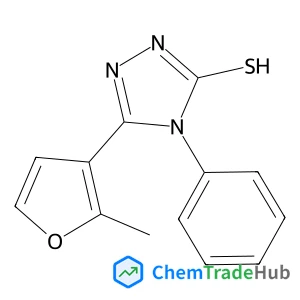
5-(2-Methyl-3-furyl)-4-phenyl-2,4-dihydro-3H-1,2,4-triazole-3-thione
CAS Number:
346464-59-3
Molecular Formula:
C13H11N3OS
![(1R,5R)-3-{[(2-Methyl-2-propanyl)oxy]carbonyl}-3-azabicyclo[3.1.0]hexane-1-carboxylic acid structure](https://static.chemtradehub.com/structs/116/1165450-63-4-bfe1.webp "(1R,5R)-3-{[(2-Methyl-2-propanyl)oxy]carbonyl}-3-azabicyclo[3.1.0]hexane-1-carboxylic acid structure")
(1R,5R)-3-{[(2-Methyl-2-propanyl)oxy]carbonyl}-3-azabicyclo[3.1.0]hexane-1-carboxylic acid
CAS Number:
1165450-63-4
Molecular Formula:
C11H17NO4
![[(2R)-6,6-Dimethyl-2-morpholinyl]methanol hydrochloride (1:1) structure](https://static.chemtradehub.com/structs/141/1416444-88-6-e06a.webp "[(2R)-6,6-Dimethyl-2-morpholinyl]methanol hydrochloride (1:1) structure")
[(2R)-6,6-Dimethyl-2-morpholinyl]methanol hydrochloride (1:1)
CAS Number:
1416444-88-6
Molecular Formula:
C7H16ClNO2
Recommended Suppliers





Disclaimer
This page provides academic journal information for reference and research purposes only. We are not affiliated with any journal publishers and do not handle publication submissions. For publication-related inquiries, please contact the respective journal publishers directly.
If you notice any inaccuracies in the information displayed, please contact us at support@chemtradehub.com. We will promptly review and address your concerns.