












Controlling the mechanism of fulvene S1/S0 decay: switching off the stepwise population transfer
Literature Information
Publication Date
2010-11-16
DOI
10.1039/C0CP01757D
Impact Factor
3.676
Authors
David Mendive-Tapia, Benjamin Lasorne, Graham A. Worth, Michael J. Bearpark, Michael A. Robb
View Original
Abstract
Direct quantum dynamics simulations were performed to model the radiationless decay of the first excited state S1 of fulvene. The full space of thirty normal mode nuclear coordinates was explicitly considered. By default, ultrafast internal conversion takes place centred on the higher-energy planar region of the S1/S0 conical intersection seam, giving the stepwise population transfer characteristic of a sloped surface crossing, and leading back to the ground state reactant. Two possible schemes for controlling whether stepwise population transfer occurs or not—either altering the initial geometry distribution or the initial momentum composition of the photo-excited wavepacket—were explored. In both cases, decay was successfully induced to occur in the lower-energy twisted/peaked region of the crossing seam, switching off the stepwise population transfer. This absence of re-crossing is a direct consequence of the change in the position on the intersection at which decay occurs (our target for control), and its consequences should provide an experimentally observable fingerprint of this system.
Related Literature
A more efficient copper-ion-exchanged ZSM-5 zeolite for N2 adsorption at room temperature: Ion-exchange in an aqueous solution of Cu(CH3COO)2
Yasushige Kuroda, Ryotaro Kumashiro, Atsushi Itadani, Mahiko Nagao, Hisayoshi Kobayashi
2001-02-27
Paper
DOI: 10.1039/B009942M
Spectroscopic and thermodynamic study of the H-bonding of olefins onto the isolated hydroxyl of amorphous silica
Paper
DOI: 10.1039/A903682B
Coagulation rates in concentrated colloidal suspensions studied by Brownian dynamics simulation
Paper
DOI: 10.1039/A904615A
Light-mediated controlled and classical polymerizations of less-activated monomers under high-pressure conditions
Anna Szelwicka, Anna Chrobok
2021-07-12
Paper
DOI: 10.1039/D1PY00738F
A theoretical investigation of OH formation in the gas-phase ozonolysis of E-but-2-ene and Z-but-2-ene
Paper
DOI: 10.1039/A903186C
Packing states of multilamellar vesicles in a nonionic surfactant system
T. D. Le, U. Olsson, K. Mortensen
2001-03-13
Paper
DOI: 10.1039/B006747O
You might also like
Compound Q&A
What are the main uses of 4-Nitrophenyl phosphate disodium salt hexahydrate (CAS: 333338-18-4)?
4-Nitrophenyl phosphate disodium salt hexahydrate is primarily used as a substra...
333338-18-44-Nitrophenyl phosph...
Compound Q&A
What are the main uses of 2-(Trifluoromethyl)-1,3-oxazole-4-carboxylic Acid (CAS: 1060816-01-4)?
2-(Trifluoromethyl)-1,3-oxazole-4-carboxylic Acid (CAS: 1060816-01-4) is widely ...
1060816-01-42-(Trifluoromethyl)-...
Compound Q&A
How should 2-Fluoro-4-biphenylcarboxylic acid (CAS: 137045-30-8) be stored?
2-Fluoro-4-biphenylcarboxylic acid should be stored in a cool, dry place at room...
137045-30-82-Fluoro-4-biphenylc...
Compound Q&A
What industries use Prednisolone-21-Carboxylic Acid (CAS: 61549-70-0)?
Prednisolone-21-Carboxylic Acid is primarily used in the pharmaceutical industry...
61549-70-0Prednisolone-21-Carb...
Compound Q&A
How should 4-(Hydrazinomethyl)-1,2,3-benzenetriol (CAS: 3614-72-0) be stored?
4-(Hydrazinomethyl)-1,2,3-benzenetriol (CAS: 3614-72-0) should be stored in a co...
3614-72-04-(Hydrazinomethyl)-...
Compound Q&A
What industries use 4-Amino-1-methyl-1H-pyrazole-5-carboxylic acid hydrochloride (CAS: 92534-70-8)?
4-Amino-1-methyl-1H-pyrazole-5-carboxylic acid hydrochloride (CAS: 92534-70-8) i...
92534-70-84-Amino-1-methyl-1H-...
Compound Q&A
What regulatory guidelines apply to dehydropachymic acid (CAS: 77012-31-8)?
Dehydropachymic acid (CAS: 77012-31-8) is regulated by various agencies. It fall...
77012-31-8Dehydropachymic acid
Compound Q&A
What is the market or research trend for 6-[(2,2-Dimethylpropanoyl)amino]nicotinic acid (CAS: 898561-66-5)?
The market and research trends for 6-[(2,2-Dimethylpropanoyl)amino]nicotinic aci...
898561-66-56-[(2,2-Dimethylprop...
Compound Q&A
How should 1,10-Phenanthroline-2,9-dicarbaldehyde (CAS: 57709-62-3) be stored?
1,10-Phenanthroline-2,9-dicarbaldehyde should be stored in a cool, dry place awa...
57709-62-31,10-Phenanthroline-...
Compound Q&A
How is 5-Carbamoyl-11-oxo-10,11-dihydro-5H-dibenzo[b,f]azepin-10-yl acetate (CAS: 113952-21-9) typically synthesized?
5-Carbamoyl-11-oxo-10,11-dihydro-5H-dibenzo[b,f]azepin-10-yl acetate can be synt...
113952-21-95-Carbamoyl-11-oxo-1...
Source Journal
Physical Chemistry Chemical Physics

CiteScore:
5.5
Self-citation Rate:
10.3%
Articles per Year:
3036
Physical Chemistry Chemical Physics (PCCP) is an international journal co-owned by 19 physical chemistry and physics societies from around the world. This journal publishes original, cutting-edge research in physical chemistry, chemical physics and biophysical chemistry. To be suitable for publication in PCCP, articles must include significant innovation and/or insight into physical chemistry; this is the most important criterion that reviewers and Editors will judge against when evaluating submissions. The journal has a broad scope and welcomes contributions spanning experiment, theory, computation and data science. Topical coverage includes spectroscopy, dynamics, kinetics, statistical mechanics, thermodynamics, electrochemistry, catalysis, surface science, quantum mechanics, quantum computing and machine learning. Interdisciplinary research areas such as polymers and soft matter, materials, nanoscience, energy, surfaces/interfaces, and biophysical chemistry are welcomed if they demonstrate significant innovation and/or insight into physical chemistry. Joined experimental/theoretical studies are particularly appreciated when complementary and based on up-to-date approaches.
Recommended Compounds
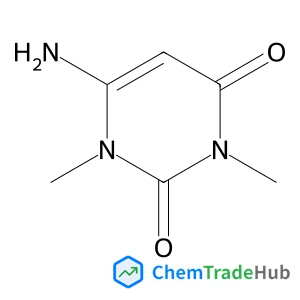
6-amino-1,3-dimethyl-1,2,3,4-tetrahydropyrimidine-2,4-dione
CAS Number:
6642-31-5
Molecular Formula:
C6H9N3O2

Recommended Suppliers






Disclaimer
This page provides academic journal information for reference and research purposes only. We are not affiliated with any journal publishers and do not handle publication submissions. For publication-related inquiries, please contact the respective journal publishers directly.
If you notice any inaccuracies in the information displayed, please contact us at support@chemtradehub.com. We will promptly review and address your concerns.