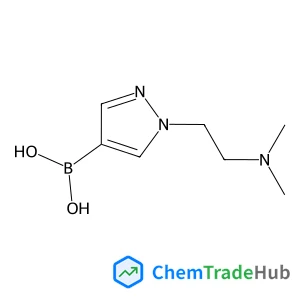
(1-(2-(Dimethylamino)ethyl)-1H-pyrazol-4-yl)boronic acid
CAS Number:
1086063-73-1
Molecular Formula:
C7H14BN3O2
Chandrashekhar V. Kulkarni, Wolfgang Wachter, Guillermo Iglesias-Salto, Sandra Engelskirchen
During the last few years, there has been an extraordinary increase in publications describing the manifold applications of monoolein, one of the most important lipids in the fields of drug delivery, emulsion stabilization and protein crystallization. In this perspective we present a comprehensive review of the phase behavior of this ‘magic lipid’. An account of various mesophases formed in the presence of water and a collection of formulae for the calculation of their nano-structural parameters are provided. Effects of chemical and biological molecules including lipids, detergents, salts, sugars, proteins and DNA on the classical behavior are also discussed. Physicochemical triggers such as, temperature, pressure and shearing modulate the phase behavior of monoolein self assemblies that are covered in subsequent sections. Finally the growing applications of monoolein in various fields are also reported.
Laura Fernandez, Sebastian Thussing, Alexander Mänz, Jörg Sundermeyer, Gregor Witte, Peter Jakob
DOI: 10.1039/C6CP07922A
M. Pérez-Rodríguez, A. Vidal-Vidal, J. M. Míguez, F. J. Blas, J.-P. Torré, M. M. Piñeiro
DOI: 10.1039/C6CP07097C
Zhen-Yu Zhang, Hai-Yu Wang, Yan-Xia Zhang, Kai-Jiao Li, Xue-Peng Zhan, Bing-Rong Gao, Qi-Dai Chen, Hong-Bo Sun
DOI: 10.1039/C6CP07522C
Martin R. S. McCoustra
DOI: 10.1039/C6CP06928B
Bingya Hou, Lang Shen, Haotian Shi, Rehan Kapadia
DOI: 10.1039/C6CP07542H
Alejandro Cadranel, Jaired E. Tate, Paola S. Oviedo, Shiori Yamazaki, José H. Hodak, Luis M. Baraldo, Valeria D. Kleiman
DOI: 10.1039/C6CP06562G
Qiang Shao, Zhijian Xu, Jinan Wang, Jiye Shi, Weiliang Zhu
DOI: 10.1039/C6CP06624K
Martin Dračínský, Jan Storch, Vladimír Církva, Ivana Císařová, Jan Sýkora
DOI: 10.1039/C6CP07552E
Iffat H. Nayyar, Sara E. Chamberlin, Tiffany C. Kaspar, Niranjan Govind, Scott A. Chambers, Peter V. Sushko
DOI: 10.1039/C6CP06087K
2-(2-Chloroacetamido)-3-phenylpropanoic acid (CAS: 7765-11-9) is generally consi...
2-(Benzyloxy)-5-bromobenzoic acid can be handled safely if appropriate precautio...
(4-Methyl-1,2,5-oxadiazol-3-yl)methanamine hydrochloride is a chemical compound ...
2-(5-Hexylthiophen-2-yl)-4,4,5,5-tetramethyl-1,3,2-dioxaborolane (CAS: 917985-54...
While 4-(8-Methyl-9H-1,3-dioxolo[4,5-h][2,3]benzodiazepin-5-yl)benzenamine (CAS:...
The market for tert-butyl 3-hydroxy-4,5,7,8-tetrahydro-2H-pyrazolo[3,4-d]azepine...
Waste containing 3,5-Diamino-1H-pyrazole-4-carbonitrile (CAS: 6844-58-2) should ...
(6-Fluoro-3-pyridinyl)boronic acid can be synthesized through the reaction of 6-...
Dibenzyl carbonimidoylbiscarbamate (CAS: 10065-79-9) finds applications in vario...
The market for (beta,beta,2,3,4,5,6-~2~H_7_)Phenylalanine (CAS: 74228-83-4) is g...

Physical Chemistry Chemical Physics (PCCP) is an international journal co-owned by 19 physical chemistry and physics societies from around the world. This journal publishes original, cutting-edge research in physical chemistry, chemical physics and biophysical chemistry. To be suitable for publication in PCCP, articles must include significant innovation and/or insight into physical chemistry; this is the most important criterion that reviewers and Editors will judge against when evaluating submissions. The journal has a broad scope and welcomes contributions spanning experiment, theory, computation and data science. Topical coverage includes spectroscopy, dynamics, kinetics, statistical mechanics, thermodynamics, electrochemistry, catalysis, surface science, quantum mechanics, quantum computing and machine learning. Interdisciplinary research areas such as polymers and soft matter, materials, nanoscience, energy, surfaces/interfaces, and biophysical chemistry are welcomed if they demonstrate significant innovation and/or insight into physical chemistry. Joined experimental/theoretical studies are particularly appreciated when complementary and based on up-to-date approaches.