












Shear ordered diblock copolymers with tuneable optical properties‡
Literature Information
Publication Date
2010-12-15
DOI
10.1039/C0CP01481H
Impact Factor
3.676
Authors
Andrew J. Parnell, Nadejda Tzokova, Andrew Pryke, Jonathan R. Howse, Oleksandr O. Mykhaylyk, Anthony J. Ryan, Pierre Panine, J. Patrick A. Fairclough
View Original
Abstract
A series of high molecular weight poly(styrene-b-isoprene) block copolymers with optical properties defined by composition in a non-selective solvent were studied using simultaneous ultra small angle X-ray scattering (USAXS) and optical spectrometry. A small magnitude shear produces ordered and oriented states in the copolymer solutions that persist for extended periods of time, and also have superior optical properties that are directly attributable to the mesoscopic block copolymer (BCP) morphology. We have demonstrated that the optical transmission of these materials can be tuned by the addition of low molecular weight poly(isoprene) and poly(styrene) to swell their respective domains within the diblock copolymer. The optical transmission peak for the diblocks could be tuned; from 380 nm–440 nm for the 670k diblock, 425 nm–540 nm for the 850k diblock and 541 nm–625 nm for the 1 million diblock by altering the solution concentration and composition. The full width at half maximum that can be achieved for the optical transmission peaks is as small as 15 nm at 473 nm with a Δλ/λ of 0.03, highlighting the high quality ordering in these systems. Also a small shift in the transmission peak wavelength was observed across a wide angle of view (15 nm at 30°) suggesting that these materials could be used for large area narrow band optical filters.
Related Literature
Polarization loss in the organic ferroelectric trialkylbenzene-1,3,5-tricarboxamide (BTA)
A. V. Gorbunov, X. Meng, I. Urbanaviciute, T. Putzeys, M. Wübbenhorst, R. P. Sijbesma
2016-12-23
Paper
DOI: 10.1039/C6CP08015D
Is energy transfer limiting multiphotochromism? answers from ab initio quantifications
Roberto Russo, Lorenzo Cupellini, Benedetta Mennucci
2016-12-19
Paper
DOI: 10.1039/C6CP07458H
Double electron–electron resonance with multiple non-selective chirp refocusing
Andrin Doll, Gunnar Jeschke
2016-12-08
Paper
DOI: 10.1039/C6CP07262C
Probing nonlinear optical coefficients in self-assembled peptide nanotubes
Soma Khanra, Kartik Ghosh, Fabio F. Ferreira, Wendel A. Alves, Francesco Punzo, Ping Yu, Suchismita Guha
2017-01-04
Paper
DOI: 10.1039/C6CP07879F
Small-angle scattering from the Cantor surface fractal on the plane and the Koch snowflake
Vladimir A. Osipov
2016-12-14
Paper
DOI: 10.1039/C6CP07496K
Luminophores of tunable colors from ternary Ag–In–S and quaternary Ag–In–Zn–S nanocrystals covering the visible to near-infrared spectral range
Grzegorz Gabka, Piotr Bujak, Kamil Kotwica, Andrzej Ostrowski, Wojciech Lisowski, Janusz W. Sobczak, Adam Pron
2016-12-02
Paper
DOI: 10.1039/C6CP07008F
Effect of doping and chemical ordering on the optoelectronic properties of complex oxides: Fe2O3–V2O3 solid solutions and hetero-structures
Iffat H. Nayyar, Sara E. Chamberlin, Tiffany C. Kaspar, Niranjan Govind, Scott A. Chambers, Peter V. Sushko
2016-12-07
Paper
DOI: 10.1039/C6CP06087K
Hysteresis phenomena in perovskite solar cells: the many and varied effects of ionic accumulation
Daniel A. Jacobs, Yiliang Wu, Heping Shen, Chog Barugkin, Fiona J. Beck, Thomas P. White, Klaus Weber, Kylie R. Catchpole
2017-01-03
Paper
DOI: 10.1039/C6CP06989D
Charge ordering and scattering pre-peaks in ionic liquids and alcohols
2016-12-06
Paper
DOI: 10.1039/C6CP07834F
Negative thermal expansion in 2H CuScO2 originating from the cooperation of transverse thermal vibrations of Cu and O atoms
Qiang Sun
2016-12-12
Paper
DOI: 10.1039/C6CP07589D
You might also like
Compound Q&A
Is 2-(2-chloroacetamido)-3-phenylpropanoic acid (CAS: 7765-11-9) safe?
2-(2-Chloroacetamido)-3-phenylpropanoic acid (CAS: 7765-11-9) is generally consi...
7765-11-92-(2-chloroacetamido...
Compound Q&A
Is 2-(Benzyloxy)-5-bromobenzoic acid (CAS: 62176-31-2) safe?
2-(Benzyloxy)-5-bromobenzoic acid can be handled safely if appropriate precautio...
62176-31-22-(Benzyloxy)-5-brom...
Compound Q&A
What is (4-Methyl-1,2,5-oxadiazol-3-yl)methanamine hydrochloride (CAS: 1159825-48-5)?
(4-Methyl-1,2,5-oxadiazol-3-yl)methanamine hydrochloride is a chemical compound ...
1159825-48-5(4-Methyl-1,2,5-oxad...
Compound Q&A
What is 2-(5-Hexylthiophen-2-yl)-4,4,5,5-tetramethyl-1,3,2-dioxaborolane (CAS: 917985-54-7)?
2-(5-Hexylthiophen-2-yl)-4,4,5,5-tetramethyl-1,3,2-dioxaborolane (CAS: 917985-54...
917985-54-72-(5-Hexylthiophen-2...
Compound Q&A
Are there alternatives to 4-(8-Methyl-9H-1,3-dioxolo[4,5-h][2,3]benzodiazepin-5-yl)benzenamine (CAS: 102771-26-6) in synthesis?
While 4-(8-Methyl-9H-1,3-dioxolo[4,5-h][2,3]benzodiazepin-5-yl)benzenamine (CAS:...
102771-26-64-(8-Methyl-9H-1,3-d...
Compound Q&A
What is the market or research trend for tert-butyl 3-hydroxy-4,5,7,8-tetrahydro-2H-pyrazolo[3,4-d]azepine-6-carboxylate (CAS: 851376-80-2)?
The market for tert-butyl 3-hydroxy-4,5,7,8-tetrahydro-2H-pyrazolo[3,4-d]azepine...
851376-80-2tert-butyl 3-hydroxy...
Compound Q&A
How should waste containing 3,5-Diamino-1H-pyrazole-4-carbonitrile (CAS: 6844-58-2) be handled?
Waste containing 3,5-Diamino-1H-pyrazole-4-carbonitrile (CAS: 6844-58-2) should ...
6844-58-23,5-Diamino-1H-pyraz...
Compound Q&A
How is (6-Fluoro-3-pyridinyl)boronic acid (CAS: 351019-18-6) typically synthesized?
(6-Fluoro-3-pyridinyl)boronic acid can be synthesized through the reaction of 6-...
351019-18-6(6-Fluoro-3-pyridiny...
Compound Q&A
What industries use Dibenzyl carbonimidoylbiscarbamate (CAS: 10065-79-9)?
Dibenzyl carbonimidoylbiscarbamate (CAS: 10065-79-9) finds applications in vario...
10065-79-9Dibenzyl carbonimido...
Compound Q&A
What is the market or research trend for (beta,beta,2,3,4,5,6-~2~H_7_)Phenylalanine (CAS: 74228-83-4)?
The market for (beta,beta,2,3,4,5,6-~2~H_7_)Phenylalanine (CAS: 74228-83-4) is g...
74228-83-4(beta,beta,2,3,4,5,6...
Source Journal
Physical Chemistry Chemical Physics

CiteScore:
5.5
Self-citation Rate:
10.3%
Articles per Year:
3036
Physical Chemistry Chemical Physics (PCCP) is an international journal co-owned by 19 physical chemistry and physics societies from around the world. This journal publishes original, cutting-edge research in physical chemistry, chemical physics and biophysical chemistry. To be suitable for publication in PCCP, articles must include significant innovation and/or insight into physical chemistry; this is the most important criterion that reviewers and Editors will judge against when evaluating submissions. The journal has a broad scope and welcomes contributions spanning experiment, theory, computation and data science. Topical coverage includes spectroscopy, dynamics, kinetics, statistical mechanics, thermodynamics, electrochemistry, catalysis, surface science, quantum mechanics, quantum computing and machine learning. Interdisciplinary research areas such as polymers and soft matter, materials, nanoscience, energy, surfaces/interfaces, and biophysical chemistry are welcomed if they demonstrate significant innovation and/or insight into physical chemistry. Joined experimental/theoretical studies are particularly appreciated when complementary and based on up-to-date approaches.
Recommended Compounds
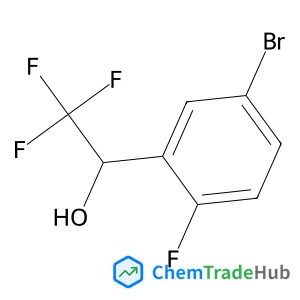
1-(5-Bromo-2-fluorophenyl)-2,2,2-trifluoroethanol
CAS Number:
1039827-16-1
Molecular Formula:
C8H5BrF4O
Recommended Suppliers








Disclaimer
This page provides academic journal information for reference and research purposes only. We are not affiliated with any journal publishers and do not handle publication submissions. For publication-related inquiries, please contact the respective journal publishers directly.
If you notice any inaccuracies in the information displayed, please contact us at support@chemtradehub.com. We will promptly review and address your concerns.