













Chiral interactions of histidine in a hydrated vermiculite clay
Literature Information
Publication Date
2010-10-28
DOI
10.1039/C0CP01387K
Impact Factor
3.676
Authors
Donald G. Fraser, H. Christopher Greenwell, Neal T. Skipper, Martin V. Smalley, Bruno Demé, R. K. Heenan
View Original
Abstract
Recent work shows a correlation between chiral asymmetry in non-terrestrial amino acids extracted from the Murchison meteorite and the presence of hydrous mineral phases in the meteorite [D. P. Glavin and J. P. Dworkin, Proc. Natl. Acad. Sci. U. S. A., 2009, 106, 5487–5492]. This highlights the need for sensitive experimental tests of the interactions of amino acids with clay minerals together with high level computational work. We present here the results of in situneutron scattering experiments designed to follow amino acid adsorption on an exchanged, 1-dimensionally ordered n-propyl ammonium vermiculite clay. The vermiculite gel has a (001) d-spacing of order 5 nm at the temperature and concentration of the experiments and the d-spacing responds sensitively to changes in concentration, temperature and electronic environment. The data show that isothermal addition of D-histidine or L-histidine solutions of the same concentration leads to an anti-osmotic swelling, and shifts in the d-spacing that are different for each enantiomer. This chiral specificity, measured in situ, in real time in the neutron beam, is of interest for the question of whether clays could have played an important role in the origin of biohomochirality.
Related Literature
Enantioselective total synthesis of a novel polyketide natural product (+)-integrasone, an HIV-1 integrase inhibitor
Goverdhan Mehta, Subhrangsu Roy
2005-05-24
Communication
DOI: 10.1039/B502024G
Duplex strand formation using alternating copolymers
Hiroshi Nakade, M. Firat Ilker, Brian J. Jordan, Oktay Uzun, Nicholas L. LaPointe, E. Bryan Coughlin, Vincent M. Rotello
2005-05-27
Communication
DOI: 10.1039/B502929E
Thioctic acid amides: convenient tethers for achieving low nonspecific protein binding to carbohydrates presented on gold surfaces
Rositsa Karamanska, Balaram Mukhopadhyay, David A. Russell, Robert A. Field
2005-05-27
Communication
DOI: 10.1039/B503843J
Rh(i)-catalyzed CO gas-free cyclohydrocarbonylation of alkynes with formaldehyde to α,β-butenolides
Koji Fuji, Tsumoru Morimoto, Ken Tsutsumi, Kiyomi Kakiuchi
2005-06-01
Communication
DOI: 10.1039/B503816B
Photoinduced DNA end capping viaN3-methyl-5-cyanovinyl-2′-deoxyuridine
Yoshinaga Yoshimura, Tadayoshi Ikemoto, Akio Nakazawa, Masayuki Hayashi, Isao Saito
2005-05-24
Communication
DOI: 10.1039/B504162G
A pH-insensitive, ratiometric chemosensor for citrate using europium luminescence
David Parker, Junhua Yu
2005-05-20
Communication
DOI: 10.1039/B502553B
Fluorescence probes for thiol-containing amino acids and peptides in aqueous solution
Hongxiang Li, Wenping Hu, Daoben Zhu
2005-05-24
Communication
DOI: 10.1039/B503772G
Polyfunctionalized macrocycles demonstrate enantioselective and ditopic binding properties
Jiachang Gong, Bruce C. Gibb
2005-05-27
Communication
DOI: 10.1039/B501774B
Cp*(iPr3P)Ru(Cl)(η2-HSiClMe2): the first complex with simultaneous Si–H and RuCl⋯SiCl inter-ligand interactions
Alexander L. Osipov, Sergei F. Vyboishchikov, Konstantin Y. Dorogov, Lyudmila G. Kuzmina, Judith A. K. Howard, Dmitrii A. Lemenovskii, Georgii I. Nikonov
2005-05-27
Communication
DOI: 10.1039/B500679A
Spontaneous assembly of a nine-vertex lithium framework encapsulating the peroxide dianion
Martyn P. Coles, Peter B. Hitchcock
2005-05-18
Communication
DOI: 10.1039/B504022A
You might also like
Compound Q&A
How should 2-Methylbenzene-1,4-diamine dihydrochloride (CAS: 615-45-2) be stored?
2-Methylbenzene-1,4-diamine dihydrochloride (CAS: 615-45-2) should be stored in ...
615-45-22-Methylbenzene-1,4-...
Compound Q&A
Is (1S,4S)-2,5-Diazabicyclo[2.2.1]heptane dihydrobromide (CAS: 132747-20-7) safe?
(1S,4S)-2,5-Diazabicyclo[2.2.1]heptane dihydrobromide is generally considered sa...
132747-20-7(1S,4S)-2,5-Diazabic...
Compound Q&A
What industries use (6-Chloropyridazin-3-YL)methanamine (CAS: 871826-15-2)?
(6-Chloropyridazin-3-YL)methanamine finds applications in the pharmaceutical ind...
871826-15-2(6-Chloropyridazin-3...
Compound Q&A
What are the main uses of 2-Fluoro-3-methylphenol (CAS: 77772-72-6)?
2-Fluoro-3-methylphenol is primarily used in the synthesis of pharmaceuticals, p...
77772-72-62-Fluoro-3-methylphe...
Compound Q&A
What precautions should be taken when handling 3-Methoxy-4-nitrobenzonitrile (CAS: 177476-75-4)?
When handling 3-Methoxy-4-nitrobenzonitrile, it is important to wear appropriate...
177476-75-43-Methoxy-4-nitroben...
Compound Q&A
What precautions should be taken when handling 1,3-Oxazolo[4,5-b]pyridine-2(3H)-thione (CAS: 211949-57-4)?
When handling 1,3-Oxazolo[4,5-b]pyridine-2(3H)-thione (CAS: 211949-57-4), it is ...
211949-57-4[1,3]Oxazolo[4,5-b]p...
Compound Q&A
What regulatory guidelines apply to 4-Ethynylbenzamide (CAS: 90347-86-7)?
4-Ethynylbenzamide (CAS: 90347-86-7) falls under various regulatory guidelines i...
90347-86-74-Ethynylbenzamide
Compound Q&A
What are the main uses of 3-(2-Ethylphenyl)-2-thioxo-4-imidazolidinone (CAS: 186822-57-1)?
3-(2-Ethylphenyl)-2-thioxo-4-imidazolidinone is primarily used as an intermediat...
186822-57-13-(2-Ethylphenyl)-2-...
Compound Q&A
What is (2-Fluoro-6-methoxyphenyl)acetic acid (CAS: 500912-19-6)?
(2-Fluoro-6-methoxyphenyl)acetic acid, also known as 4-fluoro-3-methoxybenzoic a...
500912-19-6(2-Fluoro-6-methoxyp...
Compound Q&A
What is the market or research trend for 2-[4-(Hydroxymethyl)phenoxy]ethanol (CAS: 102196-18-9)?
Market trends for 2-[4-(Hydroxymethyl)phenoxy]ethanol (CAS: 102196-18-9) indicat...
102196-18-92-[4-(Hydroxymethyl)...
Source Journal
Physical Chemistry Chemical Physics

CiteScore:
5.5
Self-citation Rate:
10.3%
Articles per Year:
3036
Physical Chemistry Chemical Physics (PCCP) is an international journal co-owned by 19 physical chemistry and physics societies from around the world. This journal publishes original, cutting-edge research in physical chemistry, chemical physics and biophysical chemistry. To be suitable for publication in PCCP, articles must include significant innovation and/or insight into physical chemistry; this is the most important criterion that reviewers and Editors will judge against when evaluating submissions. The journal has a broad scope and welcomes contributions spanning experiment, theory, computation and data science. Topical coverage includes spectroscopy, dynamics, kinetics, statistical mechanics, thermodynamics, electrochemistry, catalysis, surface science, quantum mechanics, quantum computing and machine learning. Interdisciplinary research areas such as polymers and soft matter, materials, nanoscience, energy, surfaces/interfaces, and biophysical chemistry are welcomed if they demonstrate significant innovation and/or insight into physical chemistry. Joined experimental/theoretical studies are particularly appreciated when complementary and based on up-to-date approaches.
Recommended Compounds
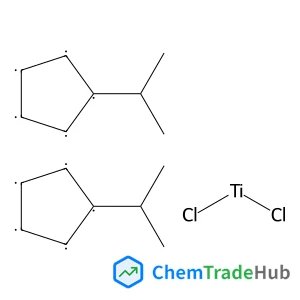
BIS(I-PROPYLCYCLOPENTADIENYL)TITANIUM DICHLORIDE
CAS Number:
12130-65-3
Molecular Formula:
C16H22Cl2Ti

(S)-1-(3-(Benzyloxy)phenyl)-3-(dimethylamino)-2-methylpropan-1-one (2r,3r)-2,3-bis(benzoyloxy)succinate
CAS Number:
1004315-81-4
Molecular Formula:
C37H37NO10
![3-[(3R,4R)-3-[(6-aminopyrimidin-4-yl)-methyl-amino]-4-methyl-1-piperidyl]-3-oxo-propanenitrile structure](https://static.chemtradehub.com/structs/164/1640971-60-3-83a4.webp "3-[(3R,4R)-3-[(6-aminopyrimidin-4-yl)-methyl-amino]-4-methyl-1-piperidyl]-3-oxo-propanenitrile structure")
3-[(3R,4R)-3-[(6-aminopyrimidin-4-yl)-methyl-amino]-4-methyl-1-piperidyl]-3-oxo-propanenitrile
CAS Number:
1640971-60-3
Molecular Formula:
C14H20N6O
![[1-(5-Methyl-2-pyridinyl)-1H-pyrazol-4-yl]methanol structure](https://static.chemtradehub.com/structs/143/1439822-99-7-6cc9.webp "[1-(5-Methyl-2-pyridinyl)-1H-pyrazol-4-yl]methanol structure")
[1-(5-Methyl-2-pyridinyl)-1H-pyrazol-4-yl]methanol
CAS Number:
1439822-99-7
Molecular Formula:
C10H11N3O
Recommended Suppliers





Disclaimer
This page provides academic journal information for reference and research purposes only. We are not affiliated with any journal publishers and do not handle publication submissions. For publication-related inquiries, please contact the respective journal publishers directly.
If you notice any inaccuracies in the information displayed, please contact us at support@chemtradehub.com. We will promptly review and address your concerns.