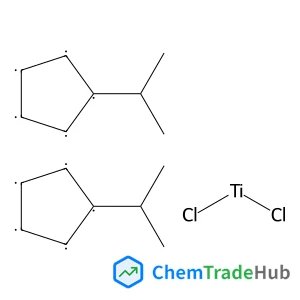
BIS(I-PROPYLCYCLOPENTADIENYL)TITANIUM DICHLORIDE
CAS Number:
12130-65-3
Molecular Formula:
C16H22Cl2Ti
Koji Fuji, Tsumoru Morimoto, Ken Tsutsumi, Kiyomi Kakiuchi
The rhodium(I)-catalyzed reaction of alkynes with formaldehyde proceeds via the double incorporation of a carbonyl moiety from formaldehyde, resulting in a CO gas-free cyclohydrocarbonylation leading to α,β-butenolides.
DOI: 10.1039/C4GC90034K
Fang Zhang, Xiaotao Wu, Chao Liang, Xiaoyan Li, Zhen Wang, Hexing Li
DOI: 10.1039/C4GC00178H
Sumit Choudhury, Jin-Ook Baeg, No-Joong Park, Rajesh K. Yadav
DOI: 10.1039/C4GC00885E
Paula M. Uberman, Natalia J. S. Costa, Rafaela C. Carmona, Alcindo A. Dos Santos, Liane M. Rossi
DOI: 10.1039/C4GC00669K
Estevão F. Mai, Marta A. Machado, Thomas E. Davies, Jose A. Lopez-Sanchez, Victor Teixeira da Silva
DOI: 10.1039/C4GC00920G
João V. Rodrigues, Diana Ruivo, Ana Rodríguez, Francisco J. Deive, José M. S. S. Esperança, Isabel M. Marrucho, Cláudio M. Gomes, Luís Paulo N. Rebelo
DOI: 10.1039/C4GC01329H
Wei Li, Jian-Hua Xie, Ming-Lei Yuan, Qi-Lin Zhou
DOI: 10.1039/C4GC00835A
Hilda Gómez Bernal, Luca Bernazzani
DOI: 10.1039/C4GC00450G
Lin He, Helfried Neumann, Matthias Beller
DOI: 10.1039/C4GC00801D
2-Methylbenzene-1,4-diamine dihydrochloride (CAS: 615-45-2) should be stored in ...
(1S,4S)-2,5-Diazabicyclo[2.2.1]heptane dihydrobromide is generally considered sa...
(6-Chloropyridazin-3-YL)methanamine finds applications in the pharmaceutical ind...
2-Fluoro-3-methylphenol is primarily used in the synthesis of pharmaceuticals, p...
When handling 3-Methoxy-4-nitrobenzonitrile, it is important to wear appropriate...
When handling 1,3-Oxazolo[4,5-b]pyridine-2(3H)-thione (CAS: 211949-57-4), it is ...
4-Ethynylbenzamide (CAS: 90347-86-7) falls under various regulatory guidelines i...
3-(2-Ethylphenyl)-2-thioxo-4-imidazolidinone is primarily used as an intermediat...
(2-Fluoro-6-methoxyphenyl)acetic acid, also known as 4-fluoro-3-methoxybenzoic a...
Market trends for 2-[4-(Hydroxymethyl)phenoxy]ethanol (CAS: 102196-18-9) indicat...

ChemComm publishes urgent research which is of outstanding significance and interest to experts in the field, while also appealing to the journal’s broad chemistry readership. Our communication format is ideally suited to short, urgent studies that are of such importance that they require accelerated publication. Our scope covers all topics in chemistry, and research at the interface of chemistry and other disciplines (such as materials science, nanoscience, physics, engineering and biology) where there is a significant novelty in the chemistry aspects. Major topic areas covered include: Analytical Chemistry Catalysis Chemical Biology and medicinal chemistry Computational Chemistry and Machine Learning Energy and sustainable chemistry Environmental Chemistry Green Chemistry Inorganic Chemistry Materials Chemistry Nanoscience Organic Chemistry Physical Chemistry Polymer Chemistry Supramolecular Chemistry