












Quantifying the symmetry content of the electronic structure of molecules: molecular orbitals and the wave function
Literature Information
Publication Date
2010-10-26
DOI
10.1039/C0CP01326A
Impact Factor
3.676
Authors
David Casanova
View Original
Abstract
A scheme to quantify the symmetry content of the electronic wave function and molecular orbitals for arbitrary molecules is developed within the formalism of Continuous Symmetry Measures (CSMs). After defining the symmetry operation expectation values (SOEVs) as the key quantity to gauge the symmetry content of molecular wavefunctions, we present the working equations to be implemented in order to carry out real calculations using standard quantum chemistry software. The potentialities of a symmetry analysis using this new method are shown by means of some illustrative examples such as the changes induced in the molecular orbitals of a diatomic molecule by an electronegativity perturbation, the breaking of orbital symmetry along the dissociation path of the H2 molecule, the changes in the molecular orbitals upon a geometrical distortion of the benzene molecule, and the inversion symmetry content in the different spin states of the [Fe(CH3)4]2− complex.
Related Literature
Fluorine-free ionic liquid electrolytes for sustainable neodymium recovery using an electrochemical approach
Kalani Periyapperuma, Jennifer M. Pringle, Laura Sanchez-Cupido, Maria Forsyth, Cristina Pozo-Gonzalo
2021-04-21
Paper
DOI: 10.1039/D1GC00361E
Effects of substrate temperature on the crystallization process and properties of mixed-ion perovskite layers
Chen Zhao, Deng Li, Heng Guo, Feiyi Liao, Wei Cao, Xiaobin Niu, Yiying Zhao
2019-01-08
Paper
DOI: 10.1039/C8TA10170A
Electron distribution tuning of fluorine-doped carbon for ammonia electrosynthesis
Di Yuan, Zengxi Wei, Peng Han, Chao Yang, Linsong Huang, Zhengxiang Gu, Yu Ding, Jianmin Ma, Gengfeng Zheng
2019-06-25
Paper
DOI: 10.1039/C9TA04141A
Selective gelation of N-(4-pyridyl)nicotinamide by copper(ii) salts
Dipankar Ghosh, Ieva Lebedytė, Dmitry S. Yufit, Krishna K. Damodaran, Jonathan W. Steed
2015-08-18
Paper
DOI: 10.1039/C5CE00901D
A hierarchical carbon nitride tube with oxygen doping and carbon defects promotes solar-to-hydrogen conversion
Wu Wang, Qianwen Chen, Yayun Pu, Weiman Zhuang
2020-01-03
Paper
DOI: 10.1039/C9TA13012H
“Protrusions” or “holes” in graphene: which is the better choice for sodium ion storage?‡
Yijun Yang, Dai-Ming Tang, Chao Zhang, Yihui Zhang, Qifeng Liang, Shimou Chen, Qunhong Weng, Min Zhou, Yanming Xue, Jiangwei Liu, Jinghua Wu, Qiu Hong Cui, Chao Lian, Guolin Hou, Fangli Yuan, Xi Wang
2017-03-15
Paper
DOI: 10.1039/C7EE00329C
Gated molecular baskets
Keith Hermann, Yian Ruan, Alex M. Hardin, Christopher M. Hadad, Jovica D. Badjić
2014-06-13
Review Article
DOI: 10.1039/C4CS00140K
Self-produced bubble-template synthesis of La2O3:Yb/Er@Au hollow spheres with markedly enhanced luminescence and release properties
Ruichan Lv, Guixin Yang, Yunlu Dai, Shili Gai, Fei He, Piaoping Yang
2014-07-07
Paper
DOI: 10.1039/C4CE01063A
A redox stable Pd-doped perovskite for SOFC applications
Andrea Marcucci, Francesca Zurlo, Isabella Natali Sora, Stefano Casciardi, Silvia Licoccia, Elisabetta Di Bartolomeo
2019-02-04
Paper
DOI: 10.1039/C8TA10645B
You might also like
Compound Q&A
What are the main uses of (5-Sulfamoyl-3-pyridinyl)boronic acid (CAS: 951233-61-7)?
(5-Sulfamoyl-3-pyridinyl)boronic acid is primarily used in chemical synthesis, p...
951233-61-7(5-Sulfamoyl-3-pyrid...
Compound Q&A
How is Benzyl 2-methyl-2-(methylsulfonyl)-4-pentenoate (CAS: 1942858-50-5) typically synthesized?
Benzyl 2-methyl-2-(methylsulfonyl)-4-pentenoate is typically synthesized via est...
1942858-50-5Benzyl 2-methyl-2-(m...
Compound Q&A
What precautions should be taken when handling 8-Fluoroquinolin-6-ol (CAS: 209353-22-0)?
When handling 8-Fluoroquinolin-6-ol (CAS: 209353-22-0), it is important to use p...
209353-22-08-Fluoroquinolin-6-o...
Compound Q&A
What are the physical and chemical properties of 1,3-Dibromo-5-(2-methyl-2-propanyl)benzene (CAS: 129316-09-2)?
1,3-Dibromo-5-(2-methyl-2-propanyl)benzene (CAS: 129316-09-2) is a crystalline c...
129316-09-21,3-Dibromo-5-(2-met...
Compound Q&A
What industries use Ethyl 7-chloro-4-oxo-1-(1,3-thiazol-2-yl)-1,4-dihydro-1,8-naphthyridine-3-carboxylate (CAS: 174726-87-5)?
Ethyl 7-chloro-4-oxo-1-(1,3-thiazol-2-yl)-1,4-dihydro-1,8-naphthyridine-3-carbox...
174726-87-5Ethyl 7-chloro-4-oxo...
Compound Q&A
What precautions should be taken when handling Delta-7-Avenasterol (CAS: 23290-26-8)?
When handling Delta-7-Avenasterol (CAS: 23290-26-8), it is important to wear app...
23290-26-8Delta-7-Avenasterol
Compound Q&A
What precautions should be taken when handling N-({(5R)-3-[3-Fluoro-4-(4-morpholinyl)phenyl]-2-oxo-1,3-oxazolidin-5-yl}methyl)acetamide (CAS: 872992-20-6)?
Proper handling involves the use of personal protective equipment such as gloves...
872992-20-6N-({(5R)-3-[3-Fluoro...
Compound Q&A
What precautions should be taken when handling 2-Methyl-2-proanyl 4-[(2-aminophenyl)amino]-1-piperidinecarboxylate (CAS: 79099-00-6)?
When handling 2-Methyl-2-proanyl 4-[(2-aminophenyl)amino]-1-piperidinecarboxylat...
79099-00-62-Methyl-2-propanyl ...
Compound Q&A
What is N-Methyl-4-chlorobenzylamine hydrochloride (CAS: 65542-24-7)?
N-Methyl-4-chlorobenzylamine hydrochloride (CAS: 65542-24-7) is a organic compou...
65542-24-7N-Methyl-4-chloroben...
Compound Q&A
Is [2-(Dodecyloxy)ethoxy]acetic acid (CAS: 27306-90-7) safe?
[2-(Dodecyloxy)ethoxy]acetic acid (CAS: 27306-90-7) is generally considered safe...
27306-90-7[2-(Dodecyloxy)ethox...
Source Journal
Physical Chemistry Chemical Physics

CiteScore:
5.5
Self-citation Rate:
10.3%
Articles per Year:
3036
Physical Chemistry Chemical Physics (PCCP) is an international journal co-owned by 19 physical chemistry and physics societies from around the world. This journal publishes original, cutting-edge research in physical chemistry, chemical physics and biophysical chemistry. To be suitable for publication in PCCP, articles must include significant innovation and/or insight into physical chemistry; this is the most important criterion that reviewers and Editors will judge against when evaluating submissions. The journal has a broad scope and welcomes contributions spanning experiment, theory, computation and data science. Topical coverage includes spectroscopy, dynamics, kinetics, statistical mechanics, thermodynamics, electrochemistry, catalysis, surface science, quantum mechanics, quantum computing and machine learning. Interdisciplinary research areas such as polymers and soft matter, materials, nanoscience, energy, surfaces/interfaces, and biophysical chemistry are welcomed if they demonstrate significant innovation and/or insight into physical chemistry. Joined experimental/theoretical studies are particularly appreciated when complementary and based on up-to-date approaches.
Recommended Compounds
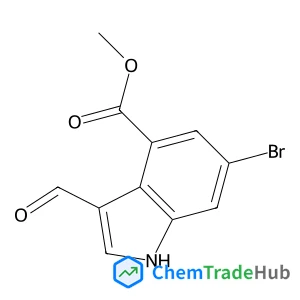
methyl 6-bromo-3-formyl-1H-indole-4-carboxylate
CAS Number:
1353636-63-1
Molecular Formula:
C11H8BrNO3
![4-[(4-Bromophenyl)sulfonyl]thiomorpholine structure](https://static.chemtradehub.com/structs/223/223555-81-5-2d67.webp "4-[(4-Bromophenyl)sulfonyl]thiomorpholine structure")
Recommended Suppliers







Disclaimer
This page provides academic journal information for reference and research purposes only. We are not affiliated with any journal publishers and do not handle publication submissions. For publication-related inquiries, please contact the respective journal publishers directly.
If you notice any inaccuracies in the information displayed, please contact us at support@chemtradehub.com. We will promptly review and address your concerns.