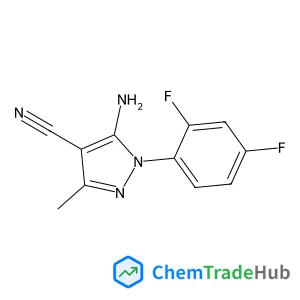
5-Amino-1-(2,4-difluorophenyl)-3-methyl-1H-pyrazole-4-carbonitrile
CAS Number:
1020057-92-4
Molecular Formula:
C11H8F2N4
María Queralt-Martín, Elena García-Giménez, Salvador Mafé, Antonio Alcaraz
In contrast to the highly-selective channels of neurophysiology employing mostly the exclusion mechanism, different factors account for the selectivity of large channels. Elucidation of these factors is essential for understanding the permeation mechanisms in ion channels and their regulation in vivo. The interaction between divalent cations and a protein channel, the bacterial porin OmpF, has been investigated paying attention to the channel selectivity and its dependence on the solution pH. Unlike the experiments performed in salts of monovalent cations, the channel is now practically insensitive to pH, being anion selective all over the pH range considered. Electrostatic calculations based on the available structural data suggest that the binding of divalent cations has two main effects: (i) the pKa values of key ionizable groups differ significantly from those of the isolated groups in solution and (ii) the cation binding has a decisive impact on the effective electric charge regulating the channel selectivity. A simple molecular model based on statistical thermodynamics provides additional qualitative explanations to the experimental findings that could also be useful for other related systems like synthetic nanopores, ion exchange membranes, and polyelectrolyte multilayers.
Zhuqing Zhang, Yanhua Ouyang, Tao Chen
DOI: 10.1039/C6CP06181H
Veronika Metlenko, WooChul Jung, Sean R. Bishop, Roger A. De Souza
DOI: 10.1039/C6CP05756J
Gunnar Jeschke, Maxim Yulikov
DOI: 10.1039/C6CP05904J
Mark A. Fennimore, Spiridoula Matsika
DOI: 10.1039/C6CP05342D
M. T. Camci, P. Aydogan, B. Ulgut, C. Kocabas, S. Suzer
DOI: 10.1039/C6CP04933H
Petr Jeřábek, Jan Florián
DOI: 10.1039/C6CP03692A
Aurélien Bornet, Arthur Pinon, Lyndon Emsley
DOI: 10.1039/C6CP05587G
Prince Saurabh Bassi, Li Xianglin, Yanan Fang, Joachim Say Chye Loo, Lydia Helena Wong
DOI: 10.1039/C6CP05379C
Sylvie Beaufils, Sophie Rigault, Bernard Cabane, Mikael Lund, Valérie Lechevalier, Cécile Le Floch-Fouéré, Maryvonne Pasco, Gilles Pabœuf, Javier Pérez, Stéphane Pezennec
DOI: 10.1039/C6CP03867K
Rafael L. H. Freire, Adam Kiejna, Juarez L. F. Da Silva
DOI: 10.1039/C6CP05620B
Ethyl 4-chlorothieno[2,3-b]pyridine-5-carboxylate (CAS: 59713-58-5) can be synth...
5-Methyl-1H-indole-3-carbaldehyde (CAS: 52562-50-2) is subject to various regula...
(1,3-Dimethyl-2,4-dioxo-1,2,3,4-tetrahydro-5-pyrimidinyl)boronic acid is a white...
Waste containing Sulfocostunolide A (CAS: 1016983-51-9) should be handled with c...
When handling Murraxocin (CAS: 88478-44-8), ensure proper personal protective eq...
Formvar (CAS: 63148-64-1) is an alkyd resin characterized by a high molecular we...
(S)-4-benzyl-2-((benzyloxy)methyl)morpholine is generally safe when handled with...
Methyl 1-(5-bromo-2-pyrimidinyl)cyclopropanecarboxylate (CAS: 1447607-69-3) is p...
2-Methyl-1-phenyl-1-propanamine hydrochloride (CAS: 24290-47-9) is generally con...
3-(4-Bromophenyl)-2-methylpropanoic acid is synthesized through a multi-step pro...

Physical Chemistry Chemical Physics (PCCP) is an international journal co-owned by 19 physical chemistry and physics societies from around the world. This journal publishes original, cutting-edge research in physical chemistry, chemical physics and biophysical chemistry. To be suitable for publication in PCCP, articles must include significant innovation and/or insight into physical chemistry; this is the most important criterion that reviewers and Editors will judge against when evaluating submissions. The journal has a broad scope and welcomes contributions spanning experiment, theory, computation and data science. Topical coverage includes spectroscopy, dynamics, kinetics, statistical mechanics, thermodynamics, electrochemistry, catalysis, surface science, quantum mechanics, quantum computing and machine learning. Interdisciplinary research areas such as polymers and soft matter, materials, nanoscience, energy, surfaces/interfaces, and biophysical chemistry are welcomed if they demonstrate significant innovation and/or insight into physical chemistry. Joined experimental/theoretical studies are particularly appreciated when complementary and based on up-to-date approaches.