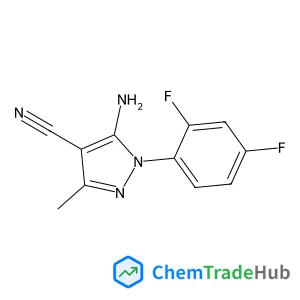
5-Amino-1-(2,4-difluorophenyl)-3-methyl-1H-pyrazole-4-carbonitrile
CAS Number:
1020057-92-4
Molecular Formula:
C11H8F2N4
Yuchun Han, Yilin Wang
Gemini surfactants are constructed by two hydrophobic chains and two polar/ionic head groups covalently connected by a spacer group at the level of the head groups. Gemini surfactants possess unique structural variations and display special aggregate transitions. Their aggregation ability and aggregate structures can be more effectively adjusted through changing their molecular structures compared with the corresponding monomeric surfactants. Moreover, gemini surfactants exhibit special and useful properties while interacting with polymers and biomacromolecules. Their strong self-aggregation ability can be applied to effectively influence the aggregation behavior of both polymers and biomacromolecules. This short review is focused on the performances of gemini surfactants in aqueous solutions investigated in the last few years, and summarizes the effects of molecular structures on aggregation behavior of gemini surfactants in aqueous solution as well as the interaction of gemini surfactants with polymers and biomacromolecules respectively.

Saudi Pharmaceutical Journal

Acta Materialia

Russian Journal of Applied Chemistry

Nature Medicine

Current Opinion in Solid State & Materials Science

New Journal of Chemistry

Russian Journal of General Chemistry

Journal of Natural Medicines

Current Opinion in Colloid & Interface Science

Journal of Saudi Chemical Society
Sergey F. Bychkov, Mikhail P. Popov, Alexander P. Nemudry
DOI: 10.1039/D0CP04856A
Elena F. Belogolova, Sergey A. Shlykov, Alexey V. Eroshin, Evgeniya P. Doronina, Valery F. Sidorkin
DOI: 10.1039/D0CP05872F
Abhishek Kumar, T. Rajagopala Rao, Rudraditya Sarkar
DOI: 10.1039/D0CP04619A
Mingzhao Liu, Zhanlan Yang, Shifu Weng, Jinguang Wu
DOI: 10.1039/D0CP04889E
Kai Li, Dong-Hui Xu, Xin Wang, Xiang-Yang Liu
DOI: 10.1039/D0CP05362G
Renan V. Viesser, Cláudio F. Tormena
DOI: 10.1039/D0CP05891B
Matthew T. O. Okenyi, Laura E. Ratcliff
DOI: 10.1039/D0CP04236F
DOI: 10.1039/D0CP06207C
Tamar L. Greaves, Karin S. Schaffarczyk McHale, Raphael F. Burkart-Radke, Jason B. Harper, Tu C. Le
DOI: 10.1039/D0CP04227G
Ethyl 4-chlorothieno[2,3-b]pyridine-5-carboxylate (CAS: 59713-58-5) can be synth...
5-Methyl-1H-indole-3-carbaldehyde (CAS: 52562-50-2) is subject to various regula...
(1,3-Dimethyl-2,4-dioxo-1,2,3,4-tetrahydro-5-pyrimidinyl)boronic acid is a white...
Waste containing Sulfocostunolide A (CAS: 1016983-51-9) should be handled with c...
When handling Murraxocin (CAS: 88478-44-8), ensure proper personal protective eq...
Formvar (CAS: 63148-64-1) is an alkyd resin characterized by a high molecular we...
(S)-4-benzyl-2-((benzyloxy)methyl)morpholine is generally safe when handled with...
Methyl 1-(5-bromo-2-pyrimidinyl)cyclopropanecarboxylate (CAS: 1447607-69-3) is p...
2-Methyl-1-phenyl-1-propanamine hydrochloride (CAS: 24290-47-9) is generally con...
3-(4-Bromophenyl)-2-methylpropanoic acid is synthesized through a multi-step pro...

Physical Chemistry Chemical Physics (PCCP) is an international journal co-owned by 19 physical chemistry and physics societies from around the world. This journal publishes original, cutting-edge research in physical chemistry, chemical physics and biophysical chemistry. To be suitable for publication in PCCP, articles must include significant innovation and/or insight into physical chemistry; this is the most important criterion that reviewers and Editors will judge against when evaluating submissions. The journal has a broad scope and welcomes contributions spanning experiment, theory, computation and data science. Topical coverage includes spectroscopy, dynamics, kinetics, statistical mechanics, thermodynamics, electrochemistry, catalysis, surface science, quantum mechanics, quantum computing and machine learning. Interdisciplinary research areas such as polymers and soft matter, materials, nanoscience, energy, surfaces/interfaces, and biophysical chemistry are welcomed if they demonstrate significant innovation and/or insight into physical chemistry. Joined experimental/theoretical studies are particularly appreciated when complementary and based on up-to-date approaches.