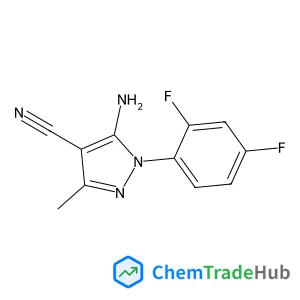
5-Amino-1-(2,4-difluorophenyl)-3-methyl-1H-pyrazole-4-carbonitrile
CAS Number:
1020057-92-4
Molecular Formula:
C11H8F2N4
Albert J. Fry
Cyclic voltammograms of several polycyclic aromatic hydrocarbons (PAH's) in highly purified N,N-dimethylformamide are known to exhibit two reversible reduction waves. To a good approximation, the potential of the first wave is independent of the nature of the supporting electrolyte, but the potential of the second wave is highly dependent upon the nature of the electrolyte. The spacing ΔE° between the first and second waves increases as the size of the cation of the electrolyte is increased from Et4N+ through Pr4N+ to Bu4N+. This is typically interpreted as due to decreasing strength of ion-pairing between the cation and the dianion of the PAH with increasing size of the electrolyte cation. However, it has been known for many years that Me4N+ exhibits anomalous behavior: even though Me4N+ is much smaller than Et4N+, ΔE° is greater with Me4N+ than with Et4N+ for anthracene and in fact greater than any of the larger electrolytes with perylene. It is now shown that this behavior arises out of the fact that Me4N+ ion is present in solution as a tetrasolvate [Me4N+/(DMF)4]. The PAH dianion (Ar−2) reacts with Me4N+/(DMF)4 to displace a molecule of DMF and produce the species Me4N+/(DMF)3/Ar−2. The computed pairing association constant Kion-pairing for the anthracene species is 35 M−1, compared with a value of 50 000 M−1 for association of the bare Me4N+ ion with the dianion; the corresponding values for perylene are computed to be 4400 and 3.5 M−1, respectively.
DOI: 10.1039/C6CP05717A
David A. Tompsett, Mayeul d'Avezac, Gregory J. Offer, Nigel P. Brandon, Nicholas M. Harrison
DOI: 10.1039/C6CP04694K
Marie Humbert-Droz, Claude Piguet, Tomasz A. Wesolowski
DOI: 10.1039/C6CP04252J
Juqiao Su, Zhongguo Zhao, Yajiang Huang, Xia Liao, Qi Yang
DOI: 10.1039/C6CP03916B
Wissam A. Saidi
DOI: 10.1039/C6CP04769F
Andrea Bianco, Giorgio Ferrari, Rossella Castagna, Andrea Rossi, Marco Carminati, Giorgio Pariani, Matteo Tommasini
DOI: 10.1039/C6CP05609A
Lu Yan
DOI: 10.1039/C6CP06536H
Carlos Cabezas, Carmen Barrientos, Antonio Largo, Jean-Claude Guillemin, J. L. Alonso
DOI: 10.1039/C6CP04474C
Diego Hunt, Gastón Garbarino, Valeria Ferrari, Matías Jobbagy, Damian A. Scherlis
DOI: 10.1039/C6CP06006D
Liujiang Zhou, Thomas Frauenheim, Li-Ming Wu
DOI: 10.1039/C6CP06332B
Ethyl 4-chlorothieno[2,3-b]pyridine-5-carboxylate (CAS: 59713-58-5) can be synth...
5-Methyl-1H-indole-3-carbaldehyde (CAS: 52562-50-2) is subject to various regula...
(1,3-Dimethyl-2,4-dioxo-1,2,3,4-tetrahydro-5-pyrimidinyl)boronic acid is a white...
Waste containing Sulfocostunolide A (CAS: 1016983-51-9) should be handled with c...
When handling Murraxocin (CAS: 88478-44-8), ensure proper personal protective eq...
Formvar (CAS: 63148-64-1) is an alkyd resin characterized by a high molecular we...
(S)-4-benzyl-2-((benzyloxy)methyl)morpholine is generally safe when handled with...
Methyl 1-(5-bromo-2-pyrimidinyl)cyclopropanecarboxylate (CAS: 1447607-69-3) is p...
2-Methyl-1-phenyl-1-propanamine hydrochloride (CAS: 24290-47-9) is generally con...
3-(4-Bromophenyl)-2-methylpropanoic acid is synthesized through a multi-step pro...

Physical Chemistry Chemical Physics (PCCP) is an international journal co-owned by 19 physical chemistry and physics societies from around the world. This journal publishes original, cutting-edge research in physical chemistry, chemical physics and biophysical chemistry. To be suitable for publication in PCCP, articles must include significant innovation and/or insight into physical chemistry; this is the most important criterion that reviewers and Editors will judge against when evaluating submissions. The journal has a broad scope and welcomes contributions spanning experiment, theory, computation and data science. Topical coverage includes spectroscopy, dynamics, kinetics, statistical mechanics, thermodynamics, electrochemistry, catalysis, surface science, quantum mechanics, quantum computing and machine learning. Interdisciplinary research areas such as polymers and soft matter, materials, nanoscience, energy, surfaces/interfaces, and biophysical chemistry are welcomed if they demonstrate significant innovation and/or insight into physical chemistry. Joined experimental/theoretical studies are particularly appreciated when complementary and based on up-to-date approaches.
![4-[(1-Methyl-1H-pyrrol-2-yl)methylene]-1,3(2H,4H)-isoquinolinedione structure](https://static.chemtradehub.com/structs/110/1104546-89-5-a600.webp "4-[(1-Methyl-1H-pyrrol-2-yl)methylene]-1,3(2H,4H)-isoquinolinedione structure")
![2-Methyl-2-propanyl 1,6-diazaspiro[3.4]octane-6-carboxylate structure](https://static.chemtradehub.com/structs/115/1158749-79-1-81ee.webp "2-Methyl-2-propanyl 1,6-diazaspiro[3.4]octane-6-carboxylate structure")