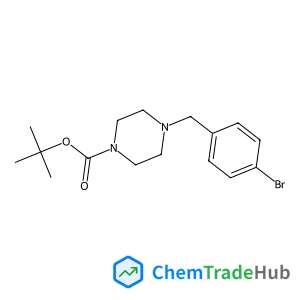
2-Methyl-2-propanyl 4-(4-bromobenzyl)-1-piperazinecarboxylate
CAS Number:
844891-10-7
Molecular Formula:
C16H23BrN2O2
Jenni Andersin, Karoliina Honkala
Catalytic groundwater remediation from chlorinated organic solvents like trichloroethene (TCE) has been found to be more effective and sustainable than traditional non-destructive methods. Among the experimentally studied catalyst materials, Pd-decorated Au nanoparticles show the highest activity and selectivity combined with the best resistance towards poisoning by chemicals present in groundwater. In this study the thermochemistry and adsorption geometries of TCE and its hydrodechlorination products are investigated via density functional theory calculations. Various model systems for Pd-supported Au nanoparticles are addressed. The adsorption of TCE is endothermic on bare Au(111), almost thermoneutral or slightly exothermic on Pd–Au surface alloys and clearly exothermic on Pd overlayer structures on Au(111). The strongest chemisorption is on the di-σ configuration between Pd atoms over the smallest 2D Pd clusters containing only a few Pd atoms. These are not, however, the best catalysts as they are too small to co-adsorb hydrogen needed for hydrodechlorination reaction. We demonstrate good correlation between adsorption energies and the d-band center of the system. The variation of adsorption energy from the one Pd–Au composition to the other can be tentatively assigned to be due to the ligand and coordination effects. Also, the ensemble effects are important; without the right ensemble the adsorption is weak or endothermic.
Xin-Long Wang, Chao Qin, En-Bo Wang, Zhong-Min Su
DOI: 10.1039/B709563E
Shan Li, Weihong Cui, Bradford B. Wayland
DOI: 10.1039/B708032H
Taisuke Morimoto, Kenji Suzuki, Motofumi Torikoshi, Tetsuro Kawahara, Hiroaki Tada
DOI: 10.1039/B705887J
Ana Galet, M. Carmen Muñoz, José Antonio Real
DOI: 10.1039/B606434E
Andrew M. Bailey, Russell J. Cox, Kate Harley, Colin M. Lazarus, Thomas J. Simpson, Elizabeth Skellam
DOI: 10.1039/B708614H
Raghu Chitta, Suresh Gadde, Francis D'Souza
DOI: 10.1039/B610171B
Laura Gómez, Anna Company, Xavier Fontrodona, Xavi Ribas, Miquel Costas
DOI: 10.1039/B707508A
Christer B. Aakeröy, John Desper, Michelle M. Smith
DOI: 10.1039/B707518A
Sarah E. Kiehna, Zachary R. Laughrey, Marcey L. Waters
DOI: 10.1039/B711431A
Waste containing 2-Ethyl-4-Methyl-1H-Imidazole-5-Carbaldehyde (CAS: 88634-80-4) ...
Triethoxy(octyl)silane (CAS: 1385031-14-0) is widely used in the pharmaceuticals...
Several alternatives to 3-iodo-7-nitro-1H-indazole (CAS: 864724-64-1) exist in t...
Yes, there are alternatives to Benzene, bis[(trimethoxysilyl)ethyl] (CAS: 266317...
Isothiazole-3-carbonitrile (CAS: 1452-17-1) is generally considered safe when us...
(3-Chlorophenyl)methanol (CAS: 873-63-2) is considered low to moderately toxic. ...
(2S,3S)-2-Hydroxy-3-({[(2-methyl-2-propanyl)oxy]carbonyl}amino)-3-(2-naphthyl)pr...
Proper handling of methyl 2-(bromomethyl)-5-methoxybenzoate requires the use of ...
6,8-Dibromoimidazo[1,2-a]pyridine-2-carboxylic acid (CAS: 904805-36-3) is an aro...
3-Amino-5-bromo-2-pyridinecarbonitrile is considered safe when handled under pro...

Physical Chemistry Chemical Physics (PCCP) is an international journal co-owned by 19 physical chemistry and physics societies from around the world. This journal publishes original, cutting-edge research in physical chemistry, chemical physics and biophysical chemistry. To be suitable for publication in PCCP, articles must include significant innovation and/or insight into physical chemistry; this is the most important criterion that reviewers and Editors will judge against when evaluating submissions. The journal has a broad scope and welcomes contributions spanning experiment, theory, computation and data science. Topical coverage includes spectroscopy, dynamics, kinetics, statistical mechanics, thermodynamics, electrochemistry, catalysis, surface science, quantum mechanics, quantum computing and machine learning. Interdisciplinary research areas such as polymers and soft matter, materials, nanoscience, energy, surfaces/interfaces, and biophysical chemistry are welcomed if they demonstrate significant innovation and/or insight into physical chemistry. Joined experimental/theoretical studies are particularly appreciated when complementary and based on up-to-date approaches.