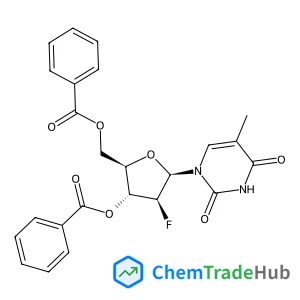
1-(3',5'-Di-O-benzoyl-2'-deoxy-2'-fluoro-b-D-arabinofuranosyl)thymine
CAS Number:
97614-47-6
Molecular Formula:
C24H21FN2O7
Masao Gohdo, Tadashi Takamasu, Masanobu Wakasa
Photo-Fries rearrangement reactions of 1-naphthyl acetate (NA) in n-hexane and in cyclohexane were studied by the magnetic field effect probe (MFE probe) under magnetic fields (B) of 0 to 7 T. Transient absorptions of the 1-naphthoxyl radical, T–T absorption of NA, and a short-lifetime intermediate (τ = 24 ns) were observed by a nanosecond laser flash photolysis technique. In n-hexane, the yield of escaped 1-naphthoxyl radicals dropped dramatically upon application of a 3 mT field, but then the yield increased with increasing B for 3 mT < B ≤ 7 T. These observed MFEs can be explained by the hyperfine coupling and the Δg mechanisms through the singlet radical pair. The fact that MFEs were observed for the present photo-Fries rearrangement reaction indicates the presence of a singlet radical pair intermediate with a lifetime as long as several tens of nanoseconds.
Ke Chen, Liurong Shi
DOI: 10.1039/C7CS00852J
Yufu Tang, Hao Chen, Si Chen, Lei Zhang, Ao Zhang, Quli Fan, Aixi Yu, Zhen Cheng
DOI: 10.1039/C8SC00206A
Yijun Yang, Dai-Ming Tang, Chao Zhang, Yihui Zhang, Qifeng Liang, Shimou Chen, Qunhong Weng, Min Zhou, Yanming Xue, Jiangwei Liu, Jinghua Wu, Qiu Hong Cui, Chao Lian, Guolin Hou, Fangli Yuan, Xi Wang
DOI: 10.1039/C7EE00329C
Xiao-Yao Dao, Jin-Han Guo, Xiao-Yu Zhang, Shi-Qing Wang, Xiao-Mei Cheng, Wei-Yin Sun
DOI: 10.1039/D0TA10278D
Andrea Marcucci, Francesca Zurlo, Isabella Natali Sora, Stefano Casciardi, Silvia Licoccia, Elisabetta Di Bartolomeo
DOI: 10.1039/C8TA10645B
Liat Avram, Yoram Cohen
DOI: 10.1039/C4CS00197D
Lahcene Maachou, Kun Qi, Eddy Petit, Zhaodan Qin, Yang Zhang, Didier Cot, Valérie Flaud, Corine Reibel, Heba El-Maghrbi, Lei Li, Philippe Miele, Daniel Kaplan, Manish Chhowalla, Nicolas Onofrio, Damien Voiry
DOI: 10.1039/D0TA09045J
Gangjian Tan, Fengyuan Shi, Jeff W. Doak, Hui Sun, Li-Dong Zhao, Pengli Wang, Ctirad Uher, Chris Wolverton, Vinayak P. Dravid
DOI: 10.1039/C4EE01463D
Vladislav G. Konstantinov, Dmitry Yu. Paraschuk
DOI: 10.1039/C6CE02565J
(5-Sulfamoyl-3-pyridinyl)boronic acid is primarily used in chemical synthesis, p...
Benzyl 2-methyl-2-(methylsulfonyl)-4-pentenoate is typically synthesized via est...
When handling 8-Fluoroquinolin-6-ol (CAS: 209353-22-0), it is important to use p...
1,3-Dibromo-5-(2-methyl-2-propanyl)benzene (CAS: 129316-09-2) is a crystalline c...
Ethyl 7-chloro-4-oxo-1-(1,3-thiazol-2-yl)-1,4-dihydro-1,8-naphthyridine-3-carbox...
When handling Delta-7-Avenasterol (CAS: 23290-26-8), it is important to wear app...
Proper handling involves the use of personal protective equipment such as gloves...
When handling 2-Methyl-2-proanyl 4-[(2-aminophenyl)amino]-1-piperidinecarboxylat...
N-Methyl-4-chlorobenzylamine hydrochloride (CAS: 65542-24-7) is a organic compou...
[2-(Dodecyloxy)ethoxy]acetic acid (CAS: 27306-90-7) is generally considered safe...

Physical Chemistry Chemical Physics (PCCP) is an international journal co-owned by 19 physical chemistry and physics societies from around the world. This journal publishes original, cutting-edge research in physical chemistry, chemical physics and biophysical chemistry. To be suitable for publication in PCCP, articles must include significant innovation and/or insight into physical chemistry; this is the most important criterion that reviewers and Editors will judge against when evaluating submissions. The journal has a broad scope and welcomes contributions spanning experiment, theory, computation and data science. Topical coverage includes spectroscopy, dynamics, kinetics, statistical mechanics, thermodynamics, electrochemistry, catalysis, surface science, quantum mechanics, quantum computing and machine learning. Interdisciplinary research areas such as polymers and soft matter, materials, nanoscience, energy, surfaces/interfaces, and biophysical chemistry are welcomed if they demonstrate significant innovation and/or insight into physical chemistry. Joined experimental/theoretical studies are particularly appreciated when complementary and based on up-to-date approaches.