












Biomimetic electro-oxidation of alkyl sulfides from exfoliated molybdenum disulfide nanosheets
Literature Information
Publication Date
2020-11-10
DOI
10.1039/D0TA09045J
Impact Factor
12.732
Authors
Lahcene Maachou, Kun Qi, Eddy Petit, Zhaodan Qin, Yang Zhang, Didier Cot, Valérie Flaud, Corine Reibel, Heba El-Maghrbi, Lei Li, Philippe Miele, Daniel Kaplan, Manish Chhowalla, Nicolas Onofrio, Damien Voiry
View Original
Abstract
Enzymes are biological catalysts that are interesting for key reactions such as hydrogen evolution, CO2 conversion into hydrocarbons and the fixation of nitrogen. Enzymes are particularly good catalysts for organic reactions because of their high selectivity. However, they exhibit modest stability and require extensive purification, which makes them costly. Here, we report a biomimetic electroactive two-dimensional (2D) catalyst based on single-layer metallic MoS2 nanosheets for the oxidation of alkyl and aryl sulfides. The structure of the MoS2 nanosheets mimics the active site of natural dimethyl sulfoxide (DMSO) reductase found in anaerobic bacteria. We demonstrate that 2D MoS2 nanosheets efficiently oxidize organic sulfides. Notably, we show that dimethyl sulfide can be electro-oxidized to DMSO with activity surpassing that of noble metal catalysts. The production of DMSO using metallic 1T′ phase MoS2 reaches 680 L per h per gram at 1500 mV vs. NHE – ∼4 times higher than platinum nanoparticles – and is stable for >24 hours. Our findings provide new directions for electrosynthesis from metallic 2D materials.
Related Literature
Atomic structure of biodegradable Mg-based bulk metallic glass
2015-04-15
Paper
DOI: 10.1039/C4CP03714F
To π or not to π – how does methanol dock onto anisole?
Matthias Heger, Jonas Altnöder, Anja Poblotzki, Martin A. Suhm
2015-04-27
Paper
DOI: 10.1039/C5CP01545F
Nonseparable exchange–correlation functional for molecules, including homogeneous catalysis involving transition metals
Haoyu S. Yu, Pragya Verma, Donald G. Truhlar
2015-04-09
Paper
DOI: 10.1039/C5CP01425E
Identifying and tracing potential energy surfaces of electronic excitations with specific character via their transition origins: application to oxirane
Jian-Hao Li, T. J. Zuehlsdorff, M. C. Payne, N. D. M. Hine
2015-04-01
Paper
DOI: 10.1039/C5CP01018G
A systematic study of metal-supported boron nitride materials for the oxygen reduction reaction
Ralph Koitz
2015-04-17
Paper
DOI: 10.1039/C5CP01384D
Self-assembly and coverage dependent thermally induced conformational changes of Ni(ii)-meso-tetrakis (4-tert-butylphenyl) benzoporphyrin on Cu(111)
2015-04-20
Paper
DOI: 10.1039/C5CP01490E
Composition-dependent buckling behaviour of hybrid boron nitride–carbon nanotubes
Jin Zhang, S. A. Meguid
2015-04-17
Paper
DOI: 10.1039/C5CP00914F
Three-dimensional sp2-hybridized carbons consisting of orthogonal nanoribbons of graphene and net C
Meng Hu, Xu Dong, Bingchao Yang, Bo Xu, Dongli Yu, Julong He
2015-04-16
Paper
DOI: 10.1039/C5CP01621E
The histone H3 N-terminal tail: a computational analysis of the free energy landscape and kinetics
Yuqing Zheng
2015-04-24
Paper
DOI: 10.1039/C5CP01858G
Bringing light into the dark triplet space of molecular systems
Jing Ge, Zhigang Geng, Shenlong Jiang, Kaili Fan, Zhenkun Guo, Jiahua Hu, Zongwei Chen
2015-04-20
Paper
DOI: 10.1039/C5CP00323G
You might also like
Compound Q&A
What are the main uses of (5-Sulfamoyl-3-pyridinyl)boronic acid (CAS: 951233-61-7)?
(5-Sulfamoyl-3-pyridinyl)boronic acid is primarily used in chemical synthesis, p...
951233-61-7(5-Sulfamoyl-3-pyrid...
Compound Q&A
How is Benzyl 2-methyl-2-(methylsulfonyl)-4-pentenoate (CAS: 1942858-50-5) typically synthesized?
Benzyl 2-methyl-2-(methylsulfonyl)-4-pentenoate is typically synthesized via est...
1942858-50-5Benzyl 2-methyl-2-(m...
Compound Q&A
What precautions should be taken when handling 8-Fluoroquinolin-6-ol (CAS: 209353-22-0)?
When handling 8-Fluoroquinolin-6-ol (CAS: 209353-22-0), it is important to use p...
209353-22-08-Fluoroquinolin-6-o...
Compound Q&A
What are the physical and chemical properties of 1,3-Dibromo-5-(2-methyl-2-propanyl)benzene (CAS: 129316-09-2)?
1,3-Dibromo-5-(2-methyl-2-propanyl)benzene (CAS: 129316-09-2) is a crystalline c...
129316-09-21,3-Dibromo-5-(2-met...
Compound Q&A
What industries use Ethyl 7-chloro-4-oxo-1-(1,3-thiazol-2-yl)-1,4-dihydro-1,8-naphthyridine-3-carboxylate (CAS: 174726-87-5)?
Ethyl 7-chloro-4-oxo-1-(1,3-thiazol-2-yl)-1,4-dihydro-1,8-naphthyridine-3-carbox...
174726-87-5Ethyl 7-chloro-4-oxo...
Compound Q&A
What precautions should be taken when handling Delta-7-Avenasterol (CAS: 23290-26-8)?
When handling Delta-7-Avenasterol (CAS: 23290-26-8), it is important to wear app...
23290-26-8Delta-7-Avenasterol
Compound Q&A
What precautions should be taken when handling N-({(5R)-3-[3-Fluoro-4-(4-morpholinyl)phenyl]-2-oxo-1,3-oxazolidin-5-yl}methyl)acetamide (CAS: 872992-20-6)?
Proper handling involves the use of personal protective equipment such as gloves...
872992-20-6N-({(5R)-3-[3-Fluoro...
Compound Q&A
What precautions should be taken when handling 2-Methyl-2-proanyl 4-[(2-aminophenyl)amino]-1-piperidinecarboxylate (CAS: 79099-00-6)?
When handling 2-Methyl-2-proanyl 4-[(2-aminophenyl)amino]-1-piperidinecarboxylat...
79099-00-62-Methyl-2-propanyl ...
Compound Q&A
What is N-Methyl-4-chlorobenzylamine hydrochloride (CAS: 65542-24-7)?
N-Methyl-4-chlorobenzylamine hydrochloride (CAS: 65542-24-7) is a organic compou...
65542-24-7N-Methyl-4-chloroben...
Compound Q&A
Is [2-(Dodecyloxy)ethoxy]acetic acid (CAS: 27306-90-7) safe?
[2-(Dodecyloxy)ethoxy]acetic acid (CAS: 27306-90-7) is generally considered safe...
27306-90-7[2-(Dodecyloxy)ethox...
Source Journal
Journal of Materials Chemistry A

CiteScore:
19.5
Self-citation Rate:
4.7%
Articles per Year:
2211
Journal of Materials Chemistry A, B & C cover high quality studies across all fields of materials chemistry. The journals focus on those theoretical or experimental studies that report new understanding, applications, properties and synthesis of materials. The journals have a strong history of publishing quality reports of interest to interdisciplinary communities and providing an efficient and rigorous service through peer review and publication. The journals are led by an international team of Editors-in-Chief and Associate Editors who are all active researchers in their fields. Journal of Materials Chemistry A, B & C are separated by the intended application of the material studied. Broadly, applications in energy and sustainability are of interest to Journal of Materials Chemistry A, applications in biology and medicine are of interest to Journal of Materials Chemistry B, and applications in optical, magnetic and electronic devices are of interest to Journal of Materials Chemistry C. More than one Journal of Materials Chemistry journal may be suitable for certain fields and researchers are encouraged to submit their paper to the journal that they feel best fits for their particular article. Example topic areas within the scope of Journal of Materials Chemistry A are listed below. This list is neither exhaustive nor exclusive. Artificial photosynthesis Batteries Carbon dioxide conversion Catalysis Fuel cells Gas capture/separation/storage Green/sustainable materials Hydrogen generation Hydrogen storage Photocatalysis Photovoltaics Self-cleaning materials Self-healing materials Sensors Supercapacitors Thermoelectrics Water splitting Water treatment
Recommended Compounds
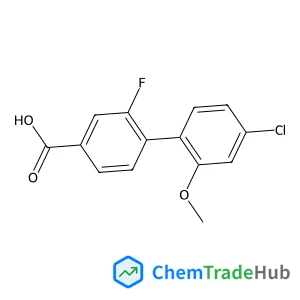
4-(4-Chloro-2-methoxyphenyl)-3-fluorobenzoic acid
CAS Number:
1261970-23-3
Molecular Formula:
C14H10ClFO3
Recommended Suppliers





Disclaimer
This page provides academic journal information for reference and research purposes only. We are not affiliated with any journal publishers and do not handle publication submissions. For publication-related inquiries, please contact the respective journal publishers directly.
If you notice any inaccuracies in the information displayed, please contact us at support@chemtradehub.com. We will promptly review and address your concerns.