












Structure-dependent iron-based metal–organic frameworks for selective CO2-to-CH4 photocatalytic reduction
Literature Information
Publication Date
2020-11-13
DOI
10.1039/D0TA10278D
Impact Factor
12.732
Authors
Xiao-Yao Dao, Jin-Han Guo, Xiao-Yu Zhang, Shi-Qing Wang, Xiao-Mei Cheng, Wei-Yin Sun
View Original
Abstract
Visible-light driven reduction of carbon dioxide (CO2) to methane (CH4) is a challenge in the photocatalytic reaction system. Herein, two Fe-based metal–organic frameworks (MOFs) MIL-100(Fe) and MIL-101(Fe) with single-trimetallic clusters but distinct organic ligands were employed to explore the structure-dependent CO2 conversion performance. Compared with MIL-101(Fe), MIL-100(Fe) exhibits superior catalytic activity and selectivity for CH4 generation under visible-light irradiation via a solvent-free route. This is the first report that MIL-100(Fe) finishes the photoreduction of CO2 into CH4. Importantly, the plausible conversion pathways of the reaction were given by density functional theory (DFT) calculations. This work furnishes new direction for constructing MOFs to achieve CO2-to-CH4 conversion.
Related Literature
The histone H3 N-terminal tail: a computational analysis of the free energy landscape and kinetics
Yuqing Zheng
2015-04-24
Paper
DOI: 10.1039/C5CP01858G
Bringing light into the dark triplet space of molecular systems
Jing Ge, Zhigang Geng, Shenlong Jiang, Kaili Fan, Zhenkun Guo, Jiahua Hu, Zongwei Chen
2015-04-20
Paper
DOI: 10.1039/C5CP00323G
Using lithium carbonate-based electron injection structures in high-performance inverted organic light-emitting diodes
Chih-Hao Chang, Ming-Kuan Hsu, Szu-Wei Wu, Mei-Hsin Chen, Hung-Hsuan Lin, Chia-Shou Li, Tun-Wen Pi, Hsin-Hua Chang, Nien-Po Chen
2015-04-16
Paper
DOI: 10.1039/C5CP01692D
Experimental determination of the rate of V–V collisional relaxation in 14N2 in its ground (X1Σg+) electronic state between 77 and 300 K
R. Z. Martínez, D. Bermejo
2015-04-23
Paper
DOI: 10.1039/C5CP01264C
Realization of a p–n junction in a single layer boron-phosphide
Deniz Çakır, Deniz Kecik, Hasan Sahin, Engin Durgun, Francois M. Peeters
2015-04-16
Paper
DOI: 10.1039/C5CP00414D
Investigation of thermal evolution of copper nanoclusters encapsulated in carbon nanotubes: a molecular dynamics study
Hamed Akbarzadeh, Mohsen Abbaspour, Sirous Salemi, Mousareza Abroodi
2015-04-16
Paper
DOI: 10.1039/C5CP01294E
A study of the mechanism of fluoride adsorption from aqueous solutions onto Fe-impregnated chitosan
Jing Zhang, Nan Chen, Zheng Tang, Yang Yu, Qili Hu, Chuanping Feng
2015-04-02
Paper
DOI: 10.1039/C5CP00817D
In silico prediction of MOFs with high deliverable capacity or internal surface area
Yi Bao, Richard L. Martin, Maciej Haranczyk
2015-02-19
Paper
DOI: 10.1039/C5CP00002E
A new diluted magnetic semiconductor based on the expanded phase of ZnS: surmounting the random distribution of magnetic impurities
Xinqiang Wang, Hengjiang Zhu
2015-04-17
Paper
DOI: 10.1039/C4CP05739B
Spectral dependence of nonlinear optical properties of symmetrical octatetraynes with p-substituted phenyl end-groups
Agata Arendt, Marek Samoc, Sławomir Szafert
2015-04-20
Paper
DOI: 10.1039/C5CP01661D
You might also like
Compound Q&A
What are the main uses of (5-Sulfamoyl-3-pyridinyl)boronic acid (CAS: 951233-61-7)?
(5-Sulfamoyl-3-pyridinyl)boronic acid is primarily used in chemical synthesis, p...
951233-61-7(5-Sulfamoyl-3-pyrid...
Compound Q&A
How is Benzyl 2-methyl-2-(methylsulfonyl)-4-pentenoate (CAS: 1942858-50-5) typically synthesized?
Benzyl 2-methyl-2-(methylsulfonyl)-4-pentenoate is typically synthesized via est...
1942858-50-5Benzyl 2-methyl-2-(m...
Compound Q&A
What precautions should be taken when handling 8-Fluoroquinolin-6-ol (CAS: 209353-22-0)?
When handling 8-Fluoroquinolin-6-ol (CAS: 209353-22-0), it is important to use p...
209353-22-08-Fluoroquinolin-6-o...
Compound Q&A
What are the physical and chemical properties of 1,3-Dibromo-5-(2-methyl-2-propanyl)benzene (CAS: 129316-09-2)?
1,3-Dibromo-5-(2-methyl-2-propanyl)benzene (CAS: 129316-09-2) is a crystalline c...
129316-09-21,3-Dibromo-5-(2-met...
Compound Q&A
What industries use Ethyl 7-chloro-4-oxo-1-(1,3-thiazol-2-yl)-1,4-dihydro-1,8-naphthyridine-3-carboxylate (CAS: 174726-87-5)?
Ethyl 7-chloro-4-oxo-1-(1,3-thiazol-2-yl)-1,4-dihydro-1,8-naphthyridine-3-carbox...
174726-87-5Ethyl 7-chloro-4-oxo...
Compound Q&A
What precautions should be taken when handling Delta-7-Avenasterol (CAS: 23290-26-8)?
When handling Delta-7-Avenasterol (CAS: 23290-26-8), it is important to wear app...
23290-26-8Delta-7-Avenasterol
Compound Q&A
What precautions should be taken when handling N-({(5R)-3-[3-Fluoro-4-(4-morpholinyl)phenyl]-2-oxo-1,3-oxazolidin-5-yl}methyl)acetamide (CAS: 872992-20-6)?
Proper handling involves the use of personal protective equipment such as gloves...
872992-20-6N-({(5R)-3-[3-Fluoro...
Compound Q&A
What precautions should be taken when handling 2-Methyl-2-proanyl 4-[(2-aminophenyl)amino]-1-piperidinecarboxylate (CAS: 79099-00-6)?
When handling 2-Methyl-2-proanyl 4-[(2-aminophenyl)amino]-1-piperidinecarboxylat...
79099-00-62-Methyl-2-propanyl ...
Compound Q&A
What is N-Methyl-4-chlorobenzylamine hydrochloride (CAS: 65542-24-7)?
N-Methyl-4-chlorobenzylamine hydrochloride (CAS: 65542-24-7) is a organic compou...
65542-24-7N-Methyl-4-chloroben...
Compound Q&A
Is [2-(Dodecyloxy)ethoxy]acetic acid (CAS: 27306-90-7) safe?
[2-(Dodecyloxy)ethoxy]acetic acid (CAS: 27306-90-7) is generally considered safe...
27306-90-7[2-(Dodecyloxy)ethox...
Source Journal
Journal of Materials Chemistry A

CiteScore:
19.5
Self-citation Rate:
4.7%
Articles per Year:
2211
Journal of Materials Chemistry A, B & C cover high quality studies across all fields of materials chemistry. The journals focus on those theoretical or experimental studies that report new understanding, applications, properties and synthesis of materials. The journals have a strong history of publishing quality reports of interest to interdisciplinary communities and providing an efficient and rigorous service through peer review and publication. The journals are led by an international team of Editors-in-Chief and Associate Editors who are all active researchers in their fields. Journal of Materials Chemistry A, B & C are separated by the intended application of the material studied. Broadly, applications in energy and sustainability are of interest to Journal of Materials Chemistry A, applications in biology and medicine are of interest to Journal of Materials Chemistry B, and applications in optical, magnetic and electronic devices are of interest to Journal of Materials Chemistry C. More than one Journal of Materials Chemistry journal may be suitable for certain fields and researchers are encouraged to submit their paper to the journal that they feel best fits for their particular article. Example topic areas within the scope of Journal of Materials Chemistry A are listed below. This list is neither exhaustive nor exclusive. Artificial photosynthesis Batteries Carbon dioxide conversion Catalysis Fuel cells Gas capture/separation/storage Green/sustainable materials Hydrogen generation Hydrogen storage Photocatalysis Photovoltaics Self-cleaning materials Self-healing materials Sensors Supercapacitors Thermoelectrics Water splitting Water treatment
Recommended Compounds
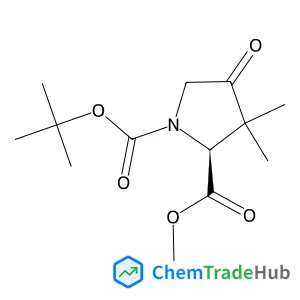
2-Methyl 1-(2-methyl-2-propanyl) (2S)-3,3-dimethyl-4-oxo-1,2-pyrrolidinedicarboxylate
CAS Number:
478698-30-5
Molecular Formula:
C13H21NO5

Recommended Suppliers





Disclaimer
This page provides academic journal information for reference and research purposes only. We are not affiliated with any journal publishers and do not handle publication submissions. For publication-related inquiries, please contact the respective journal publishers directly.
If you notice any inaccuracies in the information displayed, please contact us at support@chemtradehub.com. We will promptly review and address your concerns.