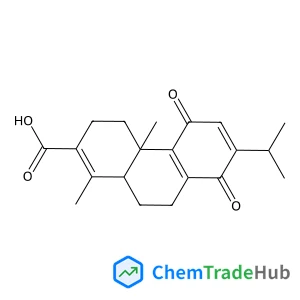
(4aS,10aS)-7-Isopropyl-1,4a-dimethyl-5,8-dioxo-3,4,4a,5,8,9,10,10a-octahydro-2-phenanthrenecarboxylic acid
CAS Number:
142950-86-5
Molecular Formula:
C20H24O4
Galina Krylova, Arnaud Brioude, Soraya Ababou-Girard, Jan Mrazek, Lubomir Spanhel
The additive free heteronucleation and nanocrystallization of ternary ZnxTiyOz sols and coatings is presented. A proper adjustment of the Zn/Ti ratio in the sol allows the formation of elaborate superhydrophilic cubic spinel-like Zn2TiO4, c-ZnTiO3 or h-ZnTiO3-ilmentite/r-TiO2-rutile films. Their morphology and natural superhydrophilicity can be fine-tuned by the inclusion of 5% silica. This doping step delivers high dye intake capacities and water contact angle values below 3°. XPS analysis indicates that Zn and Si enrichment enables greater surface hydroxylation and thus improved water wetting behaviour. The transparent h-ZnTiO3-ilmenite/r-TiO2 nanocomposite coatings deposited on glass and Si-wafers show a remarkable activity in the photomineralization of fatty-acids.
Pingping Liang, Xiaochen Dong
DOI: 10.1039/C8SC04123G
Sachin Kumar, Ghuzanfar Saeed, Nam Hoon Kim
DOI: 10.1039/C8TA00889B
Vladislav G. Konstantinov, Dmitry Yu. Paraschuk
DOI: 10.1039/C6CE02565J
Xiaoli Xu, Lingbo Xiao, Yanmin Jia, Zheng Wu, Feifei Wang, Yaojin Wang, Neale O. Haugen, Haitao Huang
DOI: 10.1039/C8EE01016A
Xiao-Yao Dao, Jin-Han Guo, Xiao-Yu Zhang, Shi-Qing Wang, Xiao-Mei Cheng, Wei-Yin Sun
DOI: 10.1039/D0TA10278D
Ruiyi Wang, Xianmo Gu, Xuebin Ke, Jianfeng Jia
DOI: 10.1039/D1GC00325A
Jungho Jae, Geoffrey A. Tompsett, Yu-Chuan Lin, Torren R. Carlson, Jiacheng Shen, Taiying Zhang, Bin Yang, Charles E. Wyman, W. Curtis Conner, George W. Huber
DOI: 10.1039/B924621P
Byeong Geun Kim, Byung-Sung Kim, Dongmok Whang, Heon-Jin Choi, Soon-Mok Choi, Won-Seon Seo, Seong-Min Jeong
DOI: 10.1039/C5CE00974J
Shougo Higashi, Takashi Tachikawa, Keiichiro Oh-ishi, Keisuke Shigetoh, Kensuke Takechi, Atsushi Beniya
DOI: 10.1039/D0TA07707K
Yijun Yang, Dai-Ming Tang, Chao Zhang, Yihui Zhang, Qifeng Liang, Shimou Chen, Qunhong Weng, Min Zhou, Yanming Xue, Jiangwei Liu, Jinghua Wu, Qiu Hong Cui, Chao Lian, Guolin Hou, Fangli Yuan, Xi Wang
DOI: 10.1039/C7EE00329C
(5-Sulfamoyl-3-pyridinyl)boronic acid is primarily used in chemical synthesis, p...
Benzyl 2-methyl-2-(methylsulfonyl)-4-pentenoate is typically synthesized via est...
When handling 8-Fluoroquinolin-6-ol (CAS: 209353-22-0), it is important to use p...
1,3-Dibromo-5-(2-methyl-2-propanyl)benzene (CAS: 129316-09-2) is a crystalline c...
Ethyl 7-chloro-4-oxo-1-(1,3-thiazol-2-yl)-1,4-dihydro-1,8-naphthyridine-3-carbox...
When handling Delta-7-Avenasterol (CAS: 23290-26-8), it is important to wear app...
Proper handling involves the use of personal protective equipment such as gloves...
When handling 2-Methyl-2-proanyl 4-[(2-aminophenyl)amino]-1-piperidinecarboxylat...
N-Methyl-4-chlorobenzylamine hydrochloride (CAS: 65542-24-7) is a organic compou...
[2-(Dodecyloxy)ethoxy]acetic acid (CAS: 27306-90-7) is generally considered safe...

Physical Chemistry Chemical Physics (PCCP) is an international journal co-owned by 19 physical chemistry and physics societies from around the world. This journal publishes original, cutting-edge research in physical chemistry, chemical physics and biophysical chemistry. To be suitable for publication in PCCP, articles must include significant innovation and/or insight into physical chemistry; this is the most important criterion that reviewers and Editors will judge against when evaluating submissions. The journal has a broad scope and welcomes contributions spanning experiment, theory, computation and data science. Topical coverage includes spectroscopy, dynamics, kinetics, statistical mechanics, thermodynamics, electrochemistry, catalysis, surface science, quantum mechanics, quantum computing and machine learning. Interdisciplinary research areas such as polymers and soft matter, materials, nanoscience, energy, surfaces/interfaces, and biophysical chemistry are welcomed if they demonstrate significant innovation and/or insight into physical chemistry. Joined experimental/theoretical studies are particularly appreciated when complementary and based on up-to-date approaches.