












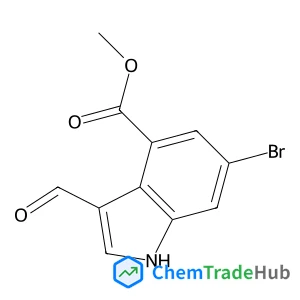
methyl 6-bromo-3-formyl-1H-indole-4-carboxylate
CAS Number:
1353636-63-1
Molecular Formula:
C11H8BrNO3
Jungho Jae, Geoffrey A. Tompsett, Yu-Chuan Lin, Torren R. Carlson, Jiacheng Shen, Taiying Zhang, Bin Yang, Charles E. Wyman, W. Curtis Conner, George W. Huber
In this paper we study the carbon efficiency of combining hydrolysis and pyrolysis processes using maple wood as a feedstock. A two-step hydrolysis of maple wood in batch reactors, that consisted of a thermochemical pretreatment in water followed by enzymatic hydrolysis, achieved an 88.7 wt% yield of glucose and an 85 wt% yield of xylose as liquid streams. The residue obtained was 80 wt% lignin. A combination of TGA and pyroprobe studies was used for the pyrolysis of pure maple wood, hemicellulose-extracted maple wood, and the lignin residue from the hydrolysis of maple wood. Pyrolysis of raw maple wood produced 67 wt% of condensable liquid products (or bio-oils) that were a mixture of compounds including sugars, water, phenolics, aldehydes, and acids. Pyrolysis of hemicellulose-extracted maple wood (the solid product after pretreatment of maple wood) showed similar bio-oil yields and compositions to raw maple wood while pyrolysis of the lignin residue (the final solid product of enzymatic hydrolysis) produced only 44.8 wt% of bio-oil. The bio-oil from the lignin residue is mostly composed of phenolics such as guaiacol and syringol compounds. Catalytic fast pyrolysis (CFP) of maple wood, hemicellulose-extracted maple wood, and lignin residue produced 18.8, 16.6 and 10.1 wt% aromatic products, respectively. Three possible options for the integration of hydrolysis with pyrolysis processes were evaluated based on their material and carbon balances: Option 1 was the pyrolysis/CFP of raw maple wood, option 2 combined hemicellulose extraction by hydrolysis with pyrolysis/CFP of hemicellulose-extracted maple wood, and option 3 combined the two-step hydrolysis of hemicellulose and cellulose sugar extraction with pyrolysis/CFP of the lignin residue. It was found that options 1, 2, and 3 all have similar overall carbon yields for sugars and bio-oils of between 66 and 67%.
M. Kazemi, D. Biria, H. Rismani-Yazdi
DOI: 10.1039/C5CP00904A
Yi Bao, Richard L. Martin, Maciej Haranczyk
DOI: 10.1039/C5CP00002E
P. Alarcón, B. Bohn
DOI: 10.1039/C5CP00253B
A. D. Godbeer, J. S. Al-Khalili, P. D. Stevenson
DOI: 10.1039/C5CP00472A
Na Li, Xiaoyu Zhang, Shulong Yuan, Xiaokai Zhang, Yuzhen Yuan, Xue Li
DOI: 10.1039/C4CP06093H
DOI: 10.1039/C5CP01490E
Qing-Yun Xiang, Yu Wang, Shi-Yu Li, Lan-Hua Wang, Li-Bin Mo, Wen-Qing Yao, Li Zhang
DOI: 10.1039/C5CP00878F
Bo Cai, Shengli Zhang, Ziyu Hu, Yonghong Hu, Yousheng Zou, Haibo Zeng
DOI: 10.1039/C5CP00563A
Chao-Feng Wu, Tian-Ran Wei, Jing-Feng Li
DOI: 10.1039/C4CP06021K
Changzeng Fan, Jian Li
DOI: 10.1039/C5CP00001G
(5-Sulfamoyl-3-pyridinyl)boronic acid is primarily used in chemical synthesis, p...
Benzyl 2-methyl-2-(methylsulfonyl)-4-pentenoate is typically synthesized via est...
When handling 8-Fluoroquinolin-6-ol (CAS: 209353-22-0), it is important to use p...
1,3-Dibromo-5-(2-methyl-2-propanyl)benzene (CAS: 129316-09-2) is a crystalline c...
Ethyl 7-chloro-4-oxo-1-(1,3-thiazol-2-yl)-1,4-dihydro-1,8-naphthyridine-3-carbox...
When handling Delta-7-Avenasterol (CAS: 23290-26-8), it is important to wear app...
Proper handling involves the use of personal protective equipment such as gloves...
When handling 2-Methyl-2-proanyl 4-[(2-aminophenyl)amino]-1-piperidinecarboxylat...
N-Methyl-4-chlorobenzylamine hydrochloride (CAS: 65542-24-7) is a organic compou...
[2-(Dodecyloxy)ethoxy]acetic acid (CAS: 27306-90-7) is generally considered safe...

Energy & Environmental Science is an international journal dedicated to publishing exceptionally important and high quality, agenda-setting research tackling the key global and societal challenges of ensuring the provision of energy and protecting our environment for the future. The scope is intentionally broad and the journal recognises the complexity of issues and challenges relating to energy conversion and storage, alternative fuel technologies and environmental science. For work to be published it must be linked to the energy-environment nexus and be of significant general interest to our community-spanning readership. All scales of studies and analysis, from impactful fundamental advances, to interdisciplinary research across the (bio)chemical, (bio/geo)physical sciences and chemical engineering disciplines are welcomed. Topics include, but are not limited to, the following: Solar energy conversion and photovoltaics Solar fuels and artificial photosynthesis Fuel cells Hydrogen storage and (bio) hydrogen production Materials for energy systems Capture, storage and fate of CO2, including chemicals and fuels from CO2 Catalysis for a variety of feedstocks (for example, oil, gas, coal, biomass and synthesis gas) Biofuels and biorefineries Materials in extreme environments Environmental impacts of energy technologies Global atmospheric chemistry and climate change as related to energy systems Water-energy nexus Energy systems and networks Globally applicable principles of energy policy and techno-economics
![Ethanone, 1-[4-chloro-2-(methylthio)-5-pyrimidinyl]- structure](https://static.chemtradehub.com/structs/661/66116-82-3-863e.webp "Ethanone, 1-[4-chloro-2-(methylthio)-5-pyrimidinyl]- structure")



