











![4,4'-[2,5-Biphenyldiylbis(oxy)]dianiline structure](https://static.chemtradehub.com/structs/941/94148-67-1-24c6.webp "4,4'-[2,5-Biphenyldiylbis(oxy)]dianiline structure")
Formation and structure of the potassium complex of valinomycin in solution studied by Raman optical activityspectroscopy
Literature Information
Publication Date
2010-07-28
DOI
10.1039/C003277H
Impact Factor
3.676
Authors
Michal Straka, Hitoshi Watarai, Petr Bouř
View Original
Abstract
The formation and structure of the potassium complex with valinomycin in solution were studied by means of Raman and Raman optical activity (ROA) spectroscopy. The complexation caused significant spectral changes, particularly in the region 1200–1400 cm−1. The experimental spectra were interpreted using first principles computations. A complete computational conformational search combined with the spectral analysis revealed the arrangement of the isopropyl side chains in the complex. From a total of 6579 unique conformers two predominant ones were confirmed in the solution by ROA. A third one was predicted theoretically, but its population in the experiment could be estimated only roughly. The most populated conformer does not exhibit C3 symmetry, and is different from that present in the crystal and the NMR-derived structure. Molecular dynamics techniques were used to estimate the molecular flexibility and its effect on the spectra. Density functional computations and Cartesian coordinate transfer (CCT) techniques provided the ROA and Raman spectral shapes and intensities well comparable with the experiment. The polar solvent (methanol) environment modeled with a polarizable continuum model (PCM) leads to rather minor changes in the conformer populations and vibrational properties as compared to vacuum computations, due to the hydrophobic character of the complex. Additional computational experiments suggest that the vibrational interactions determining the ROA spectra are quite local, which contributes to the good spatial resolution of the method. A reduction of the noise in the experimental spectra as well as increased precision of the simulations is desirable for the further exploration of the potential of the ROA spectroscopy for biomolecular studies in the future.
Recommended Journals
Related Literature
Efficient stabilization of copper(iii) in tetraaza pseudo-macrocyclic oxime-and-hydrazideligands with adjustable cavity size
Igor O. Fritsky, Henryk Kozłowski, Olga M. Kanderal, Matti Haukka, Jolanta Świątek-Kozłowska, Elżbieta Gumienna-Kontecka, Franc Meyer
2006-08-22
Communication
DOI: 10.1039/B608236J
Insertion of benzyl isocyanide into a Zr–P bond and rearrangement. Atom-economical synthesis of a phosphaalkene
Samantha N. MacMillan, Joseph M. Tanski, Rory Waterman
2007-08-07
Communication
DOI: 10.1039/B709506F
Biosensing with polydiacetylene materials: structures, optical properties and applications
Mary A. Reppy, Bradford A. Pindzola
2007-07-11
Feature Article
DOI: 10.1039/B703691D
Characterisation of 3-methylorcinaldehyde synthase (MOS) in Acremonium strictum: first observation of a reductive release mechanism during polyketide biosynthesis
Andrew M. Bailey, Russell J. Cox, Kate Harley, Colin M. Lazarus, Thomas J. Simpson, Elizabeth Skellam
2007-07-25
Communication
DOI: 10.1039/B708614H
An unusual polyoxometalate-encapsulating 3D polyrotaxane framework formed by molecular squares threading on a twofold interpenetrated diamondoid skeleton
Xin-Long Wang, Chao Qin, En-Bo Wang, Zhong-Min Su
2007-08-08
Communication
DOI: 10.1039/B709563E
The structure of nanotubes formed by diphenylalanine, the core recognition motif of Alzheimer's β-amyloid polypeptide
Carl Henrik Görbitz
2006-04-13
Communication
DOI: 10.1039/B603080G
Exceptional performance of sulfonic acid-incorporated-MCM-41 mesoporous materials prepared using a silane containing polysulfide linkages in the acetylation of anisole
OZoon Kwon, SeMin Park, Gon Seo
2007-08-02
Communication
DOI: 10.1039/B708770E
Large fullerenes stabilized by encapsulation of metallic clusters
Ramón Valencia, Antonio Rodríguez-Fortea, Josep M. Poblet
2007-08-06
Communication
DOI: 10.1039/B709548A
High pressure co-ordination chemistry of a palladium thioether complex: pressure versus electrons
David R. Allan, Alexander J. Blake, Deguang Huang, Timothy J. Prior, Martin Schröder
2006-07-06
Communication
DOI: 10.1039/B606736K
You might also like
Compound Q&A
How should waste containing 2-Ethyl-4-Methyl-1H-Imidazole-5-Carbaldehyde (CAS: 88634-80-4) be handled?
Waste containing 2-Ethyl-4-Methyl-1H-Imidazole-5-Carbaldehyde (CAS: 88634-80-4) ...
88634-80-42-Ethyl-4-Methyl-1H-...
Compound Q&A
What industries use Triethoxy(octyl)silane (CAS: 1385031-14-0)?
Triethoxy(octyl)silane (CAS: 1385031-14-0) is widely used in the pharmaceuticals...
1385031-14-0Triethoxy(octyl)sila...
Compound Q&A
Are there alternatives to 3-iodo-7-nitro-1H-indazole (CAS: 864724-64-1) in synthesis?
Several alternatives to 3-iodo-7-nitro-1H-indazole (CAS: 864724-64-1) exist in t...
864724-64-13-iodo-7-nitro-1H-in...
Compound Q&A
Are there alternatives to Benzene, bis[(trimethoxysilyl)ethyl] (CAS: 266317-71-9) in synthesis?
Yes, there are alternatives to Benzene, bis[(trimethoxysilyl)ethyl] (CAS: 266317...
266317-71-9Benzene, bis[(trimet...
Compound Q&A
Is Isothiazole-3-carbonitrile (CAS: 1452-17-1) safe?
Isothiazole-3-carbonitrile (CAS: 1452-17-1) is generally considered safe when us...
1452-17-1Isothiazole-3-carbon...
Compound Q&A
Is (3-Chlorophenyl)methanol (CAS: 873-63-2) safe?
(3-Chlorophenyl)methanol (CAS: 873-63-2) is considered low to moderately toxic. ...
873-63-2(3-Chlorophenyl)meth...
Compound Q&A
How is (2S,3S)-2-Hydroxy-3-({[(2-methyl-2-propanyl)oxy]carbonyl}amino)-3-(2-naphthyl)propanoic acid (CAS: 959583-98-3) typically synthesized?
(2S,3S)-2-Hydroxy-3-({[(2-methyl-2-propanyl)oxy]carbonyl}amino)-3-(2-naphthyl)pr...
959583-98-3(2S,3S)-2-Hydroxy-3-...
Compound Q&A
What precautions should be taken when handling Methyl 2-(bromomethyl)-5-methoxybenzoate (CAS: 788081-99-2)?
Proper handling of methyl 2-(bromomethyl)-5-methoxybenzoate requires the use of ...
788081-99-2Methyl 2-(bromomethy...
Compound Q&A
What is 6,8-Dibromoimidazo[1,2-a]pyridine-2-carboxylic acid (CAS: 904805-36-3)?
6,8-Dibromoimidazo[1,2-a]pyridine-2-carboxylic acid (CAS: 904805-36-3) is an aro...
904805-36-36,8-Dibromoimidazo[1...
Compound Q&A
Is 3-Amino-5-bromo-2-pyridinecarbonitrile (CAS: 573675-27-1) safe?
3-Amino-5-bromo-2-pyridinecarbonitrile is considered safe when handled under pro...
573675-27-13-Amino-5-bromo-2-py...
Source Journal
Physical Chemistry Chemical Physics

CiteScore:
5.5
Self-citation Rate:
10.3%
Articles per Year:
3036
Physical Chemistry Chemical Physics (PCCP) is an international journal co-owned by 19 physical chemistry and physics societies from around the world. This journal publishes original, cutting-edge research in physical chemistry, chemical physics and biophysical chemistry. To be suitable for publication in PCCP, articles must include significant innovation and/or insight into physical chemistry; this is the most important criterion that reviewers and Editors will judge against when evaluating submissions. The journal has a broad scope and welcomes contributions spanning experiment, theory, computation and data science. Topical coverage includes spectroscopy, dynamics, kinetics, statistical mechanics, thermodynamics, electrochemistry, catalysis, surface science, quantum mechanics, quantum computing and machine learning. Interdisciplinary research areas such as polymers and soft matter, materials, nanoscience, energy, surfaces/interfaces, and biophysical chemistry are welcomed if they demonstrate significant innovation and/or insight into physical chemistry. Joined experimental/theoretical studies are particularly appreciated when complementary and based on up-to-date approaches.
Recommended Compounds
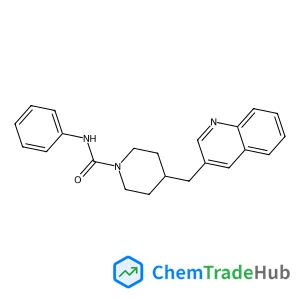
N-phenyl-4-(quinolin-3-ylmethyl)piperidine-1-carboxamide
CAS Number:
959151-50-9
Molecular Formula:
C22H23N3O
Recommended Suppliers






Disclaimer
This page provides academic journal information for reference and research purposes only. We are not affiliated with any journal publishers and do not handle publication submissions. For publication-related inquiries, please contact the respective journal publishers directly.
If you notice any inaccuracies in the information displayed, please contact us at support@chemtradehub.com. We will promptly review and address your concerns.