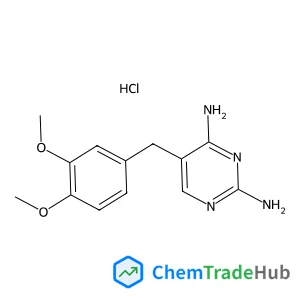
5-(3,4-Dimethoxybenzyl)-2,4-pyrimidinediamine hydrochloride (1:1)
CAS Number:
2507-23-5
Molecular Formula:
C13H17ClN4O2
Takayuki Kajikawa, Kazuyoshi Aoki, Takashi Iwashita, Dariusz M. Niedzwiedzki, Harry A. Frank, Shigeo Katsumura
Peridinin is a light-harvesting carotenoid found in oceanic photosynthetic organisms. It possesses a unique γ-ylidenbutenolide function and engages in energy transfer to chlorophyll a with very high (>90%) efficiency. In order to examine the relationship between the unique structure of peridinin and its facility in carrying out energy transfer, we have synthesized two different ylidenbutenolide-modified derivatives of peridinin. In this communication, the details of the syntheses are described as are the stereochemical and spectral characteristics of the derivatives; the novel ylidenbutenolide functional group stabilizes the molecule and maintains the conjugated π-electron system in an all-trans configuration.

Organic Preparations and Procedures International

Journal of Medicinal Chemistry

Russian Chemical Reviews

Proceedings of the National Academy of Sciences of the United States of America

European Journal of Wood and Wood Products

Israel Journal of Chemistry

Science Progress

Planta Medica

Fibre Chemistry

Kinetics and Catalysis
Malik Muhammad Umair, Yuang Zhang, Shufen Zhang, Xin Jin
DOI: 10.1039/D0SE00368A
Nishita Lucas
DOI: 10.1039/D0SE00361A
Tengfei Zhang, Zhiwei Tian, Qing Liu
DOI: 10.1039/D0SE00360C
Junxiang Jiang, Yuanhao Tang, Lin Dong, Wenhao Zhang, Haobin Wu
DOI: 10.1039/D0SE00381F
N. Queyriaux, K. Abel, J. Fize, J. Pécaut, M. Orio, L. Hammarström
DOI: 10.1039/D0SE00570C
Wei Zhang, Shuping Li, Jia Xie
DOI: 10.1039/D0SE00512F
Yuying Chang, Cenqi Yan, Qianguang Yang, Zhipeng Kan, Ranbir Singh, Manish Kumar, Gang Li, Shirong Lu, Tainan Duan
DOI: 10.1039/D0SE00335B
(1R,3S)-1,3-Cyclopentanediol finds applications in various industries. In the ph...
When handling N'-[4-(Dimethylamino)phenyl]-N,N-dimethyl-1,4-benzenediamine, it i...
There are several alternatives to 5-(2,4-Difluorophenyl)-2-methoxypyrimidine in ...
1-(3-Methoxyphenoxy)propan-2-ol (CAS: 382141-68-6) must comply with the Globally...
Tetrodotoxin Citrate is extremely dangerous and should be handled with extreme c...
2-Methyl-2-propanyl [(1R,3S)-3-hydroxycyclopentyl]carbamate (CAS: 225641-84-9) i...
Waste containing 4-(2-Hydroxyhexafluoroisopropyl)Benzoic Acid (CAS: 16261-80-6) ...
2-Methyl-2-proanyl {(2S)-1-[(benzyloxy)amino]-3-hydroxy-3-methyl-1-oxo-2-butanyl...
Benzeneethanamine, α-ethyl-, hydrochloride (1:1) is an organic compound with the...
In the synthesis of compounds similar to 3-{(E)-[4-(Dimethylamino)phenyl]diazeny...

Organic & Biomolecular Chemistry (OBC) publishes original and high impact research and reviews in organic chemistry. We welcome research that shows new or significantly improved protocols or methodologies in total synthesis, synthetic methodology or physical and theoretical organic chemistry as well as research that shows a significant advance in the organic chemistry or molecular design aspects of chemical biology, catalysis, supramolecular and macromolecular chemistry, theoretical chemistry, mechanism-oriented physical organic chemistry, medicinal chemistry or natural products. Articles published in the journal should report new work which makes a highly-significant impact in the field. Routine and incremental work is generally not suitable for publication in the journal. More details about key areas of our scope are below. In all cases authors should include in their article clear rationale for why their research has been carried out.
![[4-(Isobutyrylamino)phenyl]boronic acid structure](https://static.chemtradehub.com/structs/874/874219-50-8-6ab5.webp "[4-(Isobutyrylamino)phenyl]boronic acid structure")