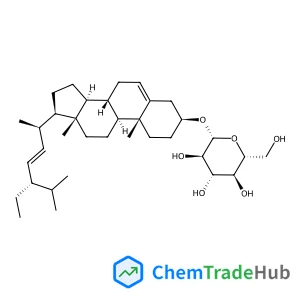
(3beta,22E)-Stigmasta-5,22-dien-3-yl beta-D-glucopyranoside
CAS Number:
19716-26-8
Molecular Formula:
C35H58O6
Nora Bergmann, Sébastien Bonhommeau, Kathrin M. Lange, Stefanie M. Greil, Frank de Groot, Majed Chergui
Catalase and methaemoglobin have very similar haem groups, which are both ferric, yet catalase decomposes hydrogen peroxide to water and oxygen very efficiently, while methaemoglobin does not. Structural studies have attributed this behaviour to their different distal environments. Here we present Fe L2,3-edge X-ray absorption spectra of these proteins in physiological solutions, which reveal clear differences in their electronic structures, in that π back-donation of the Fe atom occurs in catalase, which confers on it a partial ferryl (Fe4+) character, while this is not the case in methaemoglobin. The origin of the Fe4+ character stems from the proximal tyrosine residue. We also find that both systems are in a high spin state. Temperature effects influence the spectra of catalase only weakly, in agreement with previous studies of its chemical activity. We conclude that the high activity of catalase is not only determined by its distal environment but also by its partial ferryl character.
Jonas Elm, Patrick Norman, Merete Bilde, Kurt V. Mikkelsen
DOI: 10.1039/C4CP01206B
Christian Herrero, Annamaria Quaranta, Sanae El Ghachtouli, Winfried Leibl
DOI: 10.1039/C3CP54946A
Muthuramalingam Prakash, Kévin Mathivon, David M. Benoit, Gilberte Chambaud, Majdi Hochlaf
DOI: 10.1039/C4CP01292E
Wenjie Wang, Ivan Kuzmenko, David Vaknin
DOI: 10.1039/C4CP00657G
Takashi Tokushima, Yuka Horikawa, Osamu Takahashi, Koichiro Sadakane
DOI: 10.1039/C4CP00762J
DOI: 10.1039/C4CP00690A
Annalisa Massa, Elena Ugazio
DOI: 10.1039/C4CP01143K
Mahdi Sadeghzadeh Baviloliaei, Lars Diekhöner
DOI: 10.1039/C4CP01429D
Sho Kitano, Atsuhiro Tanaka, Keiji Hashimoto, Hiroshi Kominami
DOI: 10.1039/C4CP00863D
Yunyun Huang, Wensheng Lin, Kan Chen, Wenkai Zhang, Xudong Chen, Ming Qiu Zhang
DOI: 10.1039/C4CP00773E
When handling 2-Chloro-1,2-bis(4-methylphenyl)ethanone (CAS: 71193-32-3), it is ...
4-Ethoxy-3-(5-methyl-4-oxo-7-propyl-1,4-dihydroimidazo[5,1-f][1,2,4]triazin-2-yl...
Methyl 3-Oxo-4-Androsten-17-Carboxylate (CAS: 2681-55-2) should be stored in a c...
(R)-3-Amino-4-(3-hexylphenylamino)-4-oxobutylphosphonic acid is primarily used i...
2-Methyl-2-propanyl 3-amino-3-carbamoyl-1-azetidinecarboxylate (CAS: 1254120-14-...
There are alternative reagents that can be used in synthesis instead of (E)-4-(t...
[2-(3-Chlorophenyl)-1,3-thiazol-4-yl]methanol (CAS: 121202-20-8) is a crystallin...
The market and research trends for Methyl (2S)-[(4S)-2,2-dimethyl-1,3-dioxolan-4...
The market for 1-Bromo-2-isocyanatoethane (CAS: 42865-19-0) is driven by its use...
4-Nitro-D-phenylalanine hydrochloride (CAS: 147065-06-3) is primarily used in re...

Physical Chemistry Chemical Physics (PCCP) is an international journal co-owned by 19 physical chemistry and physics societies from around the world. This journal publishes original, cutting-edge research in physical chemistry, chemical physics and biophysical chemistry. To be suitable for publication in PCCP, articles must include significant innovation and/or insight into physical chemistry; this is the most important criterion that reviewers and Editors will judge against when evaluating submissions. The journal has a broad scope and welcomes contributions spanning experiment, theory, computation and data science. Topical coverage includes spectroscopy, dynamics, kinetics, statistical mechanics, thermodynamics, electrochemistry, catalysis, surface science, quantum mechanics, quantum computing and machine learning. Interdisciplinary research areas such as polymers and soft matter, materials, nanoscience, energy, surfaces/interfaces, and biophysical chemistry are welcomed if they demonstrate significant innovation and/or insight into physical chemistry. Joined experimental/theoretical studies are particularly appreciated when complementary and based on up-to-date approaches.