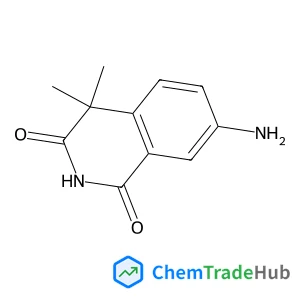
1,3(2H,4H)-Isoquinolinedione, 7-amino-4,4-dimethyl-
CAS Number:
14576-22-8
Molecular Formula:
C11H12N2O2
Takashi Tokushima, Yuka Horikawa, Osamu Takahashi, Koichiro Sadakane
Knowledge of hydrogen bonds is important in a wide range of scientific fields. However, information on the electronic state of hydrogen bonded molecules in liquids and solutions is still limited. We applied X-ray emission and absorption spectroscopy to observe the electronic state around oxygen of water and investigate the solvent dependence of occupied and unoccupied valence electronic states of water in acetonitrile, 3-methylpyridine, and ethylenediamine at room temperature under atmospheric pressure. Based on the direct comparison of the spectra, the pronounced variation of the unoccupied 2b2 state of water in acetonitrile and 3-methylpyridine was assigned to the difference of the dipole–dipole interaction and the donor hydrogen bond. For ethylenediamine solution, an enhancement of the peak structure in the post-edge region of X-ray absorption spectra and an evident shoulder structure on the higher energy side of the occupied 1b1 state in X-ray emission spectra were observed. Although ethylenediamine has two amino groups that can form the hydrogen bonds as a proton donor, the obtained results indicate that the amino groups of ethylenediamine also act as a proton acceptor in the hydrogen bond between water molecules. A systematic peak intensity variation of the pre-edge peak corresponding to the lowest unoccupied molecular orbital, 4a1, was also found through the comparison of three organic solvents. Since the peak intensity tends to decrease with increasing number of hydrogen bonds, the results can be interpreted by the covalency of hydrogen bonds.

Journal of Chemical Sciences

Chinese Journal of Chemistry

Bioorganic & Medicinal Chemistry Letters

Acta Metallurgica Sinica-English Letters

Electroanalysis

Biocatalysis and Biotransformation

Bioorganic & Medicinal Chemistry

Journal of Asian Natural Products Research

Atomization and Sprays

Polycyclic Aromatic Compounds
Tingting Xia, Zhenyi Hu, Wenzhi Ji, Shujie Zhang, Hui Shi, Chenguang Liu, Bo Pang, Guijian Liu, Xuebin Liao
DOI: 10.1039/C7QO00847C
Pengbo Zhang, Jianxi Ying, Guo Tang
DOI: 10.1039/C7QO00466D
Wei-Wei Zhao
DOI: 10.1039/C7QO00621G
Kang Chen, Ding Wang, Zhao-Wei Li, Zheng Liu, Fei Pan, Yun-Fei Zhang
DOI: 10.1039/C7QO00432J
Wenge Zhang, Hong Deng, Hongji Li
DOI: 10.1039/C7QO00542C
Ying Guo, Ling-Yan Shao, Kun-Kun Yu, Ya-Hua Hu, Hong-Wei Liu, Dao-Hua Liao, Ya-Fei Ji
DOI: 10.1039/C7QO00435D
T. Sony, S. Prabhakar, L. Raju Chowhan
DOI: 10.1039/C7QO00109F
Cheng-Kou Liu, Zhao Yang, Yu Zeng, Zheng Fang, Bo Li
DOI: 10.1039/C7QO00247E
Ali Keivanloo, Atena Soozani, Mohammad Bakherad, Amir Hossein Amin
DOI: 10.1039/C7QO00751E
When handling 4-Methyl-6-(trifluoromethyl)quinoline (CAS: 40716-16-3), safety go...
4-(3,5-Difluorophenyl)aniline is an aromatic organic compound with the CAS numbe...
5-{[4-(Trifluoromethyl)phenyl]sulfanyl}-1,2,3-thiadiazole-4-carboxylic acid can ...
The market for 4-Benzylaniline hydrochloride (CAS: 6317-57-3) is steadily growin...
[3-(Diethylsulfamoyl)phenyl]boronic acid is generally considered safe when handl...
3-Bromo-2,5-dimethoxyaniline is mainly used in the pharmaceutical and chemical i...
N-Methyl-1-(5-methyl-1H-indol-3-yl)methanamine (CAS: 915922-67-7) is subject to ...
This compound is primarily used in the pharmaceutical industry for the synthesis...
2-Methyl-2-propanyl [(1S,3R)-3-aminocyclohexyl]carbamate (CAS: 1298101-47-9) sho...
Ethyl 2-bromo-4,4,4-trifluorobutanoate (CAS: 367-33-9) is utilized in the pharma...

Physical Chemistry Chemical Physics (PCCP) is an international journal co-owned by 19 physical chemistry and physics societies from around the world. This journal publishes original, cutting-edge research in physical chemistry, chemical physics and biophysical chemistry. To be suitable for publication in PCCP, articles must include significant innovation and/or insight into physical chemistry; this is the most important criterion that reviewers and Editors will judge against when evaluating submissions. The journal has a broad scope and welcomes contributions spanning experiment, theory, computation and data science. Topical coverage includes spectroscopy, dynamics, kinetics, statistical mechanics, thermodynamics, electrochemistry, catalysis, surface science, quantum mechanics, quantum computing and machine learning. Interdisciplinary research areas such as polymers and soft matter, materials, nanoscience, energy, surfaces/interfaces, and biophysical chemistry are welcomed if they demonstrate significant innovation and/or insight into physical chemistry. Joined experimental/theoretical studies are particularly appreciated when complementary and based on up-to-date approaches.
![S-[2,3-Bis(palmitoyloxy)propyl]-N-[(9H-fluoren-9-ylmethoxy)(hydroxy)methylene]cysteine structure](https://static.chemtradehub.com/structs/210/210532-98-2-f6a7.webp "S-[2,3-Bis(palmitoyloxy)propyl]-N-[(9H-fluoren-9-ylmethoxy)(hydroxy)methylene]cysteine structure")
![1-[(4-Methylphenyl)sulfonyl]-3-(4,4,5,5-tetramethyl-1,3,2-dioxaborolan-2-yl)-1H-pyrrolo[2,3-b]pyridine-5-carbonitrile structure](https://static.chemtradehub.com/structs/143/1434747-57-5-fc0d.webp "1-[(4-Methylphenyl)sulfonyl]-3-(4,4,5,5-tetramethyl-1,3,2-dioxaborolan-2-yl)-1H-pyrrolo[2,3-b]pyridine-5-carbonitrile structure")