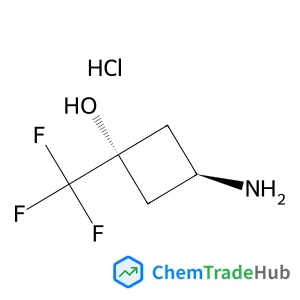
cis-3-Amino-1-(trifluoromethyl)cyclobutanol hydrochloride (1:1)
CAS Number:
1408075-16-0
Molecular Formula:
C5H9ClF3NO
We demonstrate a facile technique to assemble solution phase-synthesized bismuth telluride (Bi2Te3) nanoplatelets into arrays of micropatterns. Aminosilane self-assembled monolayers (SAMs) are printed on silicon dioxide (SiO2) substrates using microcontact printing (μCP). The SAM printed surfaces are terminated with amine-groups allowing Bi2Te3 nanoplatelet selective adsorption by electrostatic attraction. Using Kelvin probe force microscopy, the electrical potential difference between aminosilane SAM and Bi2Te3 nanoplatelet surfaces is found to be ∼650 mV, which is larger than that (∼400 mV) between the SiO2 substrate and Bi2Te3 nanoplatelet surfaces. The selective adsorption provides an opportunity for integrating solution phase-grown topological insulators toward several device-level applications.

Journal of Asian Natural Products Research

Main Group Chemistry

Medicinal Chemistry Research

Acta Metallurgica Sinica-English Letters

Journal of the Indian Institute of Science

Atomization and Sprays

Critical Reviews in Solid State and Materials Sciences

Bioorganic & Medicinal Chemistry

Cellulose

Biocatalysis and Biotransformation
Hai-Tao Tang, Jia-Hao Zeng, Jun-Jia Chen, Yun-Bing Zhou, Ren-Hao Li, Zhuang-Ping Zhan
DOI: 10.1039/C7QO00249A
Tingting Xia, Zhenyi Hu, Wenzhi Ji, Shujie Zhang, Hui Shi, Chenguang Liu, Bo Pang, Guijian Liu, Xuebin Liao
DOI: 10.1039/C7QO00847C
Danwei Zhao, Kai Kang, Haizhen Jiang, Hongmei Deng, Yunrong Chen
DOI: 10.1039/C7QO00217C
Hongxing Jin, Erqing Li
DOI: 10.1039/C7QO00596B
Jun Luo, Wan-Sha Huang, Sheng-Mou Hu, Pan-Pan Zhang, Xu-Wei Zhou, Xiao-Bing Wang, Ming-Hua Yang, Jian-Guang Luo, Chen Wang, Chang Liu, He-Quan Yao, Can Zhang, Hong-Bin Sun, Yi-Jun Chen, Ling-Yi Kong
DOI: 10.1039/C7QO00678K
Songsong Gao, Xiangdong Hu
DOI: 10.1039/C7QO00216E
Ibrahim Ata, Sadok Ben Dkhil, Martin Pfannmöller, Sara Bals, David Duché, Jean-Jacques Simon, Tomoyuki Koganezawa, Noriyuki Yoshimoto, Christine Videlot-Ackermann, Olivier Margeat, Jörg Ackermann, Peter Bäuerle
DOI: 10.1039/C7QO00222J
Sarah Saint-Auret, Hajer Abdelkafi, Didier Le Nouen, Philippe Bisseret, Nicolas Blanchard
DOI: 10.1039/C7QO00608J
Wei Zhang, Wenlong Yu, Qiangqiang Yan, Zhanxiang Liu
DOI: 10.1039/C7QO00517B
Yuzhen Ding, Zhiqiang Pan, Xiaogang Tong
DOI: 10.1039/C7QO00389G
When handling 4-Methyl-6-(trifluoromethyl)quinoline (CAS: 40716-16-3), safety go...
4-(3,5-Difluorophenyl)aniline is an aromatic organic compound with the CAS numbe...
5-{[4-(Trifluoromethyl)phenyl]sulfanyl}-1,2,3-thiadiazole-4-carboxylic acid can ...
The market for 4-Benzylaniline hydrochloride (CAS: 6317-57-3) is steadily growin...
[3-(Diethylsulfamoyl)phenyl]boronic acid is generally considered safe when handl...
3-Bromo-2,5-dimethoxyaniline is mainly used in the pharmaceutical and chemical i...
N-Methyl-1-(5-methyl-1H-indol-3-yl)methanamine (CAS: 915922-67-7) is subject to ...
This compound is primarily used in the pharmaceutical industry for the synthesis...
2-Methyl-2-propanyl [(1S,3R)-3-aminocyclohexyl]carbamate (CAS: 1298101-47-9) sho...
Ethyl 2-bromo-4,4,4-trifluorobutanoate (CAS: 367-33-9) is utilized in the pharma...

Physical Chemistry Chemical Physics (PCCP) is an international journal co-owned by 19 physical chemistry and physics societies from around the world. This journal publishes original, cutting-edge research in physical chemistry, chemical physics and biophysical chemistry. To be suitable for publication in PCCP, articles must include significant innovation and/or insight into physical chemistry; this is the most important criterion that reviewers and Editors will judge against when evaluating submissions. The journal has a broad scope and welcomes contributions spanning experiment, theory, computation and data science. Topical coverage includes spectroscopy, dynamics, kinetics, statistical mechanics, thermodynamics, electrochemistry, catalysis, surface science, quantum mechanics, quantum computing and machine learning. Interdisciplinary research areas such as polymers and soft matter, materials, nanoscience, energy, surfaces/interfaces, and biophysical chemistry are welcomed if they demonstrate significant innovation and/or insight into physical chemistry. Joined experimental/theoretical studies are particularly appreciated when complementary and based on up-to-date approaches.
![(3R,5R)-1-[(Benzyloxy)carbonyl]-5-methyl-3-piperidinecarboxylic acid structure](https://static.chemtradehub.com/structs/126/1269757-29-0-c552.webp "(3R,5R)-1-[(Benzyloxy)carbonyl]-5-methyl-3-piperidinecarboxylic acid structure")