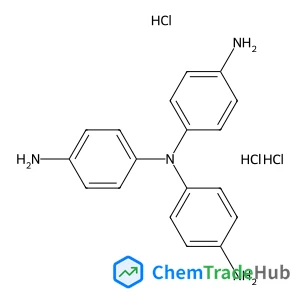
N1,N1-Bis(4-aminophenyl)benzene-1,4-diamine trihydrochloride
CAS Number:
114254-48-7
Molecular Formula:
C18H21Cl3N4
Jiao Kang
A concise preparation of halophenols directly from (hetero)aryl boronic acids/esters via tungstate-catalyzed one-pot ipso-hydroxylation bromination and iodination has been developed in the current work. A broad substrate scope, good functional group tolerance and formal synthesis of several bioactive molecules have been achieved. Utilizing environmentally and costlyfriendly reagents (NaBr, NaI, H2O2, weak organic acids) and green solvents (EtOH/H2O), this reaction can work at room temperature in the open air. It was also found to be dependent on pH, and to work smoothly with weak/moderate-strength organic acids without a tungsten catalyst. Compared to strategies developed in previous research with the same starting materials, this one-pot strategy was more step-economically friendly. Notably, the (hetero)aryl boronic acid played an interesting “one stone, two birds” role: as a starting material and promoter of the reaction by releasing B(OH)3 as a co-catalyst. B(OH)3 has normally been treated as waste in ipso-hydroxylation, but we expect the “turn waste into wealth (catalyst)” approach of the current work to inspire related research.
Florian Colléaux, James M. Ball, Paul H. Wöbkenberg, Peter J. Hotchkiss, Seth R. Marder, Thomas D. Anthopoulos
DOI: 10.1039/C1CP20769E
L. Olivi, C. Dominici, F. Ziarelli
DOI: 10.1039/C1CP20346K
Kwan Kim, Kyung Lock Kim, Jeong-Young Choi, Dongha Shin, Kuan Soo Shin
DOI: 10.1039/C1CP21249D
Yuhui Lu, Craig Lent
DOI: 10.1039/C1CP21332F
Juan Pablo Catalán
DOI: 10.1039/C1CP21380F
Grant Copeland, Mariana V. Ghosh, Dudley E. Shallcross, Carl J. Percival, John M. Dyke
DOI: 10.1039/C0CP03004J
Weiwei Zhou, Tao Chen, Kim Seng Tan, Xingtao Jia, Zhiqiang Luo, Chunxiao Cong, Huanping Yang, Chang Ming Li
DOI: 10.1039/C1CP21917K
Rajesh Kumar, Haijun Yan, Adam Johan Bergren
DOI: 10.1039/C1CP20755E
Josip Požar, Klemen Bohinc, Vojko Vlachy, Davor Kovačević
DOI: 10.1039/C1CP21291E
2-Methylbenzene-1,4-diamine dihydrochloride (CAS: 615-45-2) should be stored in ...
(1S,4S)-2,5-Diazabicyclo[2.2.1]heptane dihydrobromide is generally considered sa...
(6-Chloropyridazin-3-YL)methanamine finds applications in the pharmaceutical ind...
2-Fluoro-3-methylphenol is primarily used in the synthesis of pharmaceuticals, p...
When handling 3-Methoxy-4-nitrobenzonitrile, it is important to wear appropriate...
When handling 1,3-Oxazolo[4,5-b]pyridine-2(3H)-thione (CAS: 211949-57-4), it is ...
4-Ethynylbenzamide (CAS: 90347-86-7) falls under various regulatory guidelines i...
3-(2-Ethylphenyl)-2-thioxo-4-imidazolidinone is primarily used as an intermediat...
(2-Fluoro-6-methoxyphenyl)acetic acid, also known as 4-fluoro-3-methoxybenzoic a...
Market trends for 2-[4-(Hydroxymethyl)phenoxy]ethanol (CAS: 102196-18-9) indicat...

Organic Chemistry Frontiers publishes high-quality research from across organic chemistry. Emphases are placed on studies that make significant contributions to the field of organic chemistry by reporting either new or significantly improved protocols or methodologies. Topics include, but are not limited to the following: Organic synthesis Development of synthetic methodologies Catalysis Natural products Functional organic materials Supramolecular and macromolecular chemistry Physical and computational organic chemistry