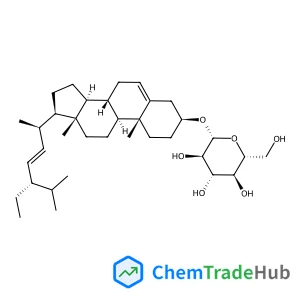
(3beta,22E)-Stigmasta-5,22-dien-3-yl beta-D-glucopyranoside
CAS Number:
19716-26-8
Molecular Formula:
C35H58O6
Ping Li, Zhixiang Wang, Houyu Zhang
A class of N-annulated perylene (NP)-based organic dyes used in dye-sensitized solar cells has been investigated by means of quantum chemical calculations. The NPs are rigidified with thiophene or benzene rings in both a one-sided and two-sided manner on a 5- or 6-member ring and are considered as electron donors in dyes. To gain a better understanding of the effect of such modulation of NP moieties on the dye performance, the geometrical and electronic structures, the optical absorption and intramolecular charge transfer properties of the dyes and dye–TiO2 complexes are analyzed in detail to establish the structure–property relationship. The calculated results indicate that the rigidified NP moieties could improve light-harvesting capacities, modulate the energy levels of frontier orbitals, accelerate intramolecular charge transfer by decreasing the aromaticity of the π-system, decreasing the reorganization energy and avoiding electon trapping in the possible multiple electron transfer pathways, and facilitate charge separation with a lower coulombic attractive energy. In particular, the bilateral dyes via a 6-member immobilization would be promising candidates with excellent performance. We hope that our calculations could give a more in-depth physical insight on the structure–property relationship and provide guidance for the exploration of high-performance NP-based dyes.

Heteroatom Chemistry

Herald of the Russian Academy of Sciences

Journal of Chemical Sciences

Main Group Chemistry

Acta Metallurgica Sinica-English Letters

Biocatalysis and Biotransformation

NDT & E International

Journal of Asian Natural Products Research

Critical Reviews in Solid State and Materials Sciences

Colloid Journal
Michael Senske, Diana Constantinescu-Aruxandei, Martina Havenith, Christian Herrmann, Hermann Weingärtner, Simon Ebbinghaus
DOI: 10.1039/C6CP05080H
Ying-Feng Hsu, Yu-Hsun Chen, Chih-Wei Chang
DOI: 10.1039/C6CP05813B
Hui Zhao, Wei-xiao Ji, Chang-wen Zhang, Ping Li, Feng Li, Pei-ji Wang, Run-wu Zhang
DOI: 10.1039/C6CP06034J
Shirui Luo, Jarrod Schiffbauer
DOI: 10.1039/C6CP06085D
Juan P. Marcolongo, Uriel N. Morzan, Ari Zeida, Damián A. Scherlis, José A. Olabe
DOI: 10.1039/C6CP06314D
Chunpeng Ai, Dianzhong Wen, Xuduo Bai
DOI: 10.1039/C6CP06084F
Baoshun Liu, Xiujian Zhao, Jiaguo Yu, Akira Fujishima
DOI: 10.1039/C6CP06320A
Xiaoyang Pan, Zhiguo Yi
DOI: 10.1039/C6CP04604E
Xue-Rong Shi, Norbert Köpfle, Dmitry Y. Zemlyanov, Axel Knop-Gericke, Michael Hävecker, Bernhard Klötzer, Simon Penner
DOI: 10.1039/C6CP07197J
When handling 2-Chloro-1,2-bis(4-methylphenyl)ethanone (CAS: 71193-32-3), it is ...
4-Ethoxy-3-(5-methyl-4-oxo-7-propyl-1,4-dihydroimidazo[5,1-f][1,2,4]triazin-2-yl...
Methyl 3-Oxo-4-Androsten-17-Carboxylate (CAS: 2681-55-2) should be stored in a c...
(R)-3-Amino-4-(3-hexylphenylamino)-4-oxobutylphosphonic acid is primarily used i...
2-Methyl-2-propanyl 3-amino-3-carbamoyl-1-azetidinecarboxylate (CAS: 1254120-14-...
There are alternative reagents that can be used in synthesis instead of (E)-4-(t...
[2-(3-Chlorophenyl)-1,3-thiazol-4-yl]methanol (CAS: 121202-20-8) is a crystallin...
The market and research trends for Methyl (2S)-[(4S)-2,2-dimethyl-1,3-dioxolan-4...
The market for 1-Bromo-2-isocyanatoethane (CAS: 42865-19-0) is driven by its use...
4-Nitro-D-phenylalanine hydrochloride (CAS: 147065-06-3) is primarily used in re...

Physical Chemistry Chemical Physics (PCCP) is an international journal co-owned by 19 physical chemistry and physics societies from around the world. This journal publishes original, cutting-edge research in physical chemistry, chemical physics and biophysical chemistry. To be suitable for publication in PCCP, articles must include significant innovation and/or insight into physical chemistry; this is the most important criterion that reviewers and Editors will judge against when evaluating submissions. The journal has a broad scope and welcomes contributions spanning experiment, theory, computation and data science. Topical coverage includes spectroscopy, dynamics, kinetics, statistical mechanics, thermodynamics, electrochemistry, catalysis, surface science, quantum mechanics, quantum computing and machine learning. Interdisciplinary research areas such as polymers and soft matter, materials, nanoscience, energy, surfaces/interfaces, and biophysical chemistry are welcomed if they demonstrate significant innovation and/or insight into physical chemistry. Joined experimental/theoretical studies are particularly appreciated when complementary and based on up-to-date approaches.
![(1R)-3-Bromo-1,7,7-trimethylbicyclo[2.2.1]heptan-2-one structure](https://static.chemtradehub.com/structs/102/10293-06-8-dd8a.webp "(1R)-3-Bromo-1,7,7-trimethylbicyclo[2.2.1]heptan-2-one structure")