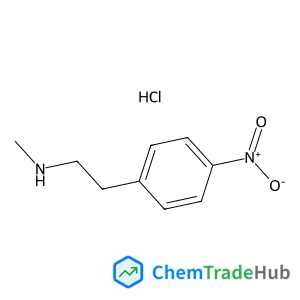
N-Methyl-2-(4-nitrophenyl)ethanamine hydrochloride (1:1)
CAS Number:
166943-39-1
Molecular Formula:
C9H13ClN2O2
Indranil Chakraborty, Urmila Saha, Dipika Mandal, Suprabhat Mukherjee, Nikhilesh Joardar, Santi P. Sinha Babu, Gopinatha Suresh Kumar, Kalyan Mandal
The emerging category of magneto-fluorescent tartrate-modified MnFe2O4 nano hollow spheres (T-MnFe2O4 NHSs) can be considered as promising candidates for biomedical applications. The interaction of bovine serum albumin (BSA) with T-MnFe2O4 NHSs has been studied using several spectroscopic techniques, which suggest that the interaction occurs by an electrostatic mechanism. Furthermore, BSA enhances the charge transfer transition from the tartrate ligand to the metal ions along with the d–d transition of Fe3+ ions on NHSs surfaces at different pH. Very strong salt bridge formation occurs between the lysine of the BSA surface and the tartrate in basic medium (pH 10), followed by the acidic (pH 3) and neutral medium (pH 7), respectively. Systematic fluorescence microscopic analysis reveals that BSA significantly enhances the contrast of T-MnFe2O4 NHSs in UV and blue light excitation because of the extended charge transfer from BSA to T-MnFe2O4 NHSs. Our report demonstrates great potential in the field of nanotechnology and biomedical applications. In vitro toxicity analysis using RAW 264.7 celline and in vivo studies on Wister rats revealed that the T-MnFe2O4 NHSs are benign. Furthermore, T-MnFe2O4 NHSs also appear to be an antimicrobial agent. Therefore, T-MnFe2O4 NHSs can be explored for future therapeutic applications.
Alexander Karabanov, Grzegorz Kwiatkowski, Carlo U. Perotto, Daniel Wiśniewski, Jonathan McMaster, Walter Köckenberger
DOI: 10.1039/C6CP04345C
Mouritz N. Svenson, Randall E. Youngman, Yuanzheng Yue, Sylwester J. Rzoska, Michal Bockowski, Lars R. Jensen, Morten M. Smedskjaer
DOI: 10.1039/C6CP06341A
Neelanjana Sengupta
DOI: 10.1039/C6CP05041G
Shinichi Enami, Michael R. Hoffmann, Agustín J. Colussi
DOI: 10.1039/C6CP06652F
Xiaokang Wan, Fujun Niu, Jinzhan Su, Liejin Guo
DOI: 10.1039/C6CP06233D
Chih-Yuan Lin, Fu Chen, Li-Hsien Yeh, Jyh-Ping Hsu
DOI: 10.1039/C6CP06459K
Shirui Luo, Jarrod Schiffbauer
DOI: 10.1039/C6CP06085D
Roland S. Kalb, Elena N. Stepurko
DOI: 10.1039/C6CP06594E
Rui-Qin Zhang, Yan-Ling Zhao, Fei Qi, Klaus Hermann, Michel A. Van Hove
DOI: 10.1039/C6CP05996A
When handling 2-Chloro-1,2-bis(4-methylphenyl)ethanone (CAS: 71193-32-3), it is ...
4-Ethoxy-3-(5-methyl-4-oxo-7-propyl-1,4-dihydroimidazo[5,1-f][1,2,4]triazin-2-yl...
Methyl 3-Oxo-4-Androsten-17-Carboxylate (CAS: 2681-55-2) should be stored in a c...
(R)-3-Amino-4-(3-hexylphenylamino)-4-oxobutylphosphonic acid is primarily used i...
2-Methyl-2-propanyl 3-amino-3-carbamoyl-1-azetidinecarboxylate (CAS: 1254120-14-...
There are alternative reagents that can be used in synthesis instead of (E)-4-(t...
[2-(3-Chlorophenyl)-1,3-thiazol-4-yl]methanol (CAS: 121202-20-8) is a crystallin...
The market and research trends for Methyl (2S)-[(4S)-2,2-dimethyl-1,3-dioxolan-4...
The market for 1-Bromo-2-isocyanatoethane (CAS: 42865-19-0) is driven by its use...
4-Nitro-D-phenylalanine hydrochloride (CAS: 147065-06-3) is primarily used in re...

Physical Chemistry Chemical Physics (PCCP) is an international journal co-owned by 19 physical chemistry and physics societies from around the world. This journal publishes original, cutting-edge research in physical chemistry, chemical physics and biophysical chemistry. To be suitable for publication in PCCP, articles must include significant innovation and/or insight into physical chemistry; this is the most important criterion that reviewers and Editors will judge against when evaluating submissions. The journal has a broad scope and welcomes contributions spanning experiment, theory, computation and data science. Topical coverage includes spectroscopy, dynamics, kinetics, statistical mechanics, thermodynamics, electrochemistry, catalysis, surface science, quantum mechanics, quantum computing and machine learning. Interdisciplinary research areas such as polymers and soft matter, materials, nanoscience, energy, surfaces/interfaces, and biophysical chemistry are welcomed if they demonstrate significant innovation and/or insight into physical chemistry. Joined experimental/theoretical studies are particularly appreciated when complementary and based on up-to-date approaches.