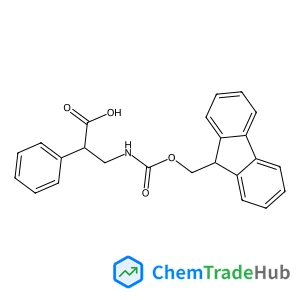
(S)-3-((((9H-Fluoren-9-yl)methoxy)carbonyl)amino)-2-phenylpropanoic acid
CAS Number:
1217663-60-9
Molecular Formula:
C24H21NO4
Giuseppe Prencipe, Stefano Maiorana, Paolo Verderio, Miriam Colombo, Paola Fermo, Enrico Caneva, Davide Prosperi, Emanuela Licandro
A versatile synthetic platform for the efficient immobilization of PNAs on magnetic iron oxides, providing magnetic nanosensors for selective DNA recognition, is presented.
Nicole Cathcart, Andrew J. Frank, Vladimir Kitaev
DOI: 10.1039/B916902D
Patricia Horcajada, Christian Serre, Cédric Boissière, David Grosso, Clément Sanchez, Gérard Férey
DOI: 10.1039/B915011K
Min Li, Sergio L. De Rooy, David K. Bwambok, Bilal El-Zahab, John F. DiTusa, Isiah M. Warner
DOI: 10.1039/B917683G
Alejandra Sornosa-Ten, M. Teresa Albelda, Juan C. Frías, Enrique García-España, José M. Llinares, Ana Budimir, Ivo Piantanida
DOI: 10.1039/C000124D
Tamil Selvi Pitchumony, Bernhard Spingler, Roberto Motterlini, Roger Alberto
DOI: 10.1039/C0OB00099J
Binbin Zhou, Mark S. Denning, Thomas A. D. Chapman, John E. McGrady, Jose M. Goicoechea
DOI: 10.1039/B917185A
Felipe E. Zilly, Andreas Taglieber, Frank Schulz, Frank Hollmann, Manfred T. Reetz
DOI: 10.1039/B913863C
Md. Badruz Zaman, David Bardelang, Xiaohua Wu, Dashan Wang, James C. Margeson, Donald M. Leek, John A. Ripmeester, Christopher I. Ratcliffe, Quan Lin, Bai Yang, Kui Yu
DOI: 10.1039/B913914A
Li-Yan Zeng, Chun Cai
DOI: 10.1039/C0OB00364F
(1R,3S)-1,3-Cyclopentanediol finds applications in various industries. In the ph...
When handling N'-[4-(Dimethylamino)phenyl]-N,N-dimethyl-1,4-benzenediamine, it i...
There are several alternatives to 5-(2,4-Difluorophenyl)-2-methoxypyrimidine in ...
1-(3-Methoxyphenoxy)propan-2-ol (CAS: 382141-68-6) must comply with the Globally...
Tetrodotoxin Citrate is extremely dangerous and should be handled with extreme c...
2-Methyl-2-propanyl [(1R,3S)-3-hydroxycyclopentyl]carbamate (CAS: 225641-84-9) i...
Waste containing 4-(2-Hydroxyhexafluoroisopropyl)Benzoic Acid (CAS: 16261-80-6) ...
2-Methyl-2-proanyl {(2S)-1-[(benzyloxy)amino]-3-hydroxy-3-methyl-1-oxo-2-butanyl...
Benzeneethanamine, α-ethyl-, hydrochloride (1:1) is an organic compound with the...
In the synthesis of compounds similar to 3-{(E)-[4-(Dimethylamino)phenyl]diazeny...

ChemComm publishes urgent research which is of outstanding significance and interest to experts in the field, while also appealing to the journal’s broad chemistry readership. Our communication format is ideally suited to short, urgent studies that are of such importance that they require accelerated publication. Our scope covers all topics in chemistry, and research at the interface of chemistry and other disciplines (such as materials science, nanoscience, physics, engineering and biology) where there is a significant novelty in the chemistry aspects. Major topic areas covered include: Analytical Chemistry Catalysis Chemical Biology and medicinal chemistry Computational Chemistry and Machine Learning Energy and sustainable chemistry Environmental Chemistry Green Chemistry Inorganic Chemistry Materials Chemistry Nanoscience Organic Chemistry Physical Chemistry Polymer Chemistry Supramolecular Chemistry
![(2S)-2-{[(9H-Fluoren-9-ylmethoxy)carbonyl]amino}-4-(methylselanyl)butanoic acid structure](https://static.chemtradehub.com/structs/121/1217852-49-7-f252.webp "(2S)-2-{[(9H-Fluoren-9-ylmethoxy)carbonyl]amino}-4-(methylselanyl)butanoic acid structure")