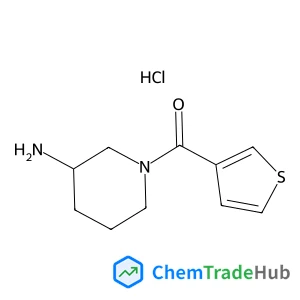
(3-Amino-piperidin-1-yl)-thiophen-3-yl-methanone hydrochloride
CAS Number:
1185316-70-4
Molecular Formula:
C10H15ClN2OS
Sulagna De, Sk. Musharaf Ali, Asraf Ali, V. G. Gaikar
The structures and thermodynamic parameters of hydrated zinc ion clusters incorporating a single zinc ion and up to eighteen water molecules have been determined with a quantum mechanical hybrid density functional, namely B3LYP using cc-PVDZ basis functions for H and O and a split valence 6-31G (d, p) basis function for Zn. The geometries for all the zinc ionwater clusters are optimized with several initial guess structures and without imposing any initial symmetry restriction. Zinc metal ion is found to be preferably four coordinated for smaller sizes of hydrated cluster but attains an octahedral coordination for larger sizes (n≥ 11) of hydrated cluster. Structures with seven or more than seven water molecules attached directly to the central zinc ion are not found. The calculated gas phase coordination number in the first solvation sphere of a large hydrated zinc metal ion is found to be six and the same is also confirmed in the force field based classical molecular dynamics simulation study for an aqueous zinc ion and thus confirms the experimental findings. The equilibrium zinc–oxygen distance of 2.09328 Å at the present B3LYP level of study is in excellent agreement with the X-ray diffraction result of 2.093 ± 0.002 Å for a hexahydrated zinc cluster.
Zhiting Wang, Hongchi Liu, Tianxiao Jiang
DOI: 10.1039/D3QO01637D
Xiao-Di Su, Qing-Shuang Zhang, Bei-Bei Zhang, Lin He, Qiang Liu, Xiang-Yu Chen
DOI: 10.1039/D3QO01719B
Yuanrui Jiang, Wenjing Zhu, Jiawen Huang, Fan Luo, Xiaobei Chen, Chunhui Fang, Xin Chen, Shihui Liu, Yanwei Hu, Shilei Zhang
DOI: 10.1039/D3QO01109G
Peilong Gu, Shuangshuang Wang, Xiangxiang Wen, Jinxin Tian, Chao Wang, Lili Zong, Choon-Hong Tan
DOI: 10.1039/D3QO01729J
Jia Wu, Xiangyun Xu, Chongwen Duan, Shan Chen, Dan Wang, Likui Fang, Weiyang Tang, Fusheng Li
DOI: 10.1039/D3QO01522J
Jinyuan Wang, Yunzhi Liu, Nan Han, Yuan Gao, Jun Luo
DOI: 10.1039/D3QO01790G
Adrián Luguera Ruiz, Elena Mariani, Stefano Protti, Maurizio Fagnoni
DOI: 10.1039/D3QO01856C
Meng Liu, Xinke Ouyang, Chenglong Xuan
DOI: 10.1039/D3QO01929B
When handling 2-Methyl-2-propanyl 5-amino-2-thiophenecarboxylate (CAS: 1498311-5...
5-Bromo-1,2-dichloro-3-fluorobenzene (CAS: 1000572-93-9) is a crystalline solid ...
(2R)-2-Amino-2-(4-bromophenyl)ethanol (CAS: 354153-64-3) should be stored in a c...
Methyl 4-(aminomethyl)tetrahydro-2H-pyran-4-carboxylate hydrochloride (CAS: 3627...
1,4-Dimethyl-1H-pyrazole-5-sulfonyl chloride is primarily used as an intermediat...
Dinaphtho[1,2-b:2',1'-d]furan is generally safe when handled with appropriate pe...
The market for 7-Methyl-7,9-dihydro-1H-purine-2,6,8(3H)-trione (CAS: 612-37-3) i...
2-(4-Chlorophenyl)malonaldehyde (CAS: 205676-17-1) is a colorless or light yello...
2-Methylchrysene (CAS: 3351-32-4) is typically synthesized via the reaction of c...
N-(6-aminopyrimidin-4-yl)acetamide (CAS: 89533-23-3) is generally considered saf...

Physical Chemistry Chemical Physics (PCCP) is an international journal co-owned by 19 physical chemistry and physics societies from around the world. This journal publishes original, cutting-edge research in physical chemistry, chemical physics and biophysical chemistry. To be suitable for publication in PCCP, articles must include significant innovation and/or insight into physical chemistry; this is the most important criterion that reviewers and Editors will judge against when evaluating submissions. The journal has a broad scope and welcomes contributions spanning experiment, theory, computation and data science. Topical coverage includes spectroscopy, dynamics, kinetics, statistical mechanics, thermodynamics, electrochemistry, catalysis, surface science, quantum mechanics, quantum computing and machine learning. Interdisciplinary research areas such as polymers and soft matter, materials, nanoscience, energy, surfaces/interfaces, and biophysical chemistry are welcomed if they demonstrate significant innovation and/or insight into physical chemistry. Joined experimental/theoretical studies are particularly appreciated when complementary and based on up-to-date approaches.
![N-[(1-Ethyl-2-pyrrolidinyl)methyl]-2-hydroxy-5-sulfamoylbenzamide structure](https://static.chemtradehub.com/structs/673/67381-52-6-877f.webp "N-[(1-Ethyl-2-pyrrolidinyl)methyl]-2-hydroxy-5-sulfamoylbenzamide structure")
![4-Chloro-N-{[4-(dimethylamino)phenyl]carbamoyl}benzenesulfonamide structure](https://static.chemtradehub.com/structs/558/5581-42-0-7dcb.webp "4-Chloro-N-{[4-(dimethylamino)phenyl]carbamoyl}benzenesulfonamide structure")