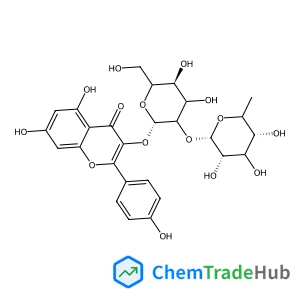
5,7-Dihydroxy-2-(4-hydroxyphenyl)-4-oxo-4H-chromen-3-yl 2-O-(6-deoxy-alpha-L-mannopyranosyl)-beta-D-glucopyranoside
CAS Number:
32602-81-6
Molecular Formula:
C27H30O15
Tatsuya Kameyama, Ken-ichi Okazaki, Katsuhiko Takagi
Inorganic multilayer films were prepared by layer-by-layer accumulation of positively charged layered double hydroxide (LDH) nanosheets and negatively charged CdS nanoparticles of different sizes. Nanoparticles were densely immobilized on LDH sheets to form a monolayer without coalescence into larger particles. The absorbance and photoluminescence intensity of immobilized CdS particles were enlarged with an increase in the accumulation number of the film. Hybrid films produced by accumulation of both monolayers of CdS particles (diameter: 5 nm) and those of smaller CdS particles (2.1 nm) exhibited characteristic photoluminescence spectra indicating the efficient energy transfer of photogenerated excitons from nanoparticle layers of smaller CdS particles to those of larger ones. LDH/CdS multilayers deposited on an F-doped SnO2 (FTO) electrode behaved as an n-type semiconductor photoelectrode in an acetonitrile solution regardless of the size of the CdS particles immobilized, but their efficiency for photocurrent generation was greatly dependent on the stacked structure of the films. Accumulation of CdS particles of 2.1 nm in diameter on pre-coated LDH/CdS layers of 5 nm-sized CdS particles on FTO remarkably enhanced the photocurrent intensity in comparison to that in the case of accumulation of these two kinds of CdS particles in the opposite sequence. These observations can be explained by photoinduced electron transfer and energy transfer along with the band gap gradient in the films.
Giacomo Carrea, Stefano Colonna, Alastair D. Meek, Gianluca Ottolina, Stanley M. Roberts
DOI: 10.1039/B401497A
Hervé Clavier, Nicolas Audic, Marc Mauduit, Jean-Claude Guillemin
DOI: 10.1039/B407964G
Hans-Jörg Schneider, Liu Tianjun, Nino Lomadze
DOI: 10.1039/B409331C
Masahiro Fujino, Takamitsu Amano, Hiroki Akutsu, Jun-ichi Yamada, Shin'ichi Nakatsuji
DOI: 10.1039/B408432B
Thea Welzel, Wolfgang Meyer-Zaika, Matthias Epple
DOI: 10.1039/B402521K
Marcin Drąg, Adam Jezierski, Pawel Kafarski
DOI: 10.1039/B401633E
Chuanlang Zhan, Lizhu Liu, Yanbiao Zhou, Minghua Liu
DOI: 10.1039/B402956A
Steven M. Miles, Stephen P. Marsden, Robin J. Leatherbarrow, William J. Coates
DOI: 10.1039/B409528F
Xuefeng Zhu, Haihui Wang, Weishen Yang
DOI: 10.1039/B400857J
Richard Scott, Ulrike Näser, Peter Friedrich, Thorsten Selmer, Wolfgang Buckel, Bernard T. Golding
DOI: 10.1039/B402322F
When handling 2-Chloro-1,2-bis(4-methylphenyl)ethanone (CAS: 71193-32-3), it is ...
4-Ethoxy-3-(5-methyl-4-oxo-7-propyl-1,4-dihydroimidazo[5,1-f][1,2,4]triazin-2-yl...
Methyl 3-Oxo-4-Androsten-17-Carboxylate (CAS: 2681-55-2) should be stored in a c...
(R)-3-Amino-4-(3-hexylphenylamino)-4-oxobutylphosphonic acid is primarily used i...
2-Methyl-2-propanyl 3-amino-3-carbamoyl-1-azetidinecarboxylate (CAS: 1254120-14-...
There are alternative reagents that can be used in synthesis instead of (E)-4-(t...
[2-(3-Chlorophenyl)-1,3-thiazol-4-yl]methanol (CAS: 121202-20-8) is a crystallin...
The market and research trends for Methyl (2S)-[(4S)-2,2-dimethyl-1,3-dioxolan-4...
The market for 1-Bromo-2-isocyanatoethane (CAS: 42865-19-0) is driven by its use...
4-Nitro-D-phenylalanine hydrochloride (CAS: 147065-06-3) is primarily used in re...

Physical Chemistry Chemical Physics (PCCP) is an international journal co-owned by 19 physical chemistry and physics societies from around the world. This journal publishes original, cutting-edge research in physical chemistry, chemical physics and biophysical chemistry. To be suitable for publication in PCCP, articles must include significant innovation and/or insight into physical chemistry; this is the most important criterion that reviewers and Editors will judge against when evaluating submissions. The journal has a broad scope and welcomes contributions spanning experiment, theory, computation and data science. Topical coverage includes spectroscopy, dynamics, kinetics, statistical mechanics, thermodynamics, electrochemistry, catalysis, surface science, quantum mechanics, quantum computing and machine learning. Interdisciplinary research areas such as polymers and soft matter, materials, nanoscience, energy, surfaces/interfaces, and biophysical chemistry are welcomed if they demonstrate significant innovation and/or insight into physical chemistry. Joined experimental/theoretical studies are particularly appreciated when complementary and based on up-to-date approaches.