


Predicting aromatic exciplex fluorescence emission energies
Literature Information
Publication Date
2019-05-03
DOI
10.1039/C9CP02027F
Impact Factor
3.676
Authors
Rachel A. Krueger, Guillaume Blanquart
View Original
Abstract
PAH dimerization has been widely posited to play an important, even rate-determining role in soot nucleation, despite scanty experimental evidence of the existence of PAH dimers in flames. Laser-induced fluorescence (LIF) offers a promising in situ method of identifying PAH dimers, if dimer fluorescence can be distinguished from the fluorescence of the constituent monomers and other species present. Predicting transition energies for excited dimers (excimers) and excited complexes (exciplexes) represents a significant challenge for theory. Nonempirically tuned LC-BLYP functionals have been used to compute excited-state geometries and emission energies for a database of 81 inter- and intramolecular PAH excimers and exciplexes. Exciplex emission energies depend sensitively on the topology of the PAHs involved, but a linear relationship between the mean monomer bandgap and the computed exciplex emission means that dimer electronic properties can be predicted based on the properties of the constituent monomers. The range of fluorescence energies calculated for structures containing small to moderately-sized PAHs indicates that either noncovalent or aliphatically-linked complexes could generate the visible-range fluorescence energies observed in LIF experiments.
Recommended Journals

Herald of the Russian Academy of Sciences

Critical Reviews in Solid State and Materials Sciences

Journal of Chemical Sciences

Biocatalysis and Biotransformation

Atomization and Sprays

Acta Metallurgica Sinica-English Letters

Bioorganic & Medicinal Chemistry

Journal of Asian Natural Products Research

Colloid Journal

Cellulose
Related Literature
Electrons, excitons and hydrogen bonding: electron-promoted desorption from molecular ice surfaces
Demian Marchione, Martin R. S. McCoustra
2016-10-17
Paper
DOI: 10.1039/C6CP05814K
Ab initio thermodynamic study of the SnO2(110) surface in an O2 and NO environment: a fundamental understanding of the gas sensing mechanism for NO and NO2
Song-Nam Hong, Yun-Hyok Kye, Chol-Jun Yu, Un-Gi Jong, Gum-Chol Ri, Chang-Song Choe, Kwang-Hui Kim, Ju-Myong Han
2016-10-12
Paper
DOI: 10.1039/C6CP05433A
Interface phonon modes in the [AlN/GaN]20 and [Al0.35Ga0.65N/Al0.55Ga0.45N]20 2D multi-quantum well structures
A. K. Sivadasan, Chirantan Singha, A. Bhattacharyya, Sandip Dhara
2016-10-04
Paper
DOI: 10.1039/C6CP05520F
Time-gated luminescence bioimaging with new luminescent nanocolloids based on [Mo6I8(C2F5COO)6]2− metal atom clusters
Chrystelle Neaime, Maria Amela-Cortes, Yann Molard, Stéphane Cordier, Benjamin Dierre, Michel Mortier, Toshiaki Takei, Kohsei Takahashi, Hajime Haneda, Marc Verelst, Séverine Lechevallier
2016-10-07
Paper
DOI: 10.1039/C6CP05290H
Glycation induces conformational changes in the amyloid-β peptide and enhances its aggregation propensity: molecular insights
Neelanjana Sengupta
2016-10-25
Paper
DOI: 10.1039/C6CP05041G
Effect of electric field non-uniformity on droplets coalescence
Shirui Luo, Jarrod Schiffbauer
2016-10-04
Paper
DOI: 10.1039/C6CP06085D
Improved electromagnetic wave absorption of Co nanoparticles decorated carbon nanotubes derived from synergistic magnetic and dielectric losses
Nannan Wu, Hailong Lv, Jiurong Liu, Yuzhen Liu, Shenyu Wang, Wei Liu
2016-10-28
Paper
DOI: 10.1039/C6CP06066H
Ionic liquids as modulators of physicochemical properties and nanostructures of sodium dodecyl sulfate in aqueous solutions and potential application in pesticide microemulsions
Jing Li, Tengfei Fan, Yong Xu, Xuemin Wu
2016-10-11
Paper
DOI: 10.1039/C6CP04722J
Carbonate based ionic liquid synthesis (CBILS®): thermodynamic analysis
Roland S. Kalb, Elena N. Stepurko
2016-10-21
Paper
DOI: 10.1039/C6CP06594E
Colored spectrum characteristics of thermal noise on the molecular scale
Nan Sheng, Haiping Fang, Rongzheng Wan
2016-10-13
Paper
DOI: 10.1039/C6CP04433F
You might also like
Compound Q&A
What precautions should be taken when handling 2-Chloro-1,2-bis(4-methylphenyl)ethanone (CAS: 71193-32-3)?
When handling 2-Chloro-1,2-bis(4-methylphenyl)ethanone (CAS: 71193-32-3), it is ...
71193-32-32-Chloro-1,2-bis(4-m...
Compound Q&A
What industries use 4-Ethoxy-3-(5-methyl-4-oxo-7-propyl-1,4-dihydroimidazo[5,1-f][1,2,4]triazin-2-yl)benzenesulfonyl chloride (CAS: 224789-26-8)?
4-Ethoxy-3-(5-methyl-4-oxo-7-propyl-1,4-dihydroimidazo[5,1-f][1,2,4]triazin-2-yl...
224789-26-84-Ethoxy-3-(5-methyl...
Compound Q&A
How should Methyl 3-Oxo-4-Androsten-17-Carboxylate (CAS: 2681-55-2) be stored?
Methyl 3-Oxo-4-Androsten-17-Carboxylate (CAS: 2681-55-2) should be stored in a c...
2681-55-2Methyl 3-Oxo-4-Andro...
Compound Q&A
What are the main uses of (R)-3-Amino-4-(3-hexylphenylamino)-4-oxobutylphosphonic acid (CAS: 909725-61-7)?
(R)-3-Amino-4-(3-hexylphenylamino)-4-oxobutylphosphonic acid is primarily used i...
909725-61-7(R)-3-Amino-4-(3-hex...
Compound Q&A
What regulatory guidelines apply to 2-Methyl-2-propanyl 3-amino-3-carbamoyl-1-azetidinecarboxylate (CAS: 1254120-14-3)?
2-Methyl-2-propanyl 3-amino-3-carbamoyl-1-azetidinecarboxylate (CAS: 1254120-14-...
1254120-14-32-Methyl-2-propanyl ...
Compound Q&A
Are there alternatives to (E)-4-(tert-Butoxy)-4-oxobut-2-enoic acid (CAS: 135355-96-3) in synthesis?
There are alternative reagents that can be used in synthesis instead of (E)-4-(t...
135355-96-3(E)-4-(tert-Butoxy)-...
Compound Q&A
What are the physical and chemical properties of [2-(3-Chlorophenyl)-1,3-thiazol-4-yl]methanol (CAS: 121202-20-8)?
[2-(3-Chlorophenyl)-1,3-thiazol-4-yl]methanol (CAS: 121202-20-8) is a crystallin...
121202-20-8[2-(3-Chlorophenyl)-...
Compound Q&A
What is the market or research trend for Methyl (2S)-[(4S)-2,2-dimethyl-1,3-dioxolan-4-yl]{[(4-methylphenyl)sulfonyl]oxy}acetate (CAS: 166249-17-8)?
The market and research trends for Methyl (2S)-[(4S)-2,2-dimethyl-1,3-dioxolan-4...
166249-17-8Methyl (2S)-[(4S)-2,...
Compound Q&A
What is the market or research trend for 1-Bromo-2-isocyanatoethane (CAS: 42865-19-0)?
The market for 1-Bromo-2-isocyanatoethane (CAS: 42865-19-0) is driven by its use...
42865-19-01-Bromo-2-isocyanato...
Compound Q&A
What are the main uses of 4-Nitro-D-phenylalanine hydrochloride (CAS: 147065-06-3)?
4-Nitro-D-phenylalanine hydrochloride (CAS: 147065-06-3) is primarily used in re...
147065-06-34-Nitro-D-phenylalan...
Source Journal
Physical Chemistry Chemical Physics

CiteScore:
5.5
Self-citation Rate:
10.3%
Articles per Year:
3036
Physical Chemistry Chemical Physics (PCCP) is an international journal co-owned by 19 physical chemistry and physics societies from around the world. This journal publishes original, cutting-edge research in physical chemistry, chemical physics and biophysical chemistry. To be suitable for publication in PCCP, articles must include significant innovation and/or insight into physical chemistry; this is the most important criterion that reviewers and Editors will judge against when evaluating submissions. The journal has a broad scope and welcomes contributions spanning experiment, theory, computation and data science. Topical coverage includes spectroscopy, dynamics, kinetics, statistical mechanics, thermodynamics, electrochemistry, catalysis, surface science, quantum mechanics, quantum computing and machine learning. Interdisciplinary research areas such as polymers and soft matter, materials, nanoscience, energy, surfaces/interfaces, and biophysical chemistry are welcomed if they demonstrate significant innovation and/or insight into physical chemistry. Joined experimental/theoretical studies are particularly appreciated when complementary and based on up-to-date approaches.
Recommended Compounds
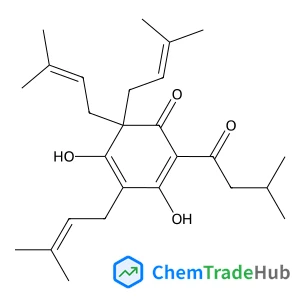
3,5-Dihydroxy-4-(3-methylbutanoyl)-2,6,6-tris(3-methyl-2-buten-1-yl)-2,4-cyclohexadien-1-one
CAS Number:
468-28-0
Molecular Formula:
C26H38O4
Recommended Suppliers





Disclaimer
This page provides academic journal information for reference and research purposes only. We are not affiliated with any journal publishers and do not handle publication submissions. For publication-related inquiries, please contact the respective journal publishers directly.
If you notice any inaccuracies in the information displayed, please contact us at support@chemtradehub.com. We will promptly review and address your concerns.