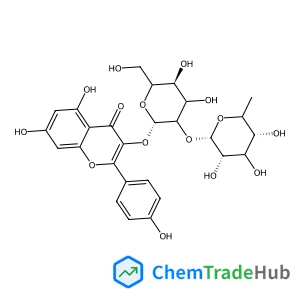
5,7-Dihydroxy-2-(4-hydroxyphenyl)-4-oxo-4H-chromen-3-yl 2-O-(6-deoxy-alpha-L-mannopyranosyl)-beta-D-glucopyranoside
CAS Number:
32602-81-6
Molecular Formula:
C27H30O15
Sérgio R. S. Veloso, Carlos A. B. Magalhães, Ana Rita O. Rodrigues, H. Vilaça, Maria-João R. P. Queiroz, J. A. Martins, Paulo J. G. Coutinho, Paula M. T. Ferreira, Elisabete M. S. Castanheira
Herein, novel dehydropeptide-based magnetogels, based on the hydrogelators Npx-L-Phe-Z-ΔAbu-OH, Npx-L-Trp-Z-ΔPhe-OH and Npx-L-Ala-Z-ΔPhe-Gly-L-Arg-Gly-L-Asp-Gly-OH and containing manganese ferrite nanoparticles (diameters around 20 nm), were prepared and characterized. TEM and FTIR measurements showed that the magnetogels maintained the fibrous structure of neat hydrogels, with fibres of ca. 20 nm average width (generally in the range 10–30 nm) and a few conformational changes relative to the neat hydrogels. The magnetogels were tested as nanocarriers for two potential fluorescent antitumor drugs: a thienopyridine derivative and the natural compound curcumin. FRET (Förster resonance energy transfer) from the aromatic moieties (energy donors) of gels to the fluorescent drugs (energy acceptors) and fluorescence anisotropy measurements confirmed the incorporation of both drugs into the magnetogel matrices. The transport of both drugs loaded into the magnetogels to membrane models (small unilamellar vesicles) was assessed by FRET between the fluorescent drugs and the dye Nile Red. The magnetogel possessing the RGD sequence was most promising for the delivery of the thienopyridine derivative, whereas three magnetogels were found to be suitable for the delivery of curcumin.

Chinese Journal of Chemistry

Medicinal Chemistry Research

Polycyclic Aromatic Compounds

Bioorganic & Medicinal Chemistry Letters

Cellulose

Acta Metallurgica Sinica-English Letters

Journal of Chemical Sciences

Colloid Journal

Journal of the Indian Institute of Science

Herald of the Russian Academy of Sciences
Eirik Hjertenæs, Anh Quynh Nguyen
DOI: 10.1039/C6CP06774C
Shinichi Enami, Michael R. Hoffmann, Agustín J. Colussi
DOI: 10.1039/C6CP06652F
C. J. (Kees-Jan) Weststrate
DOI: 10.1039/C6CP06069B
Greta Patrinoiu, Jose M. Calderon-Moreno, Ruxandra Birjega, Daniela C. Culita, Simona Somacescu, Adina M. Musuc, Tanta Spataru, Oana Carp
DOI: 10.1039/C6CP05911B
Qiang Hao, Xiuxiu Niu, Changshun Nie, Simeng Hao, Wei Zou, Jiangman Ge, Daimei Chen, Wenqing Yao
DOI: 10.1039/C6CP06122B
Michael Senske, Diana Constantinescu-Aruxandei, Martina Havenith, Christian Herrmann, Hermann Weingärtner, Simon Ebbinghaus
DOI: 10.1039/C6CP05080H
Chrystelle Neaime, Maria Amela-Cortes, Yann Molard, Stéphane Cordier, Benjamin Dierre, Michel Mortier, Toshiaki Takei, Kohsei Takahashi, Hajime Haneda, Marc Verelst, Séverine Lechevallier
DOI: 10.1039/C6CP05290H
Yu Guo, Lan-Lan He, Dong-Xia Zhao, Li-Dong Gong, Cui Liu, Zhong-Zhi Yang
DOI: 10.1039/C6CP05725J
Ying Wei, Jun Lu, Tong Lu, Feihong Meng, Jia Xu, Li Wang, Yang Li, Liping Wang, Fei Li
DOI: 10.1039/C6CP04431J
Juan P. Marcolongo, Uriel N. Morzan, Ari Zeida, Damián A. Scherlis, José A. Olabe
DOI: 10.1039/C6CP06314D
When handling 2-Chloro-1,2-bis(4-methylphenyl)ethanone (CAS: 71193-32-3), it is ...
4-Ethoxy-3-(5-methyl-4-oxo-7-propyl-1,4-dihydroimidazo[5,1-f][1,2,4]triazin-2-yl...
Methyl 3-Oxo-4-Androsten-17-Carboxylate (CAS: 2681-55-2) should be stored in a c...
(R)-3-Amino-4-(3-hexylphenylamino)-4-oxobutylphosphonic acid is primarily used i...
2-Methyl-2-propanyl 3-amino-3-carbamoyl-1-azetidinecarboxylate (CAS: 1254120-14-...
There are alternative reagents that can be used in synthesis instead of (E)-4-(t...
[2-(3-Chlorophenyl)-1,3-thiazol-4-yl]methanol (CAS: 121202-20-8) is a crystallin...
The market and research trends for Methyl (2S)-[(4S)-2,2-dimethyl-1,3-dioxolan-4...
The market for 1-Bromo-2-isocyanatoethane (CAS: 42865-19-0) is driven by its use...
4-Nitro-D-phenylalanine hydrochloride (CAS: 147065-06-3) is primarily used in re...

Physical Chemistry Chemical Physics (PCCP) is an international journal co-owned by 19 physical chemistry and physics societies from around the world. This journal publishes original, cutting-edge research in physical chemistry, chemical physics and biophysical chemistry. To be suitable for publication in PCCP, articles must include significant innovation and/or insight into physical chemistry; this is the most important criterion that reviewers and Editors will judge against when evaluating submissions. The journal has a broad scope and welcomes contributions spanning experiment, theory, computation and data science. Topical coverage includes spectroscopy, dynamics, kinetics, statistical mechanics, thermodynamics, electrochemistry, catalysis, surface science, quantum mechanics, quantum computing and machine learning. Interdisciplinary research areas such as polymers and soft matter, materials, nanoscience, energy, surfaces/interfaces, and biophysical chemistry are welcomed if they demonstrate significant innovation and/or insight into physical chemistry. Joined experimental/theoretical studies are particularly appreciated when complementary and based on up-to-date approaches.