












Surface chemistry of carbon-templated mesoporous aluminas
Literature Information
Publication Date
2009-03-23
DOI
10.1039/B821505G
Impact Factor
3.676
Authors
Ferdi Schüth, Helmut Knözinger
View Original
Abstract
Using infrared spectroscopy, a comparative investigation was carried out of the surface properties of mesoporous aluminas prepared by the carbon templating route and of a commercial alumina PURAL SB. In the hydroxylated state the mesoporous materials bear surface OH groups terminally bonded to an octahedral Al3+ ion, which has basic properties. In contrast, the surface of the commercial oxide additionally exposes OH groups which are terminally bonded to a tetrahedral cation. Bridging OH groups are Brønsted acid sites and are present on both oxides. The sites on the reference sample are stronger protonic acid sites than those on the mesoporous oxide. The strongest Brønsted acid sites are triply bridging OH groups, which are relatively more abundant on the reference oxide. Structural protons in the bulk of the oxides are also present on both oxides; they seem to be somewhat more stable in the reference sample. Condensation of basic OH groups with acidic groups at increasing dehydroxylation temperatures creates Lewis acid sites in the form of coordinatively unsaturated (cus) Al3+ ions the acid strength of which is higher on the reference material than on the mesoporous oxide. In conclusion, the surface properties of the investigated oxides are strongly dependent on the preparation route and conditions.
Related Literature
A furanosyl-carbonate autoinducer in cell-to-cell communication of V. harveyi
Kathleen M. McKenzie, Michael M. Meijler, Colin A. Lowery, Grant E. Boldt, Kim D. Janda
2005-09-06
Communication
DOI: 10.1039/B509396A
Ti2C80 is more likely a titanium carbide endohedral metallofullerene (Ti2C2)@C78
Kai Tan, Xin Lu
2005-07-29
Communication
DOI: 10.1039/B507855E
One step synthesis of highly crystalline and high coercive cobalt-ferrite nanocrystals
Sanjib Bhattacharyya, Jean-Paul Salvetat, Romain Fleurier, Anke Husmann, Thomas Cacciaguerra, Marie-Louise Saboungi
2005-09-01
Communication
DOI: 10.1039/B509026A
Nickel-catalyzed coupling of isocyanates with 1,3-iodoesters and halobenzenes: a novel method for the synthesis of imide and amide derivatives
Jen-Chieh Hsieh, Chien-Hong Cheng
2005-08-12
Communication
DOI: 10.1039/B506903C
Highly cytotoxic iron(ii) complexes with pentadentate pyridylligands as a new class of anti-tumor agents
Ella Lai-Ming Wong, Guo-Su Fang, Chi-Ming Che, Nianyong Zhu
2005-08-19
Communication
DOI: 10.1039/B507687K
Pictet–Spengler reactions in multiphasic supercritical carbon dioxide/CO2-expanded liquid media. In situ generation of carbamates as a strategy for reactions of amines in supercritical carbon dioxide
Joshua R. Dunetz, Rocco P. Ciccolini, Morgan Fröling, Scott M. Paap, Andrew J. Allen, Jefferson W. Tester, Rick L. Danheiser
2005-08-04
Communication
DOI: 10.1039/B508151C
Ultraviolet-emitting conjugated polymer poly(9,9′-alkyl-3,6-silafluorene) with a wide band gap of 4.0 eV
Yueqi Mo, Renyu Tian, Wei Shi, Yong Cao
2005-09-02
Communication
DOI: 10.1039/B507518A
Strongly luminescent binuclear aluminium chelate with polymer-like molecular packing and solution-processibility
Juan Qiao, Li. D. Wang, Jun. F. Xie, Gang. T. Lei, Guo. S. Wu, Yong Qiu
2005-08-16
Communication
DOI: 10.1039/B506907F
Aptamer biosensor for label-free impedance spectroscopy detection of proteins based on recognition-induced switching of the surface charge
Marcela C. Rodriguez, Abdel-Nasser Kawde, Joseph Wang
2005-07-12
Communication
DOI: 10.1039/B506571B
You might also like
Compound Q&A
What industries use (1R,3S)-1,3-Cyclopentanediol (CAS: 16326-97-9)?
(1R,3S)-1,3-Cyclopentanediol finds applications in various industries. In the ph...
16326-97-9(1R,3S)-1,3-Cyclopen...
Compound Q&A
What precautions should be taken when handling N'-[4-(Dimethylamino)phenyl]-N,N-dimethyl-1,4-benzenediamine (CAS: 637-31-0)?
When handling N'-[4-(Dimethylamino)phenyl]-N,N-dimethyl-1,4-benzenediamine, it i...
637-31-0N'-[4-(Dimethylamino...
Compound Q&A
Are there alternatives to 5-(2,4-Difluorophenyl)-2-methoxypyrimidine (CAS: 1352318-16-1) in synthesis?
There are several alternatives to 5-(2,4-Difluorophenyl)-2-methoxypyrimidine in ...
1352318-16-15-(2,4-Difluoropheny...
Compound Q&A
What regulatory guidelines apply to 1-(3-Methoxyphenoxy)propan-2-ol (CAS: 382141-68-6)?
1-(3-Methoxyphenoxy)propan-2-ol (CAS: 382141-68-6) must comply with the Globally...
382141-68-61-(3-Methoxyphenoxy)...
Compound Q&A
Is Tetrodotoxin Citrate (CAS: 18660-81-6) safe?
Tetrodotoxin Citrate is extremely dangerous and should be handled with extreme c...
18660-81-6Tetrodotoxin Citrate
Compound Q&A
What are the main uses of 2-Methyl-2-propanyl [(1R,3S)-3-hydroxycyclopentyl]carbamate (CAS: 225641-84-9)?
2-Methyl-2-propanyl [(1R,3S)-3-hydroxycyclopentyl]carbamate (CAS: 225641-84-9) i...
225641-84-92-Methyl-2-propanyl ...
Compound Q&A
How should waste containing 4-(2-Hydroxyhexafluoroisopropyl)Benzoic Acid (CAS: 16261-80-6) be handled?
Waste containing 4-(2-Hydroxyhexafluoroisopropyl)Benzoic Acid (CAS: 16261-80-6) ...
16261-80-64-(2-Hydroxyhexafluo...
Compound Q&A
How is 2-Methyl-2-proanyl {(2S)-1-[(benzyloxy)amino]-3-hydroxy-3-methyl-1-oxo-2-butanyl}carbamate (CAS: 102507-19-7) typically synthesized?
2-Methyl-2-proanyl {(2S)-1-[(benzyloxy)amino]-3-hydroxy-3-methyl-1-oxo-2-butanyl...
102507-19-72-Methyl-2-propanyl ...
Compound Q&A
What is Benzeneethanamine, α-ethyl-, hydrochloride (1:1) (CAS: 20735-15-3)?
Benzeneethanamine, α-ethyl-, hydrochloride (1:1) is an organic compound with the...
20735-15-3Benzeneethanamine, α...
Compound Q&A
Are there alternatives to 3-{(E)-[4-(Dimethylamino)phenyl]diazenyl}benzoic acid (CAS: 20691-84-3) in synthesis?
In the synthesis of compounds similar to 3-{(E)-[4-(Dimethylamino)phenyl]diazeny...
20691-84-33-{(E)-[4-(Dimethyla...
Source Journal
Physical Chemistry Chemical Physics

CiteScore:
5.5
Self-citation Rate:
10.3%
Articles per Year:
3036
Physical Chemistry Chemical Physics (PCCP) is an international journal co-owned by 19 physical chemistry and physics societies from around the world. This journal publishes original, cutting-edge research in physical chemistry, chemical physics and biophysical chemistry. To be suitable for publication in PCCP, articles must include significant innovation and/or insight into physical chemistry; this is the most important criterion that reviewers and Editors will judge against when evaluating submissions. The journal has a broad scope and welcomes contributions spanning experiment, theory, computation and data science. Topical coverage includes spectroscopy, dynamics, kinetics, statistical mechanics, thermodynamics, electrochemistry, catalysis, surface science, quantum mechanics, quantum computing and machine learning. Interdisciplinary research areas such as polymers and soft matter, materials, nanoscience, energy, surfaces/interfaces, and biophysical chemistry are welcomed if they demonstrate significant innovation and/or insight into physical chemistry. Joined experimental/theoretical studies are particularly appreciated when complementary and based on up-to-date approaches.
Recommended Compounds

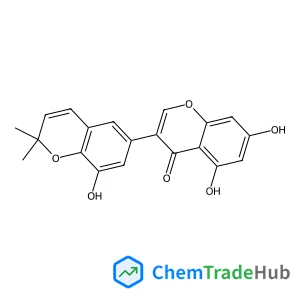
5,7,8'-Trihydroxy-2',2'-dimethyl-2'H,4H-3,6'-bichromen-4-one
CAS Number:
129280-33-7
Molecular Formula:
C20H16O6

Recommended Suppliers




Disclaimer
This page provides academic journal information for reference and research purposes only. We are not affiliated with any journal publishers and do not handle publication submissions. For publication-related inquiries, please contact the respective journal publishers directly.
If you notice any inaccuracies in the information displayed, please contact us at support@chemtradehub.com. We will promptly review and address your concerns.