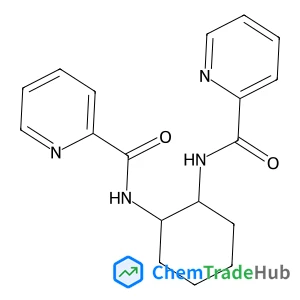
N,N'-(1R,2R)-1,2-Cyclohexanediyldi(2-pyridinecarboxamide)
CAS Number:
218290-24-5
Molecular Formula:
C18H20N4O2
Antti Valanne, Jouko Peltonen, Tero Soukka, Pekka Hänninen, Harri Härmä
A variety of particles have been adopted as solid support in bioaffinity assays, and the ability to modify the particle properties makes them a versatile tool in assay development. In separation-free fluorescence resonance energy transfer (FRET) assays, fluorescent particles have been used as donors and acceptors due to their high binding capacity and high specific activity. The availability of multiple fluorophores within the FRET range renders the orientation of individual donors and acceptors a non-factor enabling efficient sensitization. The high specific activity, being proportional to the particle size, may also inflict background fluorescence due to distance dependency of FRET, if the donor emission and detection wavelengths overlap. This is the first study to evaluate the impact of differently sized (47, 68, 92 and 202 nm in diameter) europium(III) chelate-doped polystyrene/acrylic acid donor particles on the core-related background fluorescence in a separation-free FRET-based assay utilizing competitive adsorption of acceptor-labelled protein. Within the particle size range studied, the particle core size-related background fluorescence showed no significant effect on the assay performance at the detection wavelength, which was selected on account of donor emission minimum. The assay sensitivity and dynamics showed compliancy with the rules of competitive assay. The results can be used in designing a competitive separation-free FRET-based assay utilizing particles as donors. In accordance, we applied the method for protein quantification. Sample protein prevented the adsorption of acceptor-labelled protein on the nanoparticle reducing energy transfer. Using this approach, a 100- to 1000-fold lower protein concentration was measured in comparison to traditional photometric protein assays suggesting that a high sensitivity assay can be constructed using FRET-based nanoparticle assay concepts.
Wim G. Roeterdink, Maurice H. M. Janssen
DOI: 10.1039/B107897F
E. Saiz, E. Riande
DOI: 10.1039/B106480K
Gwang-Hi Jeung, Paul Luc, Raymond Vetter, Kyoung Hoon Kim, Yoon Sup Lee
DOI: 10.1039/B107190D
Gui-xia Liu, Yi-hong Ding, Ze-sheng Li, Qiang Fu, Xu-ri Huang, Chia-chung Sun, Au-chin Tang
DOI: 10.1039/B109758J
Luís P. N. Rebelo, Zoran P. Visak, Jerzy Szydlowski
DOI: 10.1039/B109405J
Thorsten M. Bernhardt, Bernhard Kaiser, Klaus Rademann
DOI: 10.1039/B110194C
S. M. Handford-Styring, R. W. Walker
DOI: 10.1039/B108578F
DOI: 10.1039/B109974D
Tatyana Kuznetsova, Bjørn Kvamme
DOI: 10.1039/B108726F
6-Bromo-2-methylimidazo[1,2-a]pyrimidine (CAS: 1111638-05-1) falls under various...
While there are no direct alternatives, similar compounds like 1-Pyrrolidineetha...
4-Methyl-2,6-bis(2-methyl-2-propanyl)phenyl methylcarbamate (CAS: 1918-11-2) is ...
2-(3-Bromo-4-fluorophenyl)-1,3-dioxolane (CAS: 77771-04-1) should be stored in a...
4,5,6,7-Tetrahydro-1H-indazole hydrochloride is a white crystalline solid with a...
(2R)-1-Methoxy-3-phenyl-2-propanamine is a chiral organic compound with the CAS ...
Ethyl 1-(1-phenylethyl)-1H-imidazole-5-carboxylate is used in various industries...
4-[(1E,3S)-1-(4-Hydroxyphenyl)-1,4-pentadien-3-yl]phenol (CAS: 17676-24-3) falls...
(S)-3-Amino-5-phenylpentanoic acid hydrochloride is primarily used in the pharma...
7-Methoxy-1-benzothiophene-2-carboxylic acid is typically synthesized by reactin...

Analyst publishes analytical and bioanalytical research that reports premier fundamental discoveries and inventions, and the applications of those discoveries, unconfined by traditional discipline barriers.

![Benzeneacetic acid, 2-[(2,6-dichlorophenyl)amino]-, compd. with 1-pyrrolidineethanol (1:1) structure](https://static.chemtradehub.com/structs/119/119623-66-4-5301.webp "Benzeneacetic acid, 2-[(2,6-dichlorophenyl)amino]-, compd. with 1-pyrrolidineethanol (1:1) structure")