












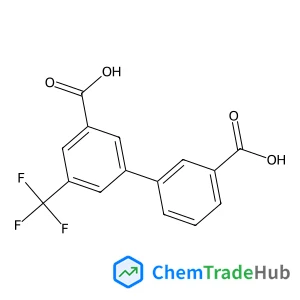
3-(3-Carboxyphenyl)-5-(trifluoromethyl)benzoic acid
CAS Number:
1261930-96-4
Molecular Formula:
C15H9F3O4
Raffaella Paparcone, Rüdiger Kniep
The shape development of a biomimetic fluorapatite–gelatine nanocomposite on the μm scale is characterised by a fractal mechanism with the origin being intrinsically coded in a (central) elongated hexagonal-prismatic seed. The 3D superstructure of the seed is distinctively overlaid by a pattern consisting of gelatine microfibrils. The orientation of the microfibrils is assumed to be controlled by an intrinsic electrical field generated by the nanocomposite during development and growth of the seed. In order to confirm this assumption and to get more detailed information on orientational relations of the complex nanocomposite we simulated the pattern formation process up to the μm scale. The results from experimental studies and simulation results on an atomistic level support a model scenario wherein the elementary building blocks for the aggregation are represented by elongated hexagonal-prismatic objects (A-units), with the embedded collagen triple-helices in their centers. The interactions of the A-units are consequently modelled by three contributions: the crystal energy part (originating from the pair-wise interactions of the “apatite shells” of the prismatic units), the electrostatic interaction (originating from the unit charges located at the ends of the collagen triple helices), and the interaction energy of the A-units mediated by the solvent. The next level of complexity is related to the fact that micro fibrils were found in the fluorapatite–gelatine nanocomposites. They consist of bundles of triple helical protein molecules, which are embedded within the 3D-hexagonal prismatic arrangement of the A-units. In our approach we consider the microfibrils as chains of flexible dipoles with effective dipole moments. The crystal growth processes is modelled as an energetically controlled stepwise association of elementary building blocks of different kind on a 3D-grid. The remarkable and excellent qualitative agreement between the simulated fibril patterns and the observations made by SEM and TEM support the concept of an intrinsic electric field driven morphogenesis of the fluorapatite–gelatine nanocomposite. The simulated fibril pattern also bears the chance to make fresh attempts in order to find explanations for experimental observations which are not understood up to now.
Ho-Jun Cho, Ju Hyun Kim
DOI: 10.1039/D3OB01619F
Tye Thompson, Pornthip Piyanuch, Nantanit Wanichacheva, Anyanee Kamkaew, Kevin Burgess
DOI: 10.1039/D3OB01654D
Long-Jin Zhong, Jian-Hong Fan, Pu Chen, Peng-Fei Huang, Bi-Quan Xiong, Ke-Wen Tang, Yu Liu
DOI: 10.1039/D3OB01762A
Peng-Fei Huang, Jia-Le Fu, Jia-Jing Huang, Bi-Quan Xiong, Ke-Wen Tang, Yu Liu
DOI: 10.1039/D3OB01915B
Enrique L. Larghi, Andrea B. J. Bracca, Sebastián O. Simonetti, Teodoro S. Kaufman
DOI: 10.1039/D3OB01837G
Narihito Ogawa, Keisuke Gonda, Yuichi Kobayashi
DOI: 10.1039/D3OB01820B
Ahmad Takallou, Munir Al-Siyabi, Sulaiman Al-Shidhani, Yazdanbakhsh Lotfi Nosood, Azizollah Habibi, Alhajaj Almaani, Muhammad U. Anwar, Ahmed Al-Harrasi
DOI: 10.1039/D3OB01768K
Hyunjin Oh, Ikyon Kim
DOI: 10.1039/D3OB01747H
4-Amino-3-bromophenol (CAS: 74440-80-5) falls under the classification of a haza...
(17beta)-3-Oxoestr-4-en-17-yl acetate should be stored in a cool, dry place away...
2-[(2,2-Diethoxyethyl)disulfanyl]-1,1-diethoxyethane (CAS: 76505-71-0) is a colo...
The market and research for 1-(β-D-ribofuranosyl)-1H-imidazo[4,5-c]pyridin-4-ami...
Waste containing Conjugated Estrogen (CAS: 12126-59-9) should be collected and d...
The market for Bis(2,2,2-trifluoroethyl) (methoxycarbonylmethyl)phosphonate (CAS...
There are several alternatives to 3,4'-Di-O-methylellagic acid (CAS: 57499-59-9)...
2-Chloro-N,N-dimethylpyridin-4-amine (CAS: 59047-70-0) is regulated under the Gl...
Cerium(3+);oxygen(2-);vanadium(5+) (CAS: 13597-19-8) is a complex inorganic comp...
7-Chloro-1-iodoisoquinoline (CAS: 1203579-27-4) is generally considered safe whe...

Physical Chemistry Chemical Physics (PCCP) is an international journal co-owned by 19 physical chemistry and physics societies from around the world. This journal publishes original, cutting-edge research in physical chemistry, chemical physics and biophysical chemistry. To be suitable for publication in PCCP, articles must include significant innovation and/or insight into physical chemistry; this is the most important criterion that reviewers and Editors will judge against when evaluating submissions. The journal has a broad scope and welcomes contributions spanning experiment, theory, computation and data science. Topical coverage includes spectroscopy, dynamics, kinetics, statistical mechanics, thermodynamics, electrochemistry, catalysis, surface science, quantum mechanics, quantum computing and machine learning. Interdisciplinary research areas such as polymers and soft matter, materials, nanoscience, energy, surfaces/interfaces, and biophysical chemistry are welcomed if they demonstrate significant innovation and/or insight into physical chemistry. Joined experimental/theoretical studies are particularly appreciated when complementary and based on up-to-date approaches.
![[3-Formyl-5-(trifluoromethoxy)phenyl]boronic acid structure](https://static.chemtradehub.com/structs/145/1451393-39-7-aebb.webp "[3-Formyl-5-(trifluoromethoxy)phenyl]boronic acid structure")
![9-Ethyl-3-{(E)-[ethyl(2-methylphenyl)hydrazono]methyl}-9H-carbazole structure](https://static.chemtradehub.com/structs/127/1274948-12-7-301f.webp "9-Ethyl-3-{(E)-[ethyl(2-methylphenyl)hydrazono]methyl}-9H-carbazole structure")






