



Scaling and dynamics of “flow distributed oscillation patterns” in the Belousov–Zhabotinsky reaction
Literature Information
Publication Date
2002-01-15
DOI
10.1039/B107627B
Impact Factor
3.676
Authors
R. Tóth, V. Gáspár
View Original
Abstract
The formation of “flow distributed oscillation” (FDO) patterns in the Belousov–Zhabotinsky (BZ) reaction is studied experimentally. We confirm the dependence of the pattern wavelength on the flow velocity and the concentration of the reactant species BrO3− and H+ as predicted in a previous study. We also report on the initial development of the FDO patterns. In contrast to simple interpretations, the patterns arise through a “wave splitting” mechanism in which a pair of counter-propagating wave pulses are created from a pacemaker site at some distance ahead of the pattern: one of these waves propagates with the flow and leaves the reactor, the other propagates against the flow and eventually settles to form the next band of the FDO pattern. This initiation mechanism is confirmed in numerical studies based on the Oregonator model. These computations also indicate the possibility of complex dynamics similar to the “resonance patterns” reported in studies of the propagation of BZ waves through capillary tubes.
Recommended Journals

Chemical Communications

Crystallography Reports

Organic Process Research & Development

Current Opinion in Solid State & Materials Science

Russian Journal of Coordination Chemistry

Current Opinion in Colloid & Interface Science

Russian Journal of Bioorganic Chemistry

Journal of Peptide Science

Chemistry Education Research and Practice

Russian Journal of General Chemistry
Related Literature
Dearomatization of 3-cyanoindoles by (3 + 2) cycloaddition: from batch to flow chemistry
Maxime Manneveau, Saori Tanii, Fanny Gens, Julien Legros
2020-04-20
Communication
DOI: 10.1039/D0OB00582G
Photocatalytic xanthate-based radical addition/cyclization reaction sequence toward 2-biphenyl isocyanides: synthesis of 6-alkylated phenanthridines
Pedro López-Mendoza, Luis D. Miranda
2020-04-22
Communication
DOI: 10.1039/D0OB00136H
Synthesis of β-lactams via diastereoselective, intramolecular Kinugasa reactions
Oskar Popik, Barbara Grzeszczyk, Olga Staszewska-Krajewska, Bartłomiej Furman, Marek Chmielewski
2020-03-16
Paper
DOI: 10.1039/D0OB00228C
1-(2H-Azirine-2-carbonyl)benzotriazoles: building blocks for the synthesis of pyrrole-containing heterocycles‡
Ekaterina E. Galenko, Firuza M. Shakirova, Vladimir A. Bodunov, Mikhail S. Novikov, Alexander F. Khlebnikov
2020-03-03
Paper
DOI: 10.1039/D0OB00206B
CuBr2-catalyzed diastereoselective allylation: total synthesis of decytospolides A and B and their C6-epimers
Birakishore Padhi, G. Sudhakar Reddy, N. Arjunreddy Mallampudi, Utkal Mani Choudhury, Debendra K. Mohapatra
2020-03-09
Paper
DOI: 10.1039/C9OB02689D
A molecular electron density theory study of the enhanced reactivity of aza aromatic compounds participating in Diels–Alder reactions
Luis R. Domingo, Patricia Pérez
2019-12-09
Paper
DOI: 10.1039/C9OB02467K
Examination of pinanediol–boronic acid ester formation in aqueous media: relevance to the relative stability of trigonal and tetrahedral boronate esters
Mayte A. Martínez-Aguirre, Marcos Flores-Alamo, Felipe Medrano, Anatoly K. Yatsimirsky
2020-03-18
Paper
DOI: 10.1039/D0OB00201A
Direct synthesis of cyclic lipopeptides using intramolecular native chemical ligation and thiol–ene CLipPA chemistry
2020-02-05
Paper
DOI: 10.1039/D0OB00203H
A Rh-catalyzed three-component reaction for the diastereoselective synthesis of pyrazolone derivatives with contiguous quaternary stereocenters
Chaoqun Ao, Jingjing Huang, Xinfang Xu, Shikun Jia, Zhenghui Kang, Wenhao Hu
2020-04-13
Communication
DOI: 10.1039/D0OB00482K
You might also like
Compound Q&A
What regulatory guidelines apply to 6-Bromo-2-methylimidazo[1,2-a]pyrimidine (CAS: 1111638-05-1)?
6-Bromo-2-methylimidazo[1,2-a]pyrimidine (CAS: 1111638-05-1) falls under various...
1111638-05-16-Bromo-2-methylimid...
Compound Q&A
Are there alternatives to 1-Pyrrolidineethanol, β-methyl-α-phenyl-, (αS,βR) (CAS: 123620-80-4) in synthesis?
While there are no direct alternatives, similar compounds like 1-Pyrrolidineetha...
123620-80-41-Pyrrolidineethanol...
Compound Q&A
Is 4-Methyl-2,6-bis(2-methyl-2-propanyl)phenyl methylcarbamate (CAS: 1918-11-2) safe?
4-Methyl-2,6-bis(2-methyl-2-propanyl)phenyl methylcarbamate (CAS: 1918-11-2) is ...
1918-11-24-Methyl-2,6-bis(2-m...
Compound Q&A
How should 2-(3-Bromo-4-fluorophenyl)-1,3-dioxolane (CAS: 77771-04-1) be stored?
2-(3-Bromo-4-fluorophenyl)-1,3-dioxolane (CAS: 77771-04-1) should be stored in a...
77771-04-12-(3-Bromo-4-fluorop...
Compound Q&A
What are the physical and chemical properties of 4,5,6,7-Tetrahydro-1H-indazole hydrochloride (CAS: 18161-11-0)?
4,5,6,7-Tetrahydro-1H-indazole hydrochloride is a white crystalline solid with a...
18161-11-04,5,6,7-Tetrahydro-1...
Compound Q&A
What is (2R)-1-Methoxy-3-phenyl-2-propanamine (CAS: 59919-07-2)?
(2R)-1-Methoxy-3-phenyl-2-propanamine is a chiral organic compound with the CAS ...
59919-07-2(2R)-1-Methoxy-3-phe...
Compound Q&A
What industries use Ethyl 1-(1-phenylethyl)-1H-imidazole-5-carboxylate (CAS: 56649-47-9)?
Ethyl 1-(1-phenylethyl)-1H-imidazole-5-carboxylate is used in various industries...
56649-47-9Ethyl 1-(1-phenyleth...
Compound Q&A
What regulatory guidelines apply to 4-[(1E,3S)-1-(4-Hydroxyphenyl)-1,4-pentadien-3-yl]phenol (CAS: 17676-24-3)?
4-[(1E,3S)-1-(4-Hydroxyphenyl)-1,4-pentadien-3-yl]phenol (CAS: 17676-24-3) falls...
17676-24-34-[(1E,3S)-1-(4-Hydr...
Compound Q&A
What industries use (S)-3-Amino-5-phenylpentanoic acid hydrochloride (CAS: 331846-97-0)?
(S)-3-Amino-5-phenylpentanoic acid hydrochloride is primarily used in the pharma...
331846-97-0(S)-3-Amino-5-phenyl...
Compound Q&A
How is 7-methoxy-1-benzothiophene-2-carboxylic acid (CAS: 88791-07-5) typically synthesized?
7-Methoxy-1-benzothiophene-2-carboxylic acid is typically synthesized by reactin...
88791-07-57-methoxy-1-benzothi...
Source Journal
Physical Chemistry Chemical Physics

CiteScore:
5.5
Self-citation Rate:
10.3%
Articles per Year:
3036
Physical Chemistry Chemical Physics (PCCP) is an international journal co-owned by 19 physical chemistry and physics societies from around the world. This journal publishes original, cutting-edge research in physical chemistry, chemical physics and biophysical chemistry. To be suitable for publication in PCCP, articles must include significant innovation and/or insight into physical chemistry; this is the most important criterion that reviewers and Editors will judge against when evaluating submissions. The journal has a broad scope and welcomes contributions spanning experiment, theory, computation and data science. Topical coverage includes spectroscopy, dynamics, kinetics, statistical mechanics, thermodynamics, electrochemistry, catalysis, surface science, quantum mechanics, quantum computing and machine learning. Interdisciplinary research areas such as polymers and soft matter, materials, nanoscience, energy, surfaces/interfaces, and biophysical chemistry are welcomed if they demonstrate significant innovation and/or insight into physical chemistry. Joined experimental/theoretical studies are particularly appreciated when complementary and based on up-to-date approaches.
Recommended Compounds
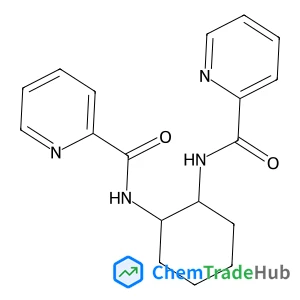
N,N'-(1R,2R)-1,2-Cyclohexanediyldi(2-pyridinecarboxamide)
CAS Number:
218290-24-5
Molecular Formula:
C18H20N4O2
Recommended Suppliers





Disclaimer
This page provides academic journal information for reference and research purposes only. We are not affiliated with any journal publishers and do not handle publication submissions. For publication-related inquiries, please contact the respective journal publishers directly.
If you notice any inaccuracies in the information displayed, please contact us at support@chemtradehub.com. We will promptly review and address your concerns.