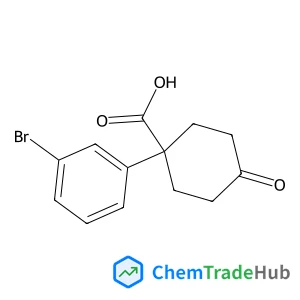
1-(3-Bromophenyl)-4-oxocyclohexanecarboxylic acid
CAS Number:
1385694-53-0
Molecular Formula:
C13H13BrO3
Micheál D. Scanlon, Emma Jennings, Damien W. M. Arrigan
The electrochemical behaviour of hen-egg-white lysozyme (HEWL) was studied at the polarized water/1,2-dichloroethane interface. The voltammetric ion-transfer response was found to be dependent on the pH and ionic strength of the aqueous phase solution and also on the nature of the organic phase electrolyte anion. The current–pH behaviour of HEWL was dominated by the charge of the biomolecule at each pH, as indicated by the close relationship between the experimental peak currents and the theoretical curve for HEWL based on its known acid–base chemistry. Three organic electrolyte anions of differing hydrophobicities were investigated (TFPB−, TPBCl− and TPB−) and it was found that the ion transfer voltammetric peaks occurred at successively higher potentials in the order of increasing hydrophobicity, ΔϕTPB < ΔϕTPBCl < ΔϕTPBF. The voltammetric response was time dependent during multi-cyclic voltammetry experiments, with the formation of a white film of precipitate at the interface. A pre-peak consistent with adsorption of the HEWL ion transfer product at the liquid/liquid interface was also observed. The results suggest that an adsorption or re-arrangement of HEWL molecules with time at the interface is taking place. A mechanism for the response on application of a triangular potential waveform with cyclic voltammetry is proposed based on an i-C-i mechanism. Our results indicate that HEWL is electroactive at the polarized liquid/liquid interface and that such electrochemical methods may provide an approach to the label-free detection and characterization of protein molecules.
Hongli Wang, Chun-Ran Chang
DOI: 10.1039/D3OB01836A
Supanat Buntasana, Panuwat Padungros
DOI: 10.1039/D3OB01618H
Peng-Fei Huang, Jia-Le Fu, Jia-Jing Huang, Bi-Quan Xiong, Ke-Wen Tang, Yu Liu
DOI: 10.1039/D3OB01915B
DOI: 10.1039/D3OB01730C
Tye Thompson, Pornthip Piyanuch, Nantanit Wanichacheva, Anyanee Kamkaew, Kevin Burgess
DOI: 10.1039/D3OB01654D
Sheng Huang, Liang Jin, Yufeng Liu, Guoping Yang, Aixin Wang, Zhanggao Le, Guofang Jiang, Zongbo Xie
DOI: 10.1039/D3OB01491F
Kaiwen Li, Hongwu Jiang, Shuangfeng Dong, Shuang-Long Li, Zhuqi Chen, Guochuan Yin
DOI: 10.1039/D3OB01770B
DOI: 10.1039/D3OB01784B
4-Amino-3-bromophenol (CAS: 74440-80-5) falls under the classification of a haza...
(17beta)-3-Oxoestr-4-en-17-yl acetate should be stored in a cool, dry place away...
2-[(2,2-Diethoxyethyl)disulfanyl]-1,1-diethoxyethane (CAS: 76505-71-0) is a colo...
The market and research for 1-(β-D-ribofuranosyl)-1H-imidazo[4,5-c]pyridin-4-ami...
Waste containing Conjugated Estrogen (CAS: 12126-59-9) should be collected and d...
The market for Bis(2,2,2-trifluoroethyl) (methoxycarbonylmethyl)phosphonate (CAS...
There are several alternatives to 3,4'-Di-O-methylellagic acid (CAS: 57499-59-9)...
2-Chloro-N,N-dimethylpyridin-4-amine (CAS: 59047-70-0) is regulated under the Gl...
Cerium(3+);oxygen(2-);vanadium(5+) (CAS: 13597-19-8) is a complex inorganic comp...
7-Chloro-1-iodoisoquinoline (CAS: 1203579-27-4) is generally considered safe whe...

Physical Chemistry Chemical Physics (PCCP) is an international journal co-owned by 19 physical chemistry and physics societies from around the world. This journal publishes original, cutting-edge research in physical chemistry, chemical physics and biophysical chemistry. To be suitable for publication in PCCP, articles must include significant innovation and/or insight into physical chemistry; this is the most important criterion that reviewers and Editors will judge against when evaluating submissions. The journal has a broad scope and welcomes contributions spanning experiment, theory, computation and data science. Topical coverage includes spectroscopy, dynamics, kinetics, statistical mechanics, thermodynamics, electrochemistry, catalysis, surface science, quantum mechanics, quantum computing and machine learning. Interdisciplinary research areas such as polymers and soft matter, materials, nanoscience, energy, surfaces/interfaces, and biophysical chemistry are welcomed if they demonstrate significant innovation and/or insight into physical chemistry. Joined experimental/theoretical studies are particularly appreciated when complementary and based on up-to-date approaches.