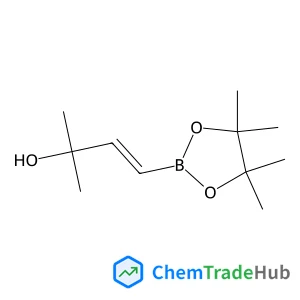
(E)-2-methyl-4-(4,4,5,5-tetramethyl-1,3,2-dioxaborolan-2-yl)but-3-en-2-ol
CAS Number:
581802-26-8
Molecular Formula:
C11H21BO3
Juan C. Gómez Martín, Mark A. Blitz, John M. C. Plane
Atomic silicon is generated by meteoric ablation in the Earth’s upper atmosphere (70–110 km). The reactions of Si(3PJ) atoms with several atmospherically relevant species were studied by the pulsed laser photolysis of a Si atom precursor (typically PheSiH3), followed by time-resolved laser induced fluorescence at 251.43 nm (Si(3p23P0→ 4s 3P1)). This yielded: k(Si + O2, 190–500 K) = 9.49 × 10⁻¹¹ + 1.80 × 10⁻¹⁰× exp(−T/115 K) cm3 molecule−1 s−1 (uncertainty ≤±15%), in good accord with recent high-level theoretical calculations but in marked disagreement with previous experimental work; k(Si + O3, 190–293 K) = (4.0 ± 0.5) × 10−10 cm3 molecule−1 s−1; k(Si + CO2, 293 K) ≤ 1.2 × 10⁻¹⁴ cm3 molecule−1 s−1; and k(Si + H2O, 293 K) ≤ 2.6 × 10⁻¹³ cm3 molecule−1 s−1. These results are explained using a combination of quantum chemistry calculations and long-range capture theory. The quenching rate coefficients k(Si(1D2) + N2, 293 K) = (4.0 ± 0.7) × 10−11 cm3 molecule−1 s−1 and k(Si(1D2) + H2O, 293 K) = (2.3 ± 0.3) × 10−10 cm3 molecule−1 s−1 were also determined.

Journal of Natural Medicines

Russian Journal of Organic Chemistry

Chemistry Education Research and Practice

Russian Journal of Coordination Chemistry

Russian Journal of General Chemistry

Journal of Saudi Chemical Society

Current Opinion in Solid State & Materials Science

Russian Journal of Bioorganic Chemistry

Journal of Peptide Science

Drug Discovery Today
Wei Guo, Xiaochuan Duan, Yan Shen, Kezhen Qi, Caiying Wei, Wenjun Zheng
DOI: 10.1039/C3CP51663F
Matthias Schnurr, Christopher Witte, Leif Schröder
DOI: 10.1039/C3CP51227D
Satheesh Sambandam, Javier Parrondo, Vijay Ramani
DOI: 10.1039/C3CP51450A
Li-Lin Tan, Hong-Yan Chen, Li-Feng Hao, Yong Shen, Li-Min Xiao, Jun-Min Liu, Dai-Bin Kuang, Cheng-Yong Su
DOI: 10.1039/C3CP51633D
João Pina, J. Seixas de Melo, D. Breusov, Ullrich Scherf
DOI: 10.1039/C3CP52056K
Bas C. van der Wiel, René M. Williams
DOI: 10.1039/C3CP52148F
Katherine M. Sharples, Emma Carter, Colan E. Hughes, Kenneth D. M. Harris, James A. Platts, Damien M. Murphy
DOI: 10.1039/C3CP52464G
Esther Rebollar, Javier R. Vázquez de Aldana, Ignacio Martín-Fabiani, Margarita Hernández, Daniel R. Rueda, Tiberio A. Ezquerra, Concepción Domingo, Pablo Moreno, Marta Castillejo
DOI: 10.1039/C3CP51523K
Pyosang Kim, Sujin Ham, Juwon Oh, Hiroki Uoyama, Hajime Watanabe, Kazunari Tagawa, Hidemitsu Uno, Dongho Kim
DOI: 10.1039/C3CP50166C
Yilei Wu, Agnieszka Olzyńska, Martin Hof, Gokhan Yahioglu, Duncan R. Casey, Oscar Ces, Jana Humpolíčková, Marina K. Kuimova
DOI: 10.1039/C3CP51953H
When considering alternatives to 1-(4-Chlorophenyl)-N-hydroxymethanimine (CAS: 3...
This compound should be stored in a cool, dry place away from direct sunlight. I...
3-(4-Bromophenyl)-5-(2-fluorophenyl)-1,2,4-oxadiazole is synthesized through a m...
5-Chloro-2-(4-chlorophenyl)-4-methyl-6-[3-(1-piperidinyl)propoxy]pyrimidine (CAS...
2-Chloro-4-(difluoromethoxy)pyridine is used in the pharmaceutical industry for ...
3-Chloro-6-methylpyridazine (CAS: 1121-79-5) is classified under the Globally Ha...
Several alternatives can be used in the synthesis of Methyl 4,5-dimethyl-2-nitro...
Alternatives to (2E,2'E)-3,3'-(1,4-Phenylene)bisacrylaldehyde include other acry...
3-Amino-5-chloropyridin-2-ol hydrochloride is an organic compound with the CAS n...
When handling 6,7-Difluoro-2,3-dihydro-4H-chromen-4-one, it is essential to wear...

Physical Chemistry Chemical Physics (PCCP) is an international journal co-owned by 19 physical chemistry and physics societies from around the world. This journal publishes original, cutting-edge research in physical chemistry, chemical physics and biophysical chemistry. To be suitable for publication in PCCP, articles must include significant innovation and/or insight into physical chemistry; this is the most important criterion that reviewers and Editors will judge against when evaluating submissions. The journal has a broad scope and welcomes contributions spanning experiment, theory, computation and data science. Topical coverage includes spectroscopy, dynamics, kinetics, statistical mechanics, thermodynamics, electrochemistry, catalysis, surface science, quantum mechanics, quantum computing and machine learning. Interdisciplinary research areas such as polymers and soft matter, materials, nanoscience, energy, surfaces/interfaces, and biophysical chemistry are welcomed if they demonstrate significant innovation and/or insight into physical chemistry. Joined experimental/theoretical studies are particularly appreciated when complementary and based on up-to-date approaches.