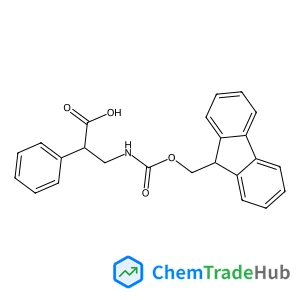
(S)-3-((((9H-Fluoren-9-yl)methoxy)carbonyl)amino)-2-phenylpropanoic acid
CAS Number:
1217663-60-9
Molecular Formula:
C24H21NO4
Satheesh Sambandam, Javier Parrondo, Vijay Ramani
The oxygen permeability of perfluorinated and hydrocarbon polymer electrolyte membranes (PEMs; Nafion®, SPEEK and SPSU), which are used as electrolytes and electrode ionomers in polymer electrolyte fuel cells (PEFCs), was estimated using chronoamperometry using a modified fuel cell set-up. A thin, cylindrical microelectrode was embedded into the PEM and used as the working electrode. The PEM was sandwiched between 2 gas diffusion electrodes, one of which was catalyzed and served as the counter and pseudo-reference electrode. Independently, from fuel cell experiments, the oxygen transport resistance arising due to transport through the ionomer film covering the catalyst active sites was estimated at the limiting current and decoupled from the overall mass transport resistance. The in situ oxygen permeability measured at 80 °C and 75% RH of perfluorinated ionomers such as Nafion® (3.85 × 10¹² mol cm−1 s−1) was observed to be an order of magnitude higher than that of hydrocarbon-based PEMs such as SPEEK (0.27 × 10¹² mol cm−1 s−1) and SPSU (0.15 × 10¹² mol cm−1 s−1). The obtained oxygen transport (through ionomer film) resistance values (Nafion® – 1.6 s cm−1, SPEEK – 2.2 s cm−1 and SPSU – 3.0 s cm−1; at 80 °C and 75% RH) correlated well with the measured oxygen permeabilities in these ion-containing polymers.
Rui Chen, Sam Williamson, Kelly M. Fulton, Susan M. Twine, Jianjun Li
DOI: 10.1039/C9AY01756A
Ryan P. Dias, Marella H. Schammel, Keith P. Reber
DOI: 10.1039/C9AY01443H
DOI: 10.1039/B008582K
Nian Bing Li, Wei Wei Zhu, Jun Hua Luo, Hong Qun Luo
DOI: 10.1039/C1AN15753A
Ping Wu, Yang Gao, Yimei Lu, Hui Zhang, Chenxin Cai
DOI: 10.1039/C3AN01375H
Masato Suzuki, Satoshi Arimoto, Tsuguhiro Korenaga, Tomoyuki Yasukawa
DOI: 10.1039/D0AN00100G
Justin L. Abell, Joonsang Lee, Qun Zhao, Harold Szu, Yiping Zhao
DOI: 10.1039/C1AN15623C
Tatiane Lima Amorim, Mariana Gavioli dos Reis Pena, Fabiano Freire Costa, Marcone Augusto Leal de Oliveira, Paula Rocha Chellini
DOI: 10.1039/C9AY01917K
When considering alternatives to 1-(4-Chlorophenyl)-N-hydroxymethanimine (CAS: 3...
This compound should be stored in a cool, dry place away from direct sunlight. I...
3-(4-Bromophenyl)-5-(2-fluorophenyl)-1,2,4-oxadiazole is synthesized through a m...
5-Chloro-2-(4-chlorophenyl)-4-methyl-6-[3-(1-piperidinyl)propoxy]pyrimidine (CAS...
2-Chloro-4-(difluoromethoxy)pyridine is used in the pharmaceutical industry for ...
3-Chloro-6-methylpyridazine (CAS: 1121-79-5) is classified under the Globally Ha...
Several alternatives can be used in the synthesis of Methyl 4,5-dimethyl-2-nitro...
Alternatives to (2E,2'E)-3,3'-(1,4-Phenylene)bisacrylaldehyde include other acry...
3-Amino-5-chloropyridin-2-ol hydrochloride is an organic compound with the CAS n...
When handling 6,7-Difluoro-2,3-dihydro-4H-chromen-4-one, it is essential to wear...

Physical Chemistry Chemical Physics (PCCP) is an international journal co-owned by 19 physical chemistry and physics societies from around the world. This journal publishes original, cutting-edge research in physical chemistry, chemical physics and biophysical chemistry. To be suitable for publication in PCCP, articles must include significant innovation and/or insight into physical chemistry; this is the most important criterion that reviewers and Editors will judge against when evaluating submissions. The journal has a broad scope and welcomes contributions spanning experiment, theory, computation and data science. Topical coverage includes spectroscopy, dynamics, kinetics, statistical mechanics, thermodynamics, electrochemistry, catalysis, surface science, quantum mechanics, quantum computing and machine learning. Interdisciplinary research areas such as polymers and soft matter, materials, nanoscience, energy, surfaces/interfaces, and biophysical chemistry are welcomed if they demonstrate significant innovation and/or insight into physical chemistry. Joined experimental/theoretical studies are particularly appreciated when complementary and based on up-to-date approaches.