












Molecular mobility and relaxation process of isolated lignin studied by multifrequency calorimetric experiments
Literature Information
Publication Date
2009-01-07
DOI
10.1039/B812512K
Impact Factor
3.676
Authors
Nathanael Guigo, Alice Mija, Luc Vincent, Nicolas Sbirrazzuoli
View Original
Abstract
The glass transition of lignin has been studied by multifrequency calorimetric measurements in order to highlight the morphological changes and the dynamic aspects associated to this relaxation process. Influences of water sorption and thermal annealing on molecular mobility have been considered. Additional investigations by thermogravimetry, infra-red spectroscopy and rheometry have been performed to corroborate the claims. The relaxation process of annealed lignin shows a different behaviour as the consequence of micro-structural modifications of lignin. These are explained by redistribution of secondary bonds as well as formation of new interunit linkages. Concerning the dynamic aspects, apparent activation energy, E, and sizes of cooperatively rearranging region, Vcrr, have been evaluated respectively from the frequency dependence and heat capacity measurements of the glass transition. Compared to dried lignin, both E and Vcrr significantly decrease in a water-sorbed matrix indicating that the three-dimensional structure presents a higher mobility and is less confined.
Related Literature
Nanopatterned L10-FePt nanoparticles from single-source metallopolymer precursors for potential application in ferromagnetic bit-patterned media magnetic recording
Zhengong Meng, Guijun Li, Sheung-Mei Ng, Hon-Fai Wong, Sze-Chun Yiu, Chi-Wah Leung
2016-06-01
Paper
DOI: 10.1039/C6PY00714G
Supramolecular polymerization of supramonomers: a way for fabricating supramolecular polymers
Qiao Song, Fei Li, Xinxin Tan, Liulin Yang, Zhiqiang Wang, Xi Zhang
2014-07-16
Communication
DOI: 10.1039/C4PY00942H
Tumor-penetrating peptide modified and pH-sensitive polyplexes for tumor targeted siRNA delivery
Guoyong Zhou, Yongmin Xu, Meiwan Chen, Du Cheng
2016-05-09
Paper
DOI: 10.1039/C6PY00427J
Synthesis, optoelectronic properties and photovoltaic performances of wide band-gap copolymers based on dibenzosilole and quinoxaline units, rivals to P3HT
P. Chávez, P. Lévêque, N. Leclerc
2016-05-13
Paper
DOI: 10.1039/C6PY00370B
Theoretical simulations of nanostructures self-assembled from copolymer systems
Zhanwen Xu, Jiaping Lin, Qian Zhang, Liquan Wang, Xiaohui Tian
2016-05-05
Review Article
DOI: 10.1039/C6PY00535G
Synthesis of poly(vinylidene fluoride-co-bromotrifluoroethylene) and effects of molecular defects on microstructure and dielectric properties
Matthew R. Gadinski, Chalatorn Chanthad, Kuo Han, Lijie Dong, Qing Wang
2014-06-26
Paper
DOI: 10.1039/C4PY00690A
Modification of cellulose model surfaces by cationic polymer latexes prepared by RAFT-mediated surfactant-free emulsion polymerization
Isabelle Chaduc, Bernadette Charleux, Eva Malmström, Franck D'Agosto, Muriel Lansalot, Anna Carlmark
2014-06-30
Paper
DOI: 10.1039/C4PY00675E
Controlled synthesis of β-sheet polymers based on side-chain amyloidogenic short peptide segments via RAFT polymerization
Sonu Kumar, Rituparna Acharya, Urmi Chatterji, Priyadarsi De
2014-07-01
Paper
DOI: 10.1039/C4PY00620H
A two-dimensional conjugated polymer framework with fully sp2-bonded carbon skeleton
Xiaodong Zhuang, Wuxue Zhao, Fan Zhang, Yu Cao, Feng Liu, Shuai Bi
2016-05-09
Paper
DOI: 10.1039/C6PY00561F
You might also like
Compound Q&A
Are there alternatives to 1-(4-Chlorophenyl)-N-hydroxymethanimine (CAS: 3848-36-0) in synthesis?
When considering alternatives to 1-(4-Chlorophenyl)-N-hydroxymethanimine (CAS: 3...
3848-36-01-(4-Chlorophenyl)-N...
Compound Q&A
How should (1R,9S,10S,12S,14E,16S,19R,20R,21S,22R)-3,9,21-Trihydroxy-5,10,12,14,16,20,22-heptamethyl-23,24-dioxatetracyclo[17.3.1.1~6,9~.0~2,7~]tetracosa-2,5,7,14-tetraen-4-one (CAS: 183202-73-5) be stored?
This compound should be stored in a cool, dry place away from direct sunlight. I...
183202-73-5(1R,9S,10S,12S,14E,1...
Compound Q&A
How is 3-(4-Bromophenyl)-5-(2-fluorophenyl)-1,2,4-oxadiazole (CAS: 419553-16-5) typically synthesized?
3-(4-Bromophenyl)-5-(2-fluorophenyl)-1,2,4-oxadiazole is synthesized through a m...
419553-16-53-(4-Bromophenyl)-5-...
Compound Q&A
How is 5-Chloro-2-(4-chlorophenyl)-4-methyl-6-[3-(1-piperidinyl)propoxy]pyrimidine (CAS: 1639220-19-1) typically synthesized?
5-Chloro-2-(4-chlorophenyl)-4-methyl-6-[3-(1-piperidinyl)propoxy]pyrimidine (CAS...
1639220-19-15-Chloro-2-(4-chloro...
Compound Q&A
What industries use 2-Chloro-4-(difluoromethoxy)pyridine (CAS: 1206978-15-5)?
2-Chloro-4-(difluoromethoxy)pyridine is used in the pharmaceutical industry for ...
1206978-15-52-Chloro-4-(difluoro...
Compound Q&A
What regulatory guidelines apply to 3-Chloro-6-methylpyridazine (CAS: 1121-79-5)?
3-Chloro-6-methylpyridazine (CAS: 1121-79-5) is classified under the Globally Ha...
1121-79-53-Chloro-6-methylpyr...
Compound Q&A
Are there alternatives to Methyl 4,5-dimethyl-2-nitrobenzoate in synthesis?
Several alternatives can be used in the synthesis of Methyl 4,5-dimethyl-2-nitro...
90922-74-0Methyl 4,5-dimethyl-...
Compound Q&A
Are there alternatives to (2E,2'E)-3,3'-(1,4-Phenylene)bisacrylaldehyde in synthesis?
Alternatives to (2E,2'E)-3,3'-(1,4-Phenylene)bisacrylaldehyde include other acry...
63405-68-5(2E,2'E)-3,3'-(1,4-P...
Compound Q&A
What is 3-Amino-5-chloropyridin-2-ol hydrochloride (CAS: 1261906-29-9)?
3-Amino-5-chloropyridin-2-ol hydrochloride is an organic compound with the CAS n...
1261906-29-93-Amino-5-chloropyri...
Compound Q&A
What precautions should be taken when handling 6,7-Difluoro-2,3-dihydro-4H-chromen-4-one (CAS: 1092349-93-3)?
When handling 6,7-Difluoro-2,3-dihydro-4H-chromen-4-one, it is essential to wear...
1092349-93-36,7-Difluoro-2,3-dih...
Source Journal
Physical Chemistry Chemical Physics

CiteScore:
5.5
Self-citation Rate:
10.3%
Articles per Year:
3036
Physical Chemistry Chemical Physics (PCCP) is an international journal co-owned by 19 physical chemistry and physics societies from around the world. This journal publishes original, cutting-edge research in physical chemistry, chemical physics and biophysical chemistry. To be suitable for publication in PCCP, articles must include significant innovation and/or insight into physical chemistry; this is the most important criterion that reviewers and Editors will judge against when evaluating submissions. The journal has a broad scope and welcomes contributions spanning experiment, theory, computation and data science. Topical coverage includes spectroscopy, dynamics, kinetics, statistical mechanics, thermodynamics, electrochemistry, catalysis, surface science, quantum mechanics, quantum computing and machine learning. Interdisciplinary research areas such as polymers and soft matter, materials, nanoscience, energy, surfaces/interfaces, and biophysical chemistry are welcomed if they demonstrate significant innovation and/or insight into physical chemistry. Joined experimental/theoretical studies are particularly appreciated when complementary and based on up-to-date approaches.
Recommended Compounds
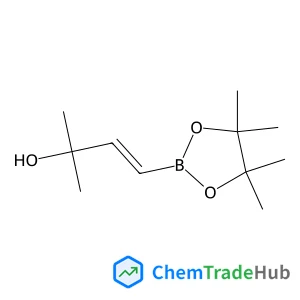
(E)-2-methyl-4-(4,4,5,5-tetramethyl-1,3,2-dioxaborolan-2-yl)but-3-en-2-ol
CAS Number:
581802-26-8
Molecular Formula:
C11H21BO3
Recommended Suppliers






Disclaimer
This page provides academic journal information for reference and research purposes only. We are not affiliated with any journal publishers and do not handle publication submissions. For publication-related inquiries, please contact the respective journal publishers directly.
If you notice any inaccuracies in the information displayed, please contact us at support@chemtradehub.com. We will promptly review and address your concerns.