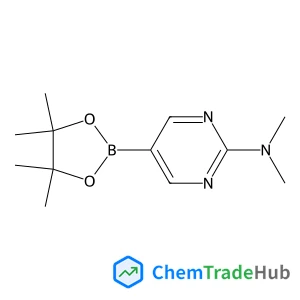
N,N-Dimethyl-5-(4,4,5,5-tetramethyl-1,3,2-dioxaborolan-2-yl)-2-pyrimidinamine
CAS Number:
1032759-30-0
Molecular Formula:
C12H20BN3O2
Xiaodong Zhuang, Wuxue Zhao, Fan Zhang, Yu Cao, Feng Liu, Shuai Bi
The synthesis of crystalline two-dimensional (2D) covalent organic frameworks (COFs) with fully unsaturated carbon–carbon backbones via a solution approach remains a great challenge. In this work, we report the first example of an olefin-linked 2D conjugated COF using a Knoevenagel polycondensation reaction of 1,4-phenylene diacetonitrile and three armed aromatic aldehyde. The resulting 2D poly(phenelyenevinylene) framework (2DPPV) possesses a sheet morphology, and a crystalline layered structure featuring a fully sp2-bonded carbon skeleton with pendant cyanide groups. Its unique alternating structure with a serrated configuration has been essentially evaluated using HR-TEM TEM analysis, nitrogen physisorption measurements, PXRD studies and theoretical simulations. Upon thermal and activation treatments, the as-prepared 2DPPV can be facilely converted into porous carbon nanosheets with large specific surface areas of up to 880 m2 g−1 which exhibit an excellent electrochemical performance as supercapacitor electrodes and electrocatalysts for the oxygen reduction reaction. This represents an economic non-template approach to 2D porous carbon materials for energy-related applications.

Russian Journal of Bioorganic Chemistry

Current Opinion in Colloid & Interface Science

Crystallography Reports

Russian Journal of Applied Chemistry

Saudi Pharmaceutical Journal

Chemical Communications

New Journal of Chemistry

Russian Journal of General Chemistry

Russian Journal of Organic Chemistry

Organic Process Research & Development
Yang Song
DOI: 10.1039/C3CP52154K
Daeil Yoon, Qing Su, Haiyan Wang, Arumugam Manthiram
DOI: 10.1039/C3CP52679H
Jaume Puy, Joan Cecília, Josep Galceran
DOI: 10.1039/C3CP51038G
Ymène Houari, Adèle D. Laurent
DOI: 10.1039/C3CP50791B
Cristina Greco, Geoffrey R. Luckhurst, Alberta Ferrarini
DOI: 10.1039/C3CP52222A
Yungang Zhou, Chengfei Yang, Xia Xiang, Xiaotao Zu
DOI: 10.1039/C3CP51518D
Chuanlang Zhan, Xunlei Ding, Shanlin Zhang, Xin Zhang, Huiying Liu, Lili Chen, Yishi Wu, Hongbing Fu, Shenggui He, Yan Huang, Jiannian Yao
DOI: 10.1039/C3CP51268A
Minqiang Hou, Jianling Zhang, Buxing Han, Qingqing Mei, Hui Ning, Dezhong Yang
DOI: 10.1039/C3CP44670K
Shamon A. Walker, Devin T. Edwards, Ting Ann Siaw, Brandon D. Armstrong
DOI: 10.1039/C3CP51628H
Diana Paiva, Galya Ivanova, Maria do Carmo Pereira, Sandra Rocha
DOI: 10.1039/C3CP51215K
When considering alternatives to 1-(4-Chlorophenyl)-N-hydroxymethanimine (CAS: 3...
This compound should be stored in a cool, dry place away from direct sunlight. I...
3-(4-Bromophenyl)-5-(2-fluorophenyl)-1,2,4-oxadiazole is synthesized through a m...
5-Chloro-2-(4-chlorophenyl)-4-methyl-6-[3-(1-piperidinyl)propoxy]pyrimidine (CAS...
2-Chloro-4-(difluoromethoxy)pyridine is used in the pharmaceutical industry for ...
3-Chloro-6-methylpyridazine (CAS: 1121-79-5) is classified under the Globally Ha...
Several alternatives can be used in the synthesis of Methyl 4,5-dimethyl-2-nitro...
Alternatives to (2E,2'E)-3,3'-(1,4-Phenylene)bisacrylaldehyde include other acry...
3-Amino-5-chloropyridin-2-ol hydrochloride is an organic compound with the CAS n...
When handling 6,7-Difluoro-2,3-dihydro-4H-chromen-4-one, it is essential to wear...

Polymer Chemistry welcomes submissions in all areas of polymer science that have a strong focus on macromolecular chemistry. Manuscripts may cover a broad range of fields, yet no direct application focus is required.
![4-[(3-Chloro-2-fluorophenyl)amino]-7-methoxy-6-quinazolinyl acetate structure](https://static.chemtradehub.com/structs/740/740081-22-5-f58f.webp "4-[(3-Chloro-2-fluorophenyl)amino]-7-methoxy-6-quinazolinyl acetate structure")